Stitching Gaza, the final collective fabric map produced in Cairo and exhibited in Istanbul (September 2025). The work translates the engraved wooden map of Gaza into thread and textile, each stitch marking a story of displacement and survival. Installed against the wall, framed on three sides, it leaves its lower edge open to flow freely, evoking the Mediterranean Sea and the uncontainable movement of memory. From the author’s archive.

Exhibition as Growth: The Mutating Life of 'Nazeh'

Stitching Gaza, the final collective fabric map produced in Cairo and exhibited in Istanbul (September 2025). The work translates the engraved wooden map of Gaza into thread and textile, each stitch marking a story of displacement and survival. Installed against the wall, framed on three sides, it leaves its lower edge open to flow freely, evoking the Mediterranean Sea and the uncontainable movement of memory. From the author’s archive.

Download article as PDF

Figure 1. Opening image from the Nazeh project, a child moving across a wooden map of Gaza, 2024.

This essay traces the growth of the exhibition Nazeh, born of displacement and continually reformed across geographies, from Cairo to Istanbul to Berlin. In Arabic, the word “Nazeh” (نازح) translates to “the displaced”—a person who has been uprooted or forced to leave their home. Rather than existing as a fixed event, the exhibition Nazeh unfolds as a living organism: it grows by accumulating traces, and it mutates when conditions force a change in form. Each iteration emerges as a response: to place, to limitation, to collective desire. Through this movement, the exhibition learns how to breathe differently each time. 

In this essay, I use growth and mutation as two distinct logics of change. Growth names the way Nazeh expands through accumulation: more traces, more participants, more layers of language, routes, and objects that remain in relation across iterations. Mutation, by contrast, describes moments when the exhibition changes its body—its material form, scale, or mode of participation—because conditions make repetition impossible. In Nazeh, mutation is often triggered by constraints (weight, borders, cost, access) and completed through participants’ hands and bodies, who transform the work from a curated display into a collectively authored surface. 

To think of exhibition as a method of growth is to accept instability as form, and to understand curating not as repetition but as re-rooting. Nazeh has grown through wood, fabric, and engraving; through language, stitching, and sound; through the memories of displaced artists who continue to move across borders. This essay, too, grows alongside the project it traces; gathering images, fragments, and reflections as it moves, learning how exhibitions, like those who are displaced, endure by transforming with every ground shift. 

Cairo: Rooting Displacement 

The story of Nazeh began in Cairo in late 2024, in the Kodak passageway in the city centre, a place that itself carried the weight of layered histories and migrations. In the aftermath of 7 October 2023, when Palestinian resistance factions affiliated with Hamas launched a large-scale attack against Israel—followed by a devastating Israeli offensive and siege on Gaza that lasted for more than two years—many Palestinians crossed into Egypt seeking temporary refuge, carrying with them fragments of homes, interrupted projects, and words that had changed meaning overnight. It was from these fragments that Nazeh was born. 

Figure 2. Kodak passageway, Cairo.

I initiated Nazeh as a curatorial and research-led framework, working as curator, facilitator, and designer across its iterations. My role included convening the initial gatherings, designing the mapping, producing the spatial installation elements (including the CNC-engraved map and display systems), and documenting the project as an evolving archive. The project was developed as part of the Gaza Biennale, which served as the main supporting and funding body. Its realisation relied on a network of local collaborations in Cairo, including production partners who supported the engraving process (CLUSTER), as well as technical support and an exhibition space that hosted the work and assisted in constructing the display (Orient Productions for Film & Theater). 

At first, it was not an exhibition but a gathering. A group of displaced artists, writers, and architects met regularly around a long wooden table. Together, we began by mapping displacement: drawing escape routes, tracing the journey from North Gaza to the South, to Rafah and then to Cairo, marking where families and neighbourhoods had been divided. This mapping was less about geography than about reassembling memory, a way to situate oneself in a world that had suddenly become borderless and uncertain. 

Figure 3. Shots from Mapping Displacement workshop, Cairo, April 2024.

From these sessions, words began to appear, spoken hesitantly, sometimes repeated, sometimes invented. Everyday expressions were reshaped by displacement, and new phrases were born out of the rupture. These verbal discoveries evolved into the Nazeh Lexicon, a living linguistic archive that captured how displacement alters meaning. Each entry was written collectively, holding both grief and humour, fatigue and imagination. One such term, Halaba, emerged during the discussions and later became a pivotal entry in the lexicon. Derived from the Arabic verb halab (حلب), meaning “to milk”, Halaba was used to describe militarised checkpoints where people are forced to pass through narrow, controlled paths under surveillance, tanks, and armed soldiers. The term evokes the humiliating choreography imposed on bodies, likening human movement to cattle led for milking. For many displaced from northern to southern Gaza, the Halaba on Salah al-Din Street marked a compulsory threshold of violence and control. As we worked through this term together, it became clear that such language demanded more than definition: it required spatial reading. The lexicon thus shifted into a hermeneutic practice, oscillating between cartography and linguistic inquiry, tracing how power inscribes itself simultaneously in space, movement, and metaphor. 

Figure 4. Cover and inside spread of “NAZEH”, a conceptual lexicon exploring the language of displacement. The book, part of the exhibition and designed in a stark black-and-white aesthetic, features art illustrations and bilingual text (English and Arabic) that reflect spatiality and the lived experiences of forced migration by Palestinian people of the Gaza Strip after 7 October 2023. From the author’s design archive.

As the lexicon grew, the question emerged: how can these words inhabit space? How can language become visible, touchable? This led to the first Nazeh exhibition, curated as an act of translation, from language to matter. The CNC-engraved wooden map of Gaza—measuring approximately 40 square metres—became the exhibition’s heart: twelve panels carved with the city’s lines, now marked by the traces of those who had fled it. Around it, the lexicon terms were displayed in black panels and light boxes, forming a constellation of words and routes. 

Figure 5. The “NAZEH” lexicon terms related to displacement are installed on black stand panels, illuminated by dim spotlights in a dark, immersive environment, from the author’s archive.

The map used for the CNC engraving was itself the outcome of an extended process of reconstruction and archiving. Over approximately three months of intensive work prior to 7 October, I collected, cross-referenced, and reassembled a complete map of the Gaza Strip from fragmented sources. Gaza does not exist as a single, readily accessible cartographic entity; administratively divided into governorates, most available maps cover only partial areas, Gaza City, the North, or the South. To reconstruct the full outline, I contacted multiple municipalities and individuals with access to pre-existing maps and verified their continuity through open-source platforms such as OpenStreetMap. This process was both technical and political: an attempt to preserve spatial knowledge already under threat of erasure. The CNC-engraved map is therefore not a neutral base, but the result of a deliberate act of cartographic care, an effort to safeguard Gaza’s spatial memory before its systematic destruction by Israeli forces. 

Figure 6. At the heart of the exhibition is an interactive map of the Gaza Strip that reconsiders the meaning of displacement, measuring approximately 40 square metres (10.8 x 3.7 m). CNC-engraved on MDF wood. After the map was created, those displaced from Gaza were invited to walk on it, mark their displacement journeys with loved ones, and engage in a supportive and commemorative environment that stimulates memory. From the author’s archive.

The audience were not passive observers. They were invited to contribute by writing, pinning, or tracing their own memories onto the map. Some left notes, others added pieces of fabric or drew symbols of their homes. Gradually, the exhibition transformed into an evolving site of storytelling. Every gesture expanded its vocabulary, turning it into a collective record of how people remember, forget, and reimagine.  

I recall one visitor who removed their shoes before stepping onto the engraved map and began tracing a route with their fingertip, pausing at a neighbourhood name as if it were a wound. They called someone on the phone, held the screen over the map, and asked, “Was it this street or the next?” In that moment, the map shifted from an object of display into a verification surface, where memory was tested through touch and geography was rebuilt through hesitant gestures. 

The exhibition did not aim to represent displacement solely as a tragedy. Instead, it positioned displacement as a method, a mode of sensing, knowing, and being in the world that fosters new forms of connection, resistance, and situated knowledge. This curatorial approach resonates closely with Edward Said’s understanding of exile, which he viewed not merely as a condition of loss, but as a critical position from which one can interrogate both the past and the present. As Said asserts, “For an exile, habits of life, expression or activity in the new environment inevitably occur against the memory of these things in another environment. Thus, both the new and the old environments are vivid, actual, occurring together contrapuntally” (Said, 2000: 186). Nazeh embraces this dual consciousness, looking backwards toward what has been lost, while simultaneously imagining what might still be reclaimed or reconfigured. 

In this way, Nazeh Cairo was not simply a representation of displacement but a method of knowledge production. Within its walls, language, geography, and experience grew together. The exhibition did not end when the doors closed; it continued to accumulate traces, voices, and meanings. Its growth was both internal and spatial, a living method that learned to sustain itself through participation, generosity, and memory. 

Figure 7. The author tracing displacement routes on the CNC-engraved Gaza map during the Nazeh exhibition, Cairo (2024).

In Cairo, I began to understand what an exhibition as a method might mean. It was not about curating objects into coherence or managing space as a technical task; it was about allowing form to emerge from relation. The exhibition became a site of learning, a place where new skills, sensitivities, and forms of collectivity could emerge. Every encounter with the displaced participants blurred the line between artist, curator, and witness. The work demanded listening rather than directing; it required care instead of control. Through this approach, curating transformed from presentation into participation, from organizing material to organizing attention. The exhibition itself became a teacher: it taught patience, negotiation, and the slow ethics of assembling what has been scattered. Nazeh revealed that method could grow from within the process, not imposed from theory, but sensed through shared practice. It was in this sense that curating displacement became a curating of growth. 

From this rooted beginning in Cairo, the project found its next movement. When the exhibition left Cairo, it carried with it not just objects and texts, but a method, a way of growing through correspondence, of listening to what each place and community could offer. The question was no longer how to exhibit displacement, but how to let the exhibition itself become displaced, transformed, and renewed. This question would guide Nazeh as it travelled to Istanbul, where its wooden map gave way to fabric, and where the act of stitching became a new language of belonging. 

Figure 8. Stitching Gaza, the final collective fabric map produced in Cairo and exhibited in Istanbul (September 2025). The work translates the engraved wooden map of Gaza into thread and textile, each stitch marking a story of displacement and survival. Installed against the wall, framed on three sides, it leaves its lower edge open to flow freely, evoking the Mediterranean Sea and the uncontainable movement of memory. From the author’s archive.

Click to open and explore in fullscreen mode

Istanbul: The Mutating Body 

If Nazeh Cairo was about rooting displacement, Nazeh Istanbul was about learning to move with it. The transition from one city to another was not a logistical transfer but a curatorial mutation, an exhibition that refused repetition, choosing instead to grow through change. When the CNC-engraved wooden map of Gaza could not be shipped due to its weight, scale, and cost, the constraint became a proposition. The question was no longer how to transport the map, but how to let the map transform itself through displacement. 

From this limitation emerged Stitching Gaza: a collective textile cartography that translated the engraved routes of displacement in Gaza into threads, fabrics, and hands. A new material logic took shape, one that was lighter, more fragile, and closer to the body. The map was printed on linen, then gathered around by fourteen displaced Gazans living in Cairo, each carrying their own story of loss, flight, and endurance. Over two weeks, through thread and conversation, the group traced their journeys across the printed outline of Gaza, not to restore what was gone, but to keep it alive through touch. 

Figure 9. Stitching Gaza workshop, Cairo (August 2025). Fourteen displaced Gazan artists and participants collaboratively stitched their displacement journeys onto a printed fabric map of Gaza. Each thread marked a path of escape, a site of memory, or a gesture of return. Through this collective act of making, the workshop transformed cartography into care, rethreading geography through lived experience.

Every thread carried a testimony. Some stitched in silence; others recounted where the line began, when the bombing started, or which street had disappeared. The act of sewing became a political gesture, a slow counter to erasure, a way of mending what cannot yet be rebuilt.  

Each participant became both cartographer and storyteller, inscribing survival into the very fabric of Gaza’s geography. Here, co-creation was not an audience add-on; it was the exhibition’s engine. The exhibition grew through the accumulation of stitched routes. Still, it mutated because authorship shifted: meaning was no longer produced primarily by curatorial selection, but by embodied inscription, by hands pulling thread, tying knots, correcting lines, refusing specific routes, and lingering on others. Bodies functioned as curatorial agents, and the artwork’s form emerged from contact rather than instruction. 

When the collective work was completed, the fabric—now dense with layers of thread, knots, and stitched memories—was shipped to Istanbul. There, it was not installed as a replica of Cairo’s exhibition, but as its next growth. The map had changed material, geography, and meaning. It arrived in a new city, carrying traces of hands, dust, and memory from Cairo, a displaced object witnessing the displacement of its makers. 

In Istanbul, Nazeh became less about the object and more about the process that sustains it. The stitched fabric, suspended and breathing in the exhibition space, gathered new audiences, new languages, and new forms of listening. Visitors traced the threads with their eyes, following routes of exile that extended beyond the frame. The exhibition’s own displacement became visible; a continuity of care and adaptation that mirrored the very condition it sought to articulate. 

What does it mean to think of exhibition as a method? In Istanbul, this question unfolded not as a theory, but as a practice of adaptation. Nazeh was no longer only a space for showing, but a site for learning. Curating became an act of listening: to the materials that resisted control, to participants who redefined the process, and to the invisible conditions that shaped what could or could not be done. The exhibition expanded beyond its walls; it became a choreography of many gestures, the planning, the sewing, the documenting, the waiting. Perhaps to curate under displacement is to accept that growth happens not through mastery, but through correspondence: between people and materials, between failure and invention, between what can be imagined and what must be endured. 

The shift from engraved wood to stitched fabric was not merely aesthetic; it was ethical. The heavy became light, the fixed became mobile, the engraved became tactile. To curate in displacement meant to remain porous, to let materials respond to the instability of geography. Each transformation carried a different politics of resilience. In this sense, Nazeh Istanbul (20 September to 8 November 2025) was not a continuation by repetition, but an iteration that changed the exhibition’s body while keeping its memory intact. 

From Istanbul, Nazeh carried forward not only a map or an artwork, but a sensibility, a way of working that embraced change as a condition of meaning. The exhibition no longer travelled as a fixed body, but as a pulse, responding to each geography with a different material language, a different mode of participation. When it reached Berlin, this pulse deepened into an architectural reflection: engraving displacement into wood once again, but this time as an echo layered upon echo, a dialogue between memory, matter, and distance. 

Figure 10. Istanbul, 2025. The author/curator in dialogue with visitors during the exhibition, tracing stories of displacement directly on the collective fabric map. This encounter transformed the artwork into a conversational surface, a living archive that grew through each exchange, where narration and touch became curatorial methods of knowledge-making. From the author’s archive.

Berlin: The Layer of Echoes 

In Berlin in October 2025, Nazeh returned to wood, not as a replica of its beginning, but as an echo of everything the project had already learned. The Gaza map was engraved again through CNC precision, yet this return was shaped by experience accumulated across earlier iterations in Cairo and Istanbul. Having worked previously with engraving, stitching, and collective interaction, we approached the wooden surface differently: with a heightened attentiveness to line weight, depth, density, and the care required to translate geography into material without overwhelming it. 

What echoed in Berlin was not a previous mark, but a familiarity with process. Decisions about which lines could remain light, which required depth, and how buildings should register on the surface were informed by earlier encounters with the map, by how people had walked on it, stitched into it, and spoken over it. The engraving thus carried a memory of use rather than an image of the past. While the layered memories of Cairo and Berlin were later added through models, furniture, and participatory elements rather than engraving, the wooden map itself bore the imprint of a learned practice: a return to material shaped by what the exhibition had already lived. What was once carved in Cairo and later reimagined through fabric and stitching in Istanbul is, in Berlin, reconstituted as a dual archive through layering rather than translation. The geographic lines of Gaza are engraved again in wood, while two temporalities of displacement are introduced through additional elements—small models, furniture, and participatory markings—added onto and around the map. One layer registers the immediacy of recent displacement, while the other gathers memories of Gaza recalled from distance. Together, these layers allow multiple times and experiences to inhabit the same surface without collapsing into a single narrative. 

This approach situates Nazeh within broader debates on counter-mapping and memory work. Recent scholarship on counter-mapping has emphasized how maps can function as sites of memory work and resistance, particularly in contexts of erasure and settler-colonial violence. As Luisa Gandolfo argues, counter-maps do not merely offer alternative representations of space, but facilitate memory work by reinserting erased names, narratives, and affects into cartographic form, often through dynamic, layered archives that resist closure (Gandolfo, 2025). While many contemporary counter-mapping projects operate through digital platforms and immersive interfaces, Nazeh departs from this paradigm by situating memory work in collective, embodied practice. Rather than aggregating testimonies into a continuously updating digital archive, the project foregrounds physical co-presence: stitching, walking, marking, and narrating as modes of counter-mapping. In this sense, Nazeh shifts counter-mapping from a primarily representational or platform-based practice toward a material and relational one, where memory is produced through shared gestures and temporal overlap rather than data accumulation alone. 

Figure 11. Nazeh: Berlin production process (2025). A sequence from the CNC laboratory where the new engraved wooden map of Gaza was produced.

The first layer holds the routes inscribed by those displaced from Gaza to Cairo after October 2023, fragile, immediate, drawn in proximity to loss. The second layer invites the Palestinian diaspora in Berlin and across Germany to mark their memories of Gaza as it once was, before the recent devastation. Together, these inscriptions weave a dialogue between two Gazas: one remembered through presence, the other through distance. Between them lies the unbridgeable space of absence, yet also the pulse of shared continuity. 

The CNC engraving in Berlin was approached as a deliberate and iterative process, rather than a purely technical execution. Instead of treating the map as a fixed dataset to be engraved uniformly, line weight, depth, and density were tested and adjusted through multiple trials. Certain routes and urban edges were engraved more lightly to avoid visual saturation, while others required greater depth to remain legible when read at scale. These decisions were informed by earlier encounters with the map in Cairo and Istanbul, by how people had walked across it, stitched into it, and lingered over specific areas. In this sense, engraving became less about maximizing precision and more about calibrating the surface for reading, touch, and memory. To engrave Gaza again was not to repeat it, but to listen to its echoes: to materialize the vibrations that linger after destruction, and to give form to what persists. 

Curating here became a choreography between hands and tools, between the certainty of digital code and the uncertainty of remembrance. While the CNC engraving provided a precise geographic base, it could not register the affective, bodily, and narrative dimensions that emerged through collective interaction. As Shannon Mattern argues, urban knowledge cannot be reduced to computation; cities—and the forms that attempt to represent them—contain modes of intelligence that exceed data processing, including embodied experience, memory, and sensory engagement (Mattern, 2017). In Nazeh, this limit was not a failure but a condition. The engraved map functioned as a partial structure, intentionally opened to other forms of knowing. What could not be mapped computationally was carried instead by bodies, gestures, and collective presence, challenging the idea that spatial knowledge can ever be fully encoded.  

The exhibition’s life continued in this tension: how to make an archive tactile without solidifying grief, how to build a map that is both exact and haunted. In this sense, precision itself became a politics of care, a refusal to let erasure blur the details of what once existed. 

Alongside the installation, a series of postcards extended the exhibition outward, dispersing fragments of Gaza into the world. Each card carries a word from the Nazeh Lexicon—“fragile”, “return”, “threshold”, “unrooted”—printed in both Arabic and English. Visitors are invited to take one, to write on it, or to send it onward. The lexicon thus migrates again, transforming from wall text to hand-held trace, multiplying the exhibition’s reach through intimate acts of exchange. 

The Berlin iteration does not close the project; it adds another layer to its unfinished archive. It transforms displacement into correspondence, between cities, between generations, between the living and the lost. Here, Nazeh is no longer simply an exhibition; it is a growing body of knowledge, carried by each participant, visitor, and object it encounters. 
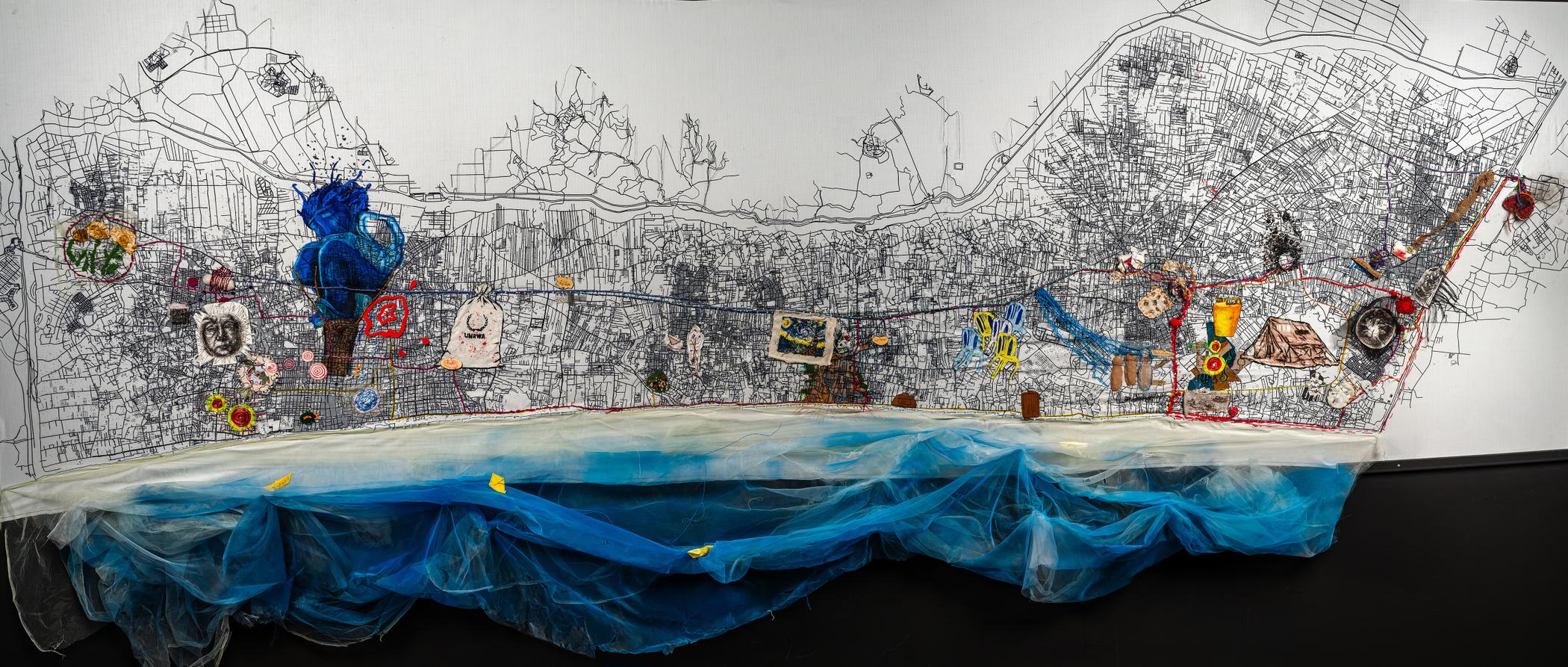
Figure 12. Nazeh Lexicon postcards, Berlin (2025). Printed as part of the Berlin iteration, the postcards carry fragments from the Nazeh Lexicon and illustrations by displaced Palestinian artists. Designed for visitors to take, write on, and circulate, they spread language and memory beyond the gallery walls.

As the exhibition opened in Berlin, it invited new marks, new testimonies, and new witnesses. This essay, like Nazeh itself, remains porous, an open text that will continue to expand through images, reflections, and documentation as the project evolves. The final layer has not yet been added; it waits for what the exhibition will reveal. 

Figure 13. Nazeh exhibition, Berlin iteration (2025).

Reflections: Growth as Method 

Across its journey from Cairo to Istanbul to Berlin, Nazeh has not merely moved; it has mutated. Cairo was the birthplace where displacement first found its language and material. Istanbul was the mutation, where the exhibition shed its wooden body to become textile, collective, porous. Berlin was the sedimentation, where memory returned to wood, but now as an echo, engraved upon itself. Through these iterations, the exhibition learned to live as matter does by changing form to remain alive. 

This rhythm of change resonates with Metode’s notion of the mutating essay, a work that, like a living organism, “embraces risk and weakness to facilitate transformation” (Halland and Solbakken, 2024). As Ingrid Halland writes, mutation is not a collapse of form but a threshold of receptivity, where instability becomes a condition for growth. In Nazeh, the same principle applies: the exhibition expands through vulnerability, through the logistical errors, broken routes, and shifting materials that shape its every move.   

In this sense, growth is not linear but concurrent, echoing Metode’s “method of proximity”, which situates writing—and curating—close to lived experience while simultaneously expanding its spatial and temporal scale. Nazeh begins near: in a shared room, a workshop, a fabric stretched between hands. Yet as it moved, it drew global distances inward. Each thread became a telegraphic signal, like those described in Metode Vol. 3 “Currents”, transmitting across damaged infrastructures of war, censorship, and exile. In this fragile circuitry, proximity and distance coexist; intimacy becomes a method of global witnessing. 

The exhibition’s growth, then, is neither progress nor repetition. Every iteration left a residue that the next absorbed. Each version of Nazeh carried traces of the previous one: Cairo’s lexicon carved into Istanbul’s stitches, Istanbul’s threads reappearing as Berlin’s engraved lines, forming an ecology of recollection. This sedimented layering recalls Edward Casey’s idea that “memory is not stored but lived” (Casey, 2000), its topology defined by return and reconfiguration.  

What may appear as error is often a form of wandering that opens unexpected paths of relation. The rhythm of Nazeh is shaped by such wanderings, each interruption becomes a pulse, a moment of listening, a chance to correspond anew. Curating under displacement means working in the interval, between what can be planned and what must be endured. It requires an attention attuned to fragments, to feedback, to the uneven tempo of collective making.  

In Nazeh, growth is not accumulative, growth unfolds through friction and resonance, through the interplay of voices, materials, and gestures that refuse completion. Because Nazeh does not end in Berlin. It continues to mutate through those who carry it, those who re-tell it, those who remember it differently.  

Bibliography  

​​

Arendt, H. 1958. The Human Condition. Chicago: University of Chicago Press. 

​Casey, E.S. 2000. Remembering: A Phenomenological Study. 2nd ed. Bloomington: Indiana University Press. 

​de Certeau, M. 1984. The Practice of Everyday Life. Translated by S. Rendall. Berkeley: University of California Press. 

​Gandolfo, L. 2025. “Place, Space, and Counter-mapping Digital Memory Work.” Memory Studies. https://doi.org/10.1177/17506980251368795

​Halland, I. and Solbakken, K. 2024. “Concurrencies: Mutating Methods and Latent Leverage.” Metode Vol. 4. https://metode.rom.no/articles/essay/concurrencies-mutating-methods-and-latent-leverage

​Ingold, T. 2013. Making: Anthropology, Archaeology, Art and Architecture. London: Routledge. 

​Mattern, S. 2017. “A City Is Not a Computer.” Places Journal, February. https://doi.org/10.22269/170207

​Said, E.W. 2000. Reflections on Exile and Other Essays. 1st ed. Cambridge, MA: Harvard University Press.​ 

Hala Eid Alnaji, “Exhibition as Growth: The Mutating Life of ‘Nazeh’”, Metode (2026), vol.4 ‘Exhibition as Method’