In Search of the Museum Object's Spark of Life

Download article as PDF

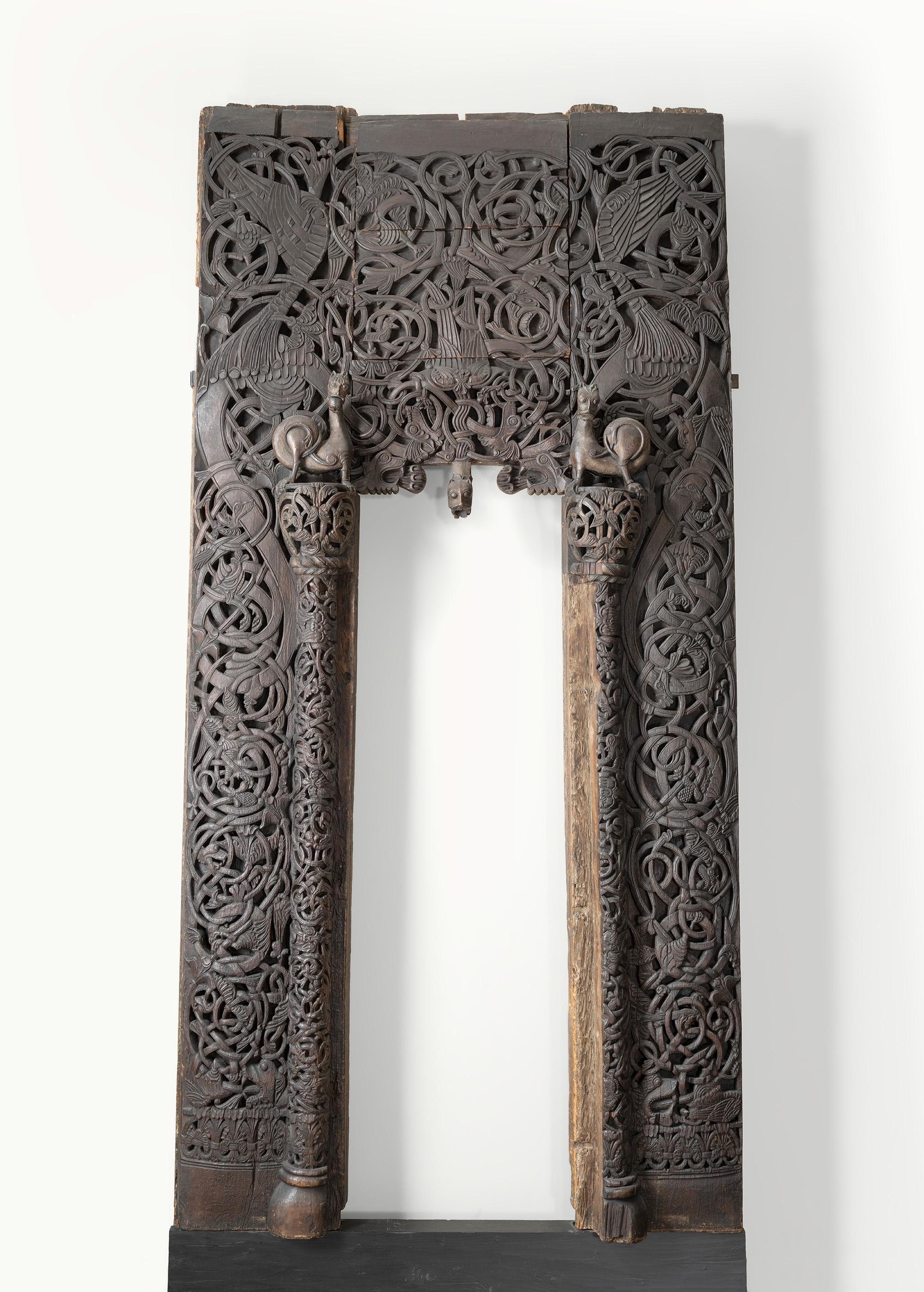
Nearly a decade ago, at the outset of my PhD research, I visited the History Museum1 in Oslo for the first time and encountered the Ål Stave Church portal in the museum’s Medieval Halls (fig. 1). I remember the experience vividly: standing before its intricate carvings, I found myself transfixed by the swirling, labyrinthine designs that seemed to pull me into their depths. As I traced the densely carved maze of vegetation and foliage with my eyes, I recalled something that Alfred Gell wrote about in his influential book on art and agency: in the context of decorated Celtic materiality, he describes such complex patterns as spiritual protection – “demonic fly-paper” designed to trap evil spirits (Gell 1998: 84). I imagined how the portal’s carvings, likely originally painted in bright colors (Blindheim 1989), would have created an even more captivating visual trap for both malevolent forces and medieval churchgoers alike. As my research progressed, and as I returned to the exhibit several times, a pressing concern took hold: the portal’s lifeless presentation, devoid of any sense of its original existence as an architectural and liminal threshold with religious functions. My worry then, one that persists today, is that cultural history museums continue to translate not only stave church portals but many other objects of cultural heritage into lifeless relics through the very manner in which they are shown. Through a five-step methodological framework, this essay argues for the researcher-curator to experiment with new modes of display as a means of searching for, and potentially reigniting, an object’s “spark of life.” I assumed this role in the exhibition experiment Looking Through Portals, focused on the stave church portal and held at the Museum of Cultural History in 2018, through which I pursued this line of inquiry. The investigation was driven by the following hypothesis: that the spark of life in the stave church portal might emerge by first researching its historical biography, then consciously severing from its previous display traditions (a particular “life phase” within that biography), returning to the object through researched theoretical and strategic insights, and translating it to audiences in an unconventional way that could create space for new sparks to fly.  

1 Historisk Museum (The Historical Museum) is part of the University of Oslo’s umbrella institution, the Museum of Cultural History (Kulturhistorisk museum, KHM). While Historisk Museum refers to the central exhibition building and public-facing museum, the institutional organization has undergone several administrative restructurings and name adjustments over time. 

Figure 1: The Ål portal (C10590) as I encountered it – the object, placed flat against a whitewashed wall, was a central piece in the medieval exhibition that was presented in the History Museum in Oslo from 1978/9 to 2021. Photo by Alexis Pantos. Copyright: History Museum, Oslo.

The need for a more pronounced role of researcher-curators in cultural history museums 

One of the central forces sterilizing audience encounters with cultural heritage stems from two intertwined developments of the 1970s “new museology” (cf. Vergo 1989). On the one hand, museums sought to become democratic spaces that communicate accessible content to a broad public; on the other, the rise of conservation science and technology increasingly restricted how objects could be shown and handled. As industries such as gaming, interface design, and digital and audiovisual media advanced, museums looked to these technologies to navigate this tension. Science museums were early adopters of such strategies, particularly in experimenting with hands-on or interactive formats to translate “dry scientific knowledge” into more engaging experiences, not least for young visitors (cf. Hein 1990). By the 1980s, external exhibition-design studios – quick to capitalize on these emerging technologies – began to assume an increasingly prominent role in museum display, laying the groundwork for what would, in the following decades, develop into the now-familiar vocabulary of “wayfinding,” “interactives,” and “storytelling.” Today, the imprint of these design studios extends far beyond science museums into cultural history museums and other institutions – recent exhibitions at Oslo’s History Museum exemplify this trend. While some scholars have pointed toward the intention of curators to play an active role in shaping meaningful and critically engaged forms of interactivity (cf. Witcomb 2003), experiences of displayed cultural heritage have increasingly become the product of this booming commercial enterprise, in which the strong presence of external design studios risks outsourcing dissemination practices, spreading a uniform scenographic model that produces a homogenous museological landscape, and marginalizing curators whose roles are often reduced to content research, object selection, and text writing.  

To counter the direction in which cultural heritage dissemination appears to be heading, I argue that cultural history museums would benefit from giving the “researcher-curator” a far greater role in shaping display practices (cf. Thomas 2016; Bjerregaard 2020; Arnold et al. 2021), enabling them to experiment through research-driven, small-scale prototyping. In this essay, I seek to advocate – through my case study of searching for the stave church portal’s spark of life – a five-step methodological plan showing how experimental exhibition-making can help recover an object’s forgotten pasts, overlooked experiences, and lost functions, and generate new encounters and understandings.  


Step 1: “Assume researcher-curator role” 

The first step is to assume the role of “researcher-curator” and secure an available space within the museum to carry out the exhibition experiment. For Looking Through Portals in 2018, this opportunity arose at Oslo’s History Museum, where I was assigned a third-floor area dedicated to experimental exhibitions shaped by a lineage of interventions including the previous year’s Trapped (2017), Situations (2017), and Letting Go (2017). Together, these projects formed part of the museum’s “Red Zone” framework, overseen by Peter Bjerregaard, then senior exhibition advisor. The initiative consisted of small, usually single-room, relatively low-budget temporary exhibitions conceived as laboratory sites for intellectual and social experimentation beyond conventional forms of presentation, where the notion of the laboratory consciously “opens up to the possibility of failure” (Bjerregaard 2020: 4; after Von Bose et al. 2015, see also Macdonald & Basu 2007).  


Step 2: “Select your object of curatorial research” 

The object I chose to examine as researcher-curator was the stave church portal – the central focus of my PhD research at the museum’s Department of Ethnography, Numismatics, Classical Archaeology and University History (SENKU), between 2016 and 2020. Only 28 stave churches survive fully standing in Norway today, a small remnant of the thousands built in the eleventh century onward during the Christianization of Scandinavia. Over time, most of these medieval churches were torn down and replaced, but from the mid-nineteenth century on, preservationists began salvaging architectural elements, sculptures, and ornaments for national collections such as those of the History Museum in Oslo. Among the most striking elements were the carved wooden portals, cut from local pine and framed in a slightly irregular H-shape with jambs, lintels, thresholds, and additional features such as dragon and lion heads. As architectural thresholds, they have long been read as liminal devices guiding churchgoers from the everyday world into sacred space. Their densely carved zoomorphic, figurative, and vegetal motifs have been associated with biblical allegories, Nordic mythology, and apotropaic traditions intended to trap evil at the church door.2  


Step 3: “Get to know the object’s life history” 

Acquaint yourself with the history of the object: although the experimental exhibition grew out of my own PhD research into the biographical life of the stave church portal, this approach is a cornerstone in the method of searching for an object’s spark of life. Its historicity – that is, the interrelated network of objects, (non-)human engagement, and contextual linkages to political, social, and cultural developments that gathers and accumulates over time (cf. Latour 2005) – allows us to explore, retrieve, and bring together a wide range of affiliations, associations, parallels, and material, theoretical, sensorial, and experiential concepts that can inform new ways of thinking about and presenting the object.  

In tracing the portal’s extended, accumulating biography,3 I followed the object from “geofact” (in situ within stave churches), through “mediafact” (its reproduction and mediation through various technologies), to “museofact” (its transformation into a museum display object).4 The last stage became a main focus: I examined how the portals were displayed across changing exhibition scenographies at the cultural history university museums in Bergen and Oslo from the mid-nineteenth century to the present, excluding Oslo’s current Arv / Heritage exhibition (opened 2023), which lay outside the research period. To give a sense of this display history, I summarize below, in short points, how the portals were previously exhibited at Oslo’s History Museum (cf. Falkenburg, submitted 2026).


1902–1904: The museum building on Frederiks Gate was purpose-built to accommodate the portals (particularly in “Room 102” – a space on the first floor of the museum dedicated primarily to medieval objects until 2023) after the move from the nearby Domus Academica: architect Henrik Bull raised the first-floor ceiling for the Sauland portal (Kjesrud 2025: 474), underscoring their national-pedagogical significance (cf. Mikkelsen 2004). 

1904 display: Gabriel Gustafson and Bull installed the portals upright against the walls in a symmetrical arrangement emphasizing aesthetic impact over narrative coherence (fig. 2).  

1932 reorganization: Under Eivind Engelstad, with architect P. S. Michelsen and archaeologist Sigurd Grieg, the wall-bound, decontextualized mode persisted, though refined through improved lighting and reduced object density aligned with international pedagogical standards (fig. 3; Shetelig 1944; Streeton & Kollandsrud 2014). 

1947 experiment: Gerhard Fischer disrupted this convention by mounting portals in grouped clusters within temporary wall openings, enabling bodily passage and experiential engagement with their gateway function (fig. 4). 

1972 parallel approach (not in the museum): Sverre Fehn’s exhibition at the Henie Onstad Kunstsenter outside of Oslo presented portals as free-standing sculptural forms (O’Donnell 2016: 223). 

1970s conservation shift: Fischer acknowledged the contrivance of clustering portals in this artificial way (Fischer 1948), and the installation-related structural stresses contributed to tightened conservation regulations (Blindheim 1990). 

1979 return to the wall: A new permanent medieval exhibition, based on the 1972 exhibition at Henie Onstad, was created by Sverre Fehn and the curator Martin Blindheim, where the portals were reinstalled in wall-adjacent positions, some mounted on dark sleeper beams, presenting them as autonomous art objects within a modernist scenography influenced by Carlo Scarpa (fig. 5). This mode remained until dismantling in 2021. 

Overall pattern: Across more than a century, stave church portals were repeatedly isolated as decontextualized and defunctionalized aesthetic sculptures shaped by early l’art pour l’art ideals and art historian Erwin Panofsky’s iconographic legacy. 

2 For an in-depth study, see Hohler 1999a, 1999b; cf. Ambrose et al. 2022; Falkenburg 2019; Anker 2016a, 2016b; Murphy 2013. 

3 The notion of an “extended, accumulating biography” is borrowed from Kopytoff’s contribution to Appadurai’s The Social Life of Things (1986) and further developed by Gosden and Marshall (1999) and Hodder (2012).  

4 In retrospect, a more suitable term than “geofact” might have been “archifact,” to emphasize its status as an object that continues to function as part of the architectural structure.  

Figure 2 (left). Gustafson’s 1903 medieval exhibition. Figure 3 (right). The Sauland portal seen displayed against the wall in Engelstad’s 1932 medieval exhibition. Photographers unknown. Copyright: History Museum, Oslo.

Figure 4: Fischer’s 1947 medieval exhibition, showing the Øye II portal, Hylestad II portal, and Ål II portal. Image retrieved from the Historical Museum photo archives. Photographer unknown. Copyright: History Museum, Oslo.

Figure 5. Fehn’s 1979 medieval exhibition. Sauland portal left corner. The Atrå, Fåberg, and Ål portals placed against the wall (left to right). Photo taken by Eek, Ann Christine (2020). Copyright: History Museum, Oslo.

One could argue that each of the portal displays responded to a specific historical moment, reflecting the museum politics and theoretical frameworks that curators and architects were working with at the time. In their own ways – whether fixed statically against walls in symmetrical arrangements or modernist scenographies, or reimagined as decontextualized gateways – they “came to life,” but only faintly, in a scarcely enlivened manner that remained fundamentally static, non-dynamic, and void of (multi)sensorial engagement. Indeed, for the most part, the portals remained decontextualized and defunctionalized, their potential stifled as they increasingly succumbed to conservation policies that continue to shape their presentation today. In the subsequent search for the portal’s spark of life, I wanted to explore whether that spark might lie, perhaps paradoxically, in offering experiences that drew back on the portal’s extended biography, from geofact to museofact (including the discussed display historicity). Experimenting with this concept first required consulting a variety of strategies and theoretical perspectives. 


Step 4: “Draw from strategies, models, and theories” 

Useful tools for the researcher-curator’s experimental practice include identifying and drawing upon relevant strategies, models, and theoretical frameworks from a range of fields, particularly (though not exclusively) within academia. The search for such frameworks – and the process of selecting those deemed relevant to the experiment – is inevitably a subjective endeavor. These choices can be criticized, and others might prefer alternative theories or approaches. Nevertheless, experimenting with different theories (perhaps even including the viewpoints that critique them) may enhance both exhibition making practices and the museological discourse more broadly. 

For the Looking Through Portals exhibition, I first of all found Bjerregaard and Willerslev’s essay Materialities of Passing (2016) particularly applicable. Their discussion helped translate the theoretical idea of “enlivening” into practical museum terms. They argue that museum objects are not lifeless but contain an inherent “spark of life,” an anonymous life force that exceeds the object’s functional or symbolic identity (2016: 222). They describe this force almost as a soul – an entity of pure immanence existing outside actualized time (2016: 226–27). Crucially, they contend that accessing this lifeforce does not come from preserving past identities but from severing the object’s ties to its original context, function, and setting. Through innovative display, most notably the parataxis juxtaposition of non-related objects across time, they suggest that museums can rupture habitual aesthetic expectations and allow new sparks of life to emerge (Bjerregaard & Willerslev 2016: 224; see also Willerslev & Suhr 2013).  

Although my approach did not align precisely with the authors’ theory of the spark of life, I drew two key insights from their concepts of “severance” and “experimental display.” First, it encouraged me to sever the impulse to reconstruct or transplant historical contexts as if they were exact sciences, thereby avoiding the reproduction of singular, authoritative narratives of historicity. Second, it offered a means of moving beyond previously established modes of research, interpretation, and presentation associated with the portal – as seen, for instance, in its earlier displays, and thereby resisting the tendency to invite audiences to walk through it as a static aesthetic gateway sculpture, or to treat it primarily as a remnant of the past valued for its craftsmanship or iconographic meaning. Severance, in this sense, becomes a gesture toward moving beyond such traditions and opening space to explore the portal’s entire biography – one composed of multiple temporalities (including speculative futures) and an accumulating network of interrelated actions, things, entities, concepts, and associations – to be reassembled in ways that may allow new sparks to emerge. Such an exploration aligned well with the Red Zone’s experimental orientation, which encouraged attempts to produce ruptures that situate the object “outside ordinary time and space” (pers. com. Bjerregaard 2025; cf. Bjerregaard & Willerslev 2016; Willerslev & Suhr 2013). The earliest seed for this approach came, unexpectedly, from Christopher Nolan’s science fiction movie Interstellar (2014), in which the protagonist enters a black hole and encounters the “tesseract” – a space where time folds, converges, and becomes simultaneously accessible. I imagined offering visitors something akin to that experience: an encounter with the portal’s many lived moments at once. 

In seeking ways to invite visitors to access the extended life of the portals through this ruptured framework – whilst also navigating the museum’s unavoidable disposition toward preservation and conservation, which often constrains the object’s display potential – I was furthermore inspired by anthropologists who have explored different kinds and acts of looking, such as “emphatic visual imagination” (Ingold 2000) and “visual intimacy at a distance” (Willerslev 2007). Equally influential were readings on rudimentary looking devices once deployed in nineteenth-century amusement parks and carnival fairs, deemed “unfit” for museum settings, such as peepholes and magic lanterns, as well as more “museum-appropriate” devices including dioramas and panoramas (Bennett 1995; Henning 2006; Huhtamo 2013). Art-historical studies of Caspar David Friedrich’s paintings (Busch 2003; Grave 2012) were also formative: Friedrich, interestingly enough, had an indirect yet significant influence in the nineteenth century on the classification of stave church portals as valued elements of Norwegian cultural heritage, and his works invite the viewer to contemplate various modes of seeing, not seeing, imaginative seeing, and even transcendental seeing. These readings collectively helped shaped a curatorial exploration of how different acts or moments of looking – expressed through non-linear juxtapositions and positionalities – could serve as gateways for accessing the extended biography of the stave church portal as geofact, mediafact, and museofact.  

Part of the researcher-curator’s exploration involves considering whether the “authentic” object is essential to the experimental exhibition, or whether its spark of life might also be activated through other means. This includes reflecting on the potential roles of replicas, facsimiles, or scaled copies – not only as pragmatic responses to restrictive conservation policies, but as possible complements to, or extensions of, the authentic object’s presentation. Such questions were central during the making of the Looking Through Portals experiment, particularly in the workshops organized to support and guide the researcher-curator.  


Step 5: “Create the experiment” 


Phase 1: From workshops to experimental display 

The making of an exhibition, even a small-scale Red Zone experiment, always involves a team within the museum. The researcher-curator can benefit greatly, as I did, from organizing workshops in which modes of presentation are discussed and prototyped. For Looking Through Portals, two such workshops were held with participants working in the field of museums and heritage, including conservators, architects, educators, researchers, designers, curators, and filmmakers. The first workshop explored potential presentation methods using photographs and printed images of stave church portals that mapped their extended biography – from geofact to mediafact to museofact – alongside images collected by the author and participants of portal-like forms encountered in other media or environments, whether manmade or naturally occurring. The second workshop invited participants to construct model installations using craft materials and cut-out cardboard reproductions of portals in varying scales. Drawing on the insights generated in these sessions – and further inspired by historian Eelco Runia’s notion of “metonymically presenting absences” (2006) and Walter Benjamin’s idea of the object’s “extended aura” (cf. Dorrian 2014), in which an object’s historicity and aesthetic presence can persist in copied or facsimile form (cf. Walkley 2023)5 – we decided not to employ an original, “authentic” portal. Instead, we worked with the materials, models, images, and conceptual insights associated with the stave church portal produced through the workshops as the foundation for the experimental display. 


Phase 2: The machine “looking” apparatus  

A cornucopia of experimental display possibilities can emerge from the researcher-curator’s preparatory research, especially when supplemented by workshops. At a certain point, however, a (necessarily subjective) selection must be made; time and budget also become determining factors, as does the question of whether to test each display feature with audience members – a potentially flawed endeavor altogether (see discussion below). This selection typically emerges through discussions between the researcher-curator and the architect responsible for producing the floor plan – taking into account safety and accessibility protocols – and in consultation with the conservator charged with protecting the object(s), before the carpenter can begin construction. For our exhibition project, “playful” experimental displays were selected precisely because no authentic portals were involved – yet I would argue that similar playful solutions could be developed even when working with an authentic object, or that such experimental displays could function as adjacent, complementary experiences alongside the protected artifact. 

One of the principal experimental displays developed for the Red Zone exhibition was to reassemble and translate the original portal into an immersive, machine-like apparatus – a ruptured, “tesseract-inspired” space through which visitors could encounter multiple facets of the portal’s accumulated biographical life (figs. 6, 7). This apparatus – which reconceptualized the traditional cabinet-of-curiosity or wonder-room display into a contemporary wonder room that functioned as both “laboratory and church” – was equipped with “looking” features, a combination of old and modern viewing technologies to present a series of scenarios that alluded to the portal’s extended biographies (fig. 8). These were staged as choreographed artistic settings that drew on strategies of Dadaist collage and photomontage, conceptual art installation, and André Malraux’s “imaginary museum” of assembled reproductions, both virtual and physical. One peephole device, for example, staged “white cube museum scenes” – referring to how portals tend to be conventionally presented as museum objects – comprised of miniature cardboard model copies of portals (fig. 9). Another presented a collage of “mediafact derivatives”: assembled printed images of nineteenth- and twentieth-century paintings and photographs (for example, works by Caspar David Friedrich, Johan Christian Dahl, and Claude Monet) depicting portal structures related to various churches and heritage buildings across historical and contemporary landscapes (fig. 10). Many of these artists, particularly Dahl and Friedrich, intersect with the biographical life of the portal on multiple levels – for instance, through their influence on its classification as national cultural heritage in Norway, their association with Nordic Romanticism and the symbolism of the portal as a gateway between nature and the sacred, and their recurring treatment of portals (and more broadly speaking of churches) as imaginative or transcendental thresholds toward death and the afterlife. Another peephole revealed a miniature portal within a wooden maquette of the Borgund Stave Church, indicating its original function as a gateway (fig. 11). Two additional digital screens displayed, respectively, photographs of portals situated in their original landscapes and close-up moving-image studies of portals presented as decontextualized artworks (fig. 12) – the latter “looking” screen denotes an intriguing background of portals “floating in space” (outside of ordinary time and space), in a way linking back to the “tesseract” meta-concept discussed above. Visitors could also sit on a bench (built into the interior) and contemplate a 3D-printed gypsum model of a miniature Urnes portal, placed within a small vaulted cabinet reminiscent of a side chapel (as a kind of “reliquary”), which could be opened like a triptych (fig. 13). Nearby, a plexiglass panel, illuminated by a projector casting shifting colors, presented layered drawings of stave church portals that accentuated the carvings’ mesmerizing visual power (fig. 14). 

5 This use of copies and facsimiles was also discussed at the conference Multiple Museum Practices: The Museum as Cornucopia, Norwegian Museum of Science and Technology, Oslo, October 2016. 

Figure 6: Blueprint drawing of Looking Through Portals exhibition, designed by Lars D. Holen (Manthey Kula Architect Firm). All documentation copyrights reserved for Falkenburg’s publications.

Figure 7 (left): Photo of construction unit from the back side. Photo by Lill-Ann Chepstow-Lusty. Copyright: History Museum, Oslo.

Figure 8 (right): Photograph taken from entranceway. It shows a few visitors using certain peepholes and looking through devices. Taken by the author.

Figures 9, 10, & 11: Photos of peephole boxes. Photos by Lill-Ann Chepstow-Lusty. Copyright: History Museum, Oslo.

Figure 12: example of digital screen as “viewing” device. Photo by Lill-Ann Chepstow-Lusty. Copyright: History Museum, Oslo.

Figure 13 (left): Reliquary-like box with 3D copy of Urnes Stave Church portal. Photo by Lill-Ann Chepstow-Lusty. Copyright: History Museum, Oslo.

Figure 14 (right): Window / stained-glass “looking through” plexiglass. Photo by Lill-Ann Chepstow-Lusty. Copyright: History Museum, Oslo.

 Reflections 


Audiences 

The “searching for the spark of life” method, as an experimental exhibition-making practice, can in principle be tested with audiences in order to see whether any “sparks” emerged in their encounters with the display. Such “sparks” might take the form of new insights, unexpected experiences, intellectual stimulation, curiosity, strangeness, confusion, or even discomfort. Yet this raises a fundamental question: to what end should such testing occur? If cultural history museums function primarily as keepers and dispensers of knowledge and objects—although this assumption can be scrutinized—then it may be reasonable to elicit audience responses to this knowledge, and perhaps even to tailor displays toward particular visitor groupings (Falk & Dierking 2013). However, if the aim is instead to rethink the purpose of cultural history museums, to move away from didactic knowledge-transfer, and to encourage audiences to (meta)reflect on what a museum is and what and how it chooses to show – something closer to the ethos of many contemporary art museums – then the utility of evaluating the “effectiveness” of particular display features possibly becomes less clear, perhaps even futile. The Looking Through Portals experiment leaned more toward this latter orientation. Rather than guiding visitors through predetermined interpretations of didactic knowledge forms, the aim was for visitors to discover for themselves and leave with more questions than answers. Our intention was to activate them – physically, intellectually, and emotionally – in their encounter with the portal’s accumulated biographical life, reassembled as an active, experiential site. This responded to scholars who call on museums to create environments in which visitors become active participants in the experience of cultural heritage (Macdonald 2007; Bal 2002). Signs of this activation were observable: visitors crouched, sat, bent, opened, and handled the various “looking” devices; the peepholes prompted attentiveness and curiosity, compelling them, almost despite themselves, to engage in inquisitive visual practices. 

“Talk with the Curator” – a small area within the exhibition furnished with a table, chairs, and some cookies – invited visitors to sit and share their impressions. The process was unsystematic but yielded several revealing responses. For example, two Norwegian women in their mid-thirties described how the exhibition resonated with their familiarity with Viking heritage and with living near extant stave churches. They appreciated how the portals were transformed from the conventional presentation downstairs into a more three-dimensional experience through multiple perspectives. Another visitor, a woman, remarked on the “multi-layered understanding” afforded by the installation, praising both the aesthetic qualities and the playful modes of looking. A couple from the United Kingdom (a 31-year-old man and a 27-year-old woman) noted how surprising and inventive the experiment was; they doubted that such interactive and experimental approaches would be permitted in museums in the United Kingdom. A group of men from France commented on the sensory engagement, comparing it to the Musée des Confluences in Lyon, which similarly mixes art, architecture, and archaeology. They wished, however, that the installation had been even more interactive. Visitors also offered critical feedback: some were uncertain about which features could be touched, others (especially the elderly) found it difficult to peer through the peepholes, and some found the installation “too arty” or difficult to understand. Other responses foregrounded the exhibition’s atmosphere, using descriptors such as “medieval,” “mysterious,” “sacral,” “gloomy,” and “intimate.” These associations were not intentionally cultivated (with the partial exception of intimacy), though they may have emerged from specific design elements, including the black-painted interior, architectural references to church spaces, the “contemplative bench,” and the illuminated 3D print housed in a reliquary-like structure, among other features.  

Notably, most responses did not reflect the intended aim of encouraging visitors to develop their own networked understanding of the portal’s biographical life through acts of attentive looking and self-reflexive engagement. Such forms of meta-reflection may be more commonly associated with art museum contexts – and even there, it remains questionable to what extent visitors actively register or sustain them. In my view, clearer orientation or guidance at the exhibition’s entrance would have supported these aims more effectively. Nonetheless, precisely because cultural history museums are traditionally oriented toward structured knowledge dissemination, visitor responses should not be regarded as futile in this context, as they sometimes are within the domain of more “subjective” interpretive traditions often attributed to art museums (which themselves are not exempt from comparable challenges). Rather, such responses provide particularly productive feedback for an emerging shift within cultural history museums – a slowly crystallizing movement seeking to develop self-directed, exploratory modes of knowledge engagement for visitors. 


Museum takeaways 

This method of exhibition-making is intended for, and most beneficial to, the museum itself. Experimental displays generated through this approach can offer the museum a range of insights and opportunities: 

- to reclaim the dissemination of cultural heritage from commercial enterprises, such as external exhibition design studios

- to develop diverse and object-specific modes of display 

- to integrate academic research directly into exhibition practice 

- to influence, inform, or inspire the work of other researchers, the immediate project team, and the wider community of practitioners within the institution 

- to reflect critically on the use, purpose, and meaning of cultural heritage as communicated through display 

- to challenge what the museum and cultural heritage are understood to stand for – whether as sites of mass tourism, spaces of learning, or intellectual arenas, etc. 

These aspects were realized within the Looking Through Portals experiment, and it is possible, though presently uncertain, that some of the latter points also carried over into the semi-permanent exhibition Arv / Heritage, installed at Oslo’s Museum of Cultural History a few years later (cf. Kjesrud & Fuglerud 2023). From the final exhibition outcome, however, we can observe that the authentic stave church portals once again occupy their traditional position: set against, or very near to, the walls as isolated, static “lifeless” aesthetic sculptures (fig. 15), in some cases further demarcated by rope barriers. ​​In this context, it would be intriguing to interview the exhibition architects from the influential design studio Snøhetta to ask to what extent conservation policies shaped their design choices, and whether the incorporation of large arched gateways into the segmented wall partitions (fig. 16) sought to evoke a bodily experience of “passing through” such thresholds, thereby echoing – albeit very faintly – the display strategy implemented by Gerhard Fischer in his medieval exhibition of the late 1940s. 

Figure 15: One of the portals on display in the Arv exhibition. Photo by Lill-Ann Chepstow-Lusty. Copyright: History Museum, Oslo.

Figure 16. Arv/ Heritage exhibition. Photo by Lill-Ann Chepstow-Lusty. Copyright: History Museum, Oslo.

The five-step method of “searching for the spark of life” extends beyond the specific case of stave church portals, offering a transferable framework for experimenting with the display of diverse forms of cultural heritage within cultural history museums and beyond. Such an approach is increasingly important as budgetary pressures, risk aversion, and reliance on predictable branding and marketing models drive museums to outsource exhibitions to profit-driven studios. In contrast, experimental exhibition-making – conceived as research-driven, small-scale prototyping – offers a productive alternative that enables iterative testing, embraces failure as a mode of learning, and sustains a continual search for new sparks of life within museum objects. Without this commitment, museums risk failing to demonstrate their capacity to repeatedly and dynamically animate encounters with cultural heritage, instead becoming mausoleums or defaulting to standardized, homogenized exhibition landscapes. This does not imply that playful, multi-layered experimental displays must replace the stringent, conservation-protected presentation of authentic objects. Rather, the two modes of display can, and should, coexist. What matters is that museums cultivate the conditions, perhaps in certain allocated exhibition spaces, in which new sparks – new meanings, new experiences, and new ways of seeing – can continually emerge. 

Bibliography 

Ambrose, K., G. Murray, and M. S. Andås, eds. 2022. Urnes Stave Church and Its Global Romanesque Connections. Studies in the Visual Cultures of the Middle Ages, vol. 18. Turnhout: Brepols. 

Anker, L. 2016a. Between a Temple and a House of Cards. In Preserving the Stave Churches: Craftsmanship and Research, eds. K. Bakken, A. Amlo, L. Anker, and Riksantikvaren. Oslo: Pax forlag, pp. 135–166.  

Anker, L. 2016b. What is a Stave Church? In Preserving the Stave Churches: Craftsmanship and Research, eds. K. Bakken, A. Amlo, L. Anker, and Riksantikvaren. Oslo: Pax forlag, pp. 17–22.  

Arnold, K., Bencard, A., Tybjerg, K., and Whiteley, L. 2021. Museum as Academy: Research Practices at Copenhagen’s Medical Museion, The Garage Journal: Studies in Art, Museums & Culture, vol. 3, pp. 52–81. https://doi.org/10.35074/GJ.2021.42.68.005

Bal, M. 2002. Travelling Concepts in the Humanities: A Rough Guide. Toronto: University of Toronto Press. 

Bennett, T. 1995. The Birth of the Museum: History, Theory, Politics. London: Routledge. 

Bjerregaard, P. ed. 2020. Exhibitions as Research: Experimental Methods in Museums. London: Routledge. 

Bjerregaard, P. and R. Willerslev. 2016. Assembling the “Spark of Life.” In Materialities of Passing: Explorations in Transformation, Transition and Transience, eds. P. Bjerregaard, E.A. Rasmussen, and T. Sørensen. London: Routledge, pp. 221–238. 

Blindheim, M. 1989. Primær bruk av farge og tjære ved utsmykking av norske stavkirker. In Universitetets Oldsaksamling, Årbok 1986–1988. Oslo: Universitetets Oldsaksamling, pp. 109–132. 

Blindheim, M. 1990. Gerhard Fischer som museumsmann. Oslo: Foreningen til norske fortidsminnesmerkers bevaring. 

Busch, W. 2003. Caspar David Friedrich: Ästhetik und Religion. Munich: C. H. Beck. 

Dorrian, M. 2014. “Museum Atmospheres: Notes on Aura, Distance and Affect.” Museum & Society 12 (3): 179–189. 

Falk, J. H. and L. D. Dierking. 2013. The Museum Experience Revisited. Walnut Creek, CA: Left Coast Press. 

Falkenburg, J. 2019. Looking Through Portals: An Investigation of Stave Church Portals as Display Objects in Norwegian Museums. Oslo: University of Oslo, Faculty of Humanities (unpublished PhD dissertation). 

Falkenburg, J. Submitted 2026. The Challenges of Exhibiting Stave Church Portals. Norsk Museumstidsskrift (Scandinavian University Press). 

Fischer, G. 1948. Middelalderen. Oslo: Fabritius & Sønners Boktrykkeri. 

Gell, A. 1998. Art and Agency: An Anthropological Theory. Oxford: Clarendon Press. 

Gosden, C. and Y. Marshall. 1999. The Cultural Biography of Things. World Archaeology 31(2): 169–178. 

Grave, J. 2012. Caspar David Friederich. Munich: Prestel.  

Hein, G. E. 1990. Learning in the Museum. London: Routledge. 

Henning, M. 2006. Museums, Media and Cultural Theory. Maidenhead: Open University Press. 

Hodder, I. 2012. Entangled: An Archaeology of the Relationships between Humans and Things. Malden, MA: Wiley-Blackwell. 

Hohler, E. B. 1999a. Norwegian Stave Church Sculpture I. Oslo: Scandinavian University Press.   

Hohler, E. B. 1999b. Norwegian Stave Church Sculpture II. Oslo: Scandinavian University Press.  

Huhtamo, E. 2013. Illusions in Motion: Media Archaeology of the Moving Panorama and Related Spectacles. Cambridge, MA: MIT Press.  

Ingold, T. 2000. The Perception of the Environment: Essays on Livelihood, Dwelling and Skill. London: Routledge. 

Kjesrud, K. 2025. Medieval Displays at the Museum of Cultural History, University of Oslo. In Sacred Medieval Objects and Their Afterlives in Scandinavia, eds. N. L. W. Streeton, T. Frøysaker, and P. Bjerregaard. The Northern World, vol. 98. Leiden: Brill. 

Kjesrud, K. and Ø. Fuglerud. 2023. HERITAGE: Our Place in History. Oslo: Museum of Cultural History.  

Kopytoff, I. 1986. The Cultural Biography of Things: Commoditization as Process. In The Social Life of Things: Commodities in Cultural Perspective, ed. A. Appadurai. Cambridge: University Press, pp. 64–91. 

Latour, B. 2005. Reassembling The Social: An Introduction to Actor-Network-Theory. Oxford: Oxford University Press.  

Macdonald, S. and P. Basu. 2007. Exhibition Experiments. Malden, MA: Blackwell.  

Malraux, A. 1967. The Museum Without Walls. Translated by Stuart Gilbert and Francis Price. New York: Doubleday. 

Mikkelsen, E. 2004. Før Historisk museum: Universitetsmuseenes eldste historie. In Kulturhistorier i sentrum: Historisk museum 100 år, eds. A. Perminow, A. Eek, and J. Bergstøl. Oslo: Kulturhistorisk museum, Universitetet i Oslo, pp. 37–59.  

Murphy, G. R. 2013. Tree of Salvation: Yggdrasil and the Cross in the North. Oxford: Oxford University Press.  

O’Donnell, N. H. 2016. Space as Curatorial Practice: The Exhibition as a Spatial Construct. Oslo: Oslo School of Architecture and Design (unpublished PhD dissertation).  

Runia, E. 2006. Presence. History and Theory 45(1): 1–29.   

Shetelig, H. 1944. Norske museers historie: Festskrift til Thor B. Kielland på 50-årsdagen 9.12.1944. Oslo: Cappelen. 

Streeton, N. L. W., T. Frøysaker, and P. Bjerregaard, eds. 2025. Sacred Medieval Objects and Their Afterlives in Scandinavia. The Northern World, vol. 98. Leiden: Brill. 

Streeton, N. L. W. and K. Kollandsrud, eds. 2014. Paint and Piety: Collected Essays on Medieval Painting and Polychrome Sculpture. London: Archetype. 

Suhr, C. and R. Willerslev, eds. 2013. Transcultural Montage. New York and Oxford: Berghahn Books. 

Thomas, N. 2016. The Return of Curiosity: What Museums are Good For in the 21st Century. London: Reaktion Books. 

Vergo, P. 1989. The New Museology. London: Reaktion Books. 

Von Bose, F., K. Poehls, F. Schneider, and A. Schwarz, eds. 2015. Museums and Difference. Bielefeld: Transcript Verlag. 

Walkley, N. 2023. The Matter of Illusion. Metode, vol. 1, “Deep Surface.” 

Willerslev, R. 2007. Soul Hunters: Hunting, Animism, and Personhood among the Siberian Yukaghirs. Berkeley: University of California Press. 

Witcomb, A. 2003. Re-Imagining the Museum: Beyond the Mausoleum. London: Routledge. 

Jason A. Falkenburg, “In Search of the Museums Object’s Spark of Life”, Metode (2026), vol.4 ‘Exhibition as Method’.