
This essay is accompanied by an essay of ornaments by Bjørn Blikstad, titled «Self-Birth,» drawn in dialogue with Karen Pinkus’s essay. The increased spacing marks a new paragraph, and a new entry point into the premise. The ornaments runs vertically to the left of the text, but can be downloaded as an individual pdf here. Like Pinkus’s essay, Blikstad’s essay explores a premise through paragraphs, and ends in a conclusion. The PDF show the ornaments in their respected paragraphs.
Anonymous, detail from copy after Leonardo da Vinci’s Leda and the Swan, c.1515-1530. Public domain.
What If Nature Comes First?
What if, as a thought experiment, we take the above question literally, in the context of architecture: What if Nature does indeed come first? I don’t mean buildings designed with elements found in nature. I don’t mean structures made by animals for their own dwelling or accidental geological formations that might provide shelter, although, to be sure, recent work on these subjects has yielded fascinating reconsiderations of human uniqueness. I mean Nature, Natura, the female figure that emerges in Western medieval allegorical and philosophical writings, typically a virgin wearing a jeweled crown and a regal robe, who over time becomes intermixed with goddesses of the earth or maternal figures such as Gaia.[1]
“Natura” comes from the Latin verb nasci, “to be born.”[2] Contrary to what we might think, she is not, first, a goddess of flora and fauna or living matter “out there” (the Umwelt, environment, miljø). She is not, first, “the natural order” or “that which humans have destroyed with their wasteful ways” or “Earth.” And she is not immediately recognizable as a translation of the Greek word phusis, which, according to one of the most astute thinkers of the (im)possible nature of translation, Martin Heidegger, means something like a rising up, a clearing or an illumination.[3] She is, instead, first, a figure of birth, of the natal, but she is not necessarily maternal. She creates the conditions for (multiple and indistinguishable?) babies, but she does not raise them or keep house.
[1] Many ancient and non-Western cultures have figures of the Earth or fertility that are gendered female. I am grateful to Ann Simmons for conversations that helped me develop this essay; and to the editors of Metode for their incisive feedback, especially Nick Walkley and Andreas Ervik.
[2] “Natura” also derives from the Proto-Indo-European root gene, “to generate or give birth.” “Nature” is the common translation for the Greek Phusis, also a feminine noun, which can refer to growth or springing forth.
[3] Martin Heidegger, “The Origin of the Work of Art,” in Poetry, Language, Thought. Trans. Albert Hofstadter (New York: Harper and Row, 1971), p. 41.
This essay will follow different and sometimes contradictory threads around Nature as a rhetorical, visual and ideological figure. I did not set out to raise gender as a major concern or to redeem Nature as feminine. I simply began to think about “it” coming first and tried to stay open to the places “it” would take me.
Who’s Complaining?
Natura is not born from a definitive spatio-temporal origin. However, a series of texts gives rise to the medieval European version of Natura, from ancient Greece and Rome, Plato and Aristotle, Pliny the Elder, Macrobius and Boethius through the Scholastics.[4] She comes into particularly sharp focus in a text titled De planctu naturae (The Complaint of Nature), written around 1160-1170, in Latin, by the cleric Alain de Lille (Alanus de Insulis).[5] In prose and poetry intermixed, the author—the “I” of the text—speaks directly with Natura. She is called an offspring of God (dei proles), both genetrix and artifex, which we might translate as “[female] originator (or womb)” and “maker.”
The genitive of Alain’s title—The Complaint of Nature—is ambiguous. At points the complaint clearly emanates from Nature, but at other points it seems to be about her. Alain’s prose is full of twists and turns, in and out of the figure. Notably, though, the complaint centers not on trees and animals (what we might conventionally call “nature”) but on the human male, subject to the goddess Venus, who sometimes, capriciously, “makes men women” or “unmans men” (I, 5-6, p. 3). My reference to grammar might seem pedantic, but it is not arbitrary. For Alain there is a problem in the world that is as much linguistic as it is material: That problem is the apparent threat to fertility posed by practices of homo-sex or trans-sex. He writes:
Man is made woman, he blackens the honor of his sex, the craft of magic Venus makes him of double gender. He is both predicate and subject, he becomes likewise of two declensions, he pushes the law of grammar too far. He, though made by Nature’s skill, barbarously denies that he is a man […]. He strikes an anvil which emits no sparks. The very hammer deforms its own anvil. (I, 28-9, p. 4).
The “perversion” represented by man’s scorning of female beauty is not limited to prose but finds an analogue in verse as well: “The spirit of the womb imprints no seal on matter, but rather the plowshare plows along a sterile beach. Thus the iambic measure goes badly with the dactylic foot of earth love, in which always the long syllable does not permit a short.” (I, 29-34, p.4)
[4] Two classic historical/philological works that elaborate on the evolution of Natura are Ernst Robert Curtius, European Literature and the Latin Middle Ages (Princeton: Princeton University Press, 1973); and George Economou. The Goddess Natura in Medieval Literature (Cambridge, Massachusetts: Harvard University Press, 1972). They have not been surpassed, to my knowledge, in the breadth of their erudition, but of course in my modes of reading the figures of Nature—both rhetorical and pictorial—depart considerably from them. Another canonical work of intellectual history, R.G. Collingwood’s The Idea of Nature, first published in 1945, follows the term “nature” (sometimes capitalized) from ancient Greece to modern science, never mentioning gender. It assumes the term in English as a translation from other languages whose meaning changes with historical context, but it does not dwell on language as such, as a problem. I am grateful to Maria Fabricius Hansen for pointing me to this work.
[5] I am citing from the English translation by Douglas Moffat (New Haven, Connecticut: Yale University Press, 1972 [first edition 1908]). TheComplaint also influenced Chaucer’s poem from 1381, Parlement of Foules (modernized as “fowls”), another dream vision about love. The textual history of the Complaint is complicated, and it seems important to point out that most manuscripts of the period did not use capitalization, so distinctions a modern version might make between “Natura” and “natura” are not necessarily relevant.
What If Waste …?
Here is a question that has certainly never been asked before: What is waste in the ecology of the Complaint of Nature? It is not the detritus remaining after consumption or extraction of natural materials, but sperm, released under various circumstances in or outside of bodies, so not directed toward the womb.
Demography/History
Doubtless,The Complaint, while it carries forward tropes inherited from past authors, could be read as a product of a particular historical period—one riddled with fears about fertility and population. As a document of its times, the Complaint may reflect actual practices of non-reproductive sexuality, whether same-sex or idealized forms of “courtly love.” It certainly doesn’t engage with actual childbirth. Removing the demographic-historicist frame, we might ask, for instance, what a queer reading of the text could reveal: Perhaps too much protesting against what the author (or other authors) fear about their own desires? We should also note that the author cannot express his complaint to/of Nature without resorting, at times, to “nature” with a small n. For instance, Genius is described as bending to naturalis concupiscentia (“natural inclination”). Here “natural” is an adjective, obviously, derived from the same root, but distinct from the female figure. When Alain first introduces Natura, he writes: “Her hair, which shone not with borrowed light but with its own, and which displayed the likeness of rays, not by semblance, but by native clearness surpassing nature, showed on a starry body the head of a virgin.” (4-8, p. 5, emphasis mine).[6] As medievalist George Economou notes, citing Cicero, nature is difficult to define, by nature (naturam ipsam definire difficile est).[7] In anycase, keep in mind that Alain’s text is primarily a philosophical meditation, not a practical or a theological treatise on marriage, although these do exist in roughly the same period.
[6] The Latin is: cujus crinis non mendicata luce, sed propria scintillans, non similitudinarie radiorum repraesentans effigiem, sed eorum claritate nativa naturam praeveniens, in stellare corpus caput effigiabat puellae (italics mine).
[7] Economou, p. 3.
Like an Architect
As I noted, Natura in the Complaint is not herself an architect, but rather, a maker and producer. The word architectus appears twice in the Complaint. First, it refers to the woodpecker, pictured on Natura’s elaborate robe, as the architect of his own little house (I, 270, p. 13).[8] Then, in a discussion of Natura’s relation to making, Alain explains:
When God wished to bring the creation of His worldly palace out from the spiritual abode of His inner preconception into external mold, and to express, as in a material word and by its real existence, the mental word which He had conceived from the everlasting foundation of the universe, like a splendid world’s architect, like a goldsmith working in gold, like the skillful artisan of a stupendous production, like the industrious workman of a wonderful work, He fashioned the marvelous form of His earthly palace, not with the laborious assistance of an exterior agency, not by the help of material lying there at hand, nor because of any base need, but by the power of His sole independent will. (IV, 319, p. 43).
Note that God is like an architectus, but also like a goldsmith, artisan or worker.
However, different from these others, he can create something material from nothing. He can translate an abstract idea into a concrete form. Should we take these analogies to express something about real constructions? Is it worthwhile to contextualize the figures/analogies in the Complaint?
In a classic of art history, Gothic Architecture and Scholasticism (1951), Erwin Panofsky affirms that there are parallels, and even adirect one-to-one influence, between (Scholastic) philosophy and architecture.[9] Architects were generally well-respected urbanites who went to school, heard sermons and were exposed to ideas in circulation even if they did not study Scholastic texts directly. Gothic architecture, like the scholastic summa (a systemic, comprehensive text), aimed at a unified totality. In Panofsky’s proposal: “It sought to embody the whole of Christian knowledge, theological, moral, natural, and historical, with everything in its place and that which no longer found its place, suppressed.”[10] Overall, then, the High Gothic cathedral, exemplified by parts of Saint-Denis, just north of Paris, developed by Abbot Suger, stood for a kind of organized coherence without extraneous or secondary elements to distract from the central message. The High Gothic was, Panofsky notes, a negotiation between Faith and Reason borne out in the open, as manifestatio, as “principle of transparency” (p. 43). We might translate this to something like a negotiation between ideals and practicalities (of engineering, materials, terrain, and so on). More than any other period of architecture/philosophy in the Middle Ages, Panofsky maintains, High Gothic and High Scholasticism aim at “one perfect and final solution,” seeking to embody “the whole of Christian knowledge, theological, moral, natural and historical, with everything in its place and that which no longer found its place, suppressed” (44). In architecture this meant an “unparalleled balance between the basilica and the central plan type, suppressing all elements that might endanger this balance, such as the crypt, the galleries, and towers other than two in front” (44). Panofsky warns us not to go too far with the analogy: We are always in the middle of the extremes between “all is function—all is illusion,” as, in philosophy, between “all is search for truth—all is intellectual gymnastics and oratory” (57). Can we say that God the Architect (as figure) hovers over the cathedral? Is there any place for the feminine or Natura in the endeavor?
During a pause in the process of constructing Saint-Denis, Abbot Suger wrote:
Eager to press on my success, since I wished nothing more under heaven than to seek the honor of my mother church which with maternal affection had suckled me as a child, had held me upright as a stumbling youth, had mightily strengthened me as a mature man, and had solemnly set me among the princes of the Church and the realm, we devoted ourselves to the completion of the work.[11]
Here, the mother is not Natura, to be sure, but a feminine life force invoked briefly, during a deviation, and only when needed by the human architect; a force that helps mediate his relation with the Godly architect. Let us keep him in the back of our minds as we return to Natura.
[8] In Latin: Illic piccus propriae architectus domunculae.
[9] Alain shared some elements of Scholasticism, but he was also eccentric and embraced forms of Mysticism.
[10] Erwin Panofsky, Gothic Architecture and Scholasticism (New York: Meridian Books, 1957; first edition 1951), p. 44-5.
[11] Cited in Erwin Panofsky, Abbot Suger on the Abbey Church of St. Denis and Its Art Treasures (Princeton, New Jersey: Princeton University Press, 1946), p. 51. Italics in original.
Art, Imitation and Alchemy
Alain’s Natura and surrounding rhetoric makes her way into portions of the Roman de la rose [Romance of the Rose], what some consider to be the most significant literary work on love from medieval Europe. It was written in French, in two parts, first by Guillaume de Lorris (c. 1230) and then by Jean de Meun (c. 1270-1280). The Romance was reprinted numerous times during the early modern period, often with lavish illustrations. In the first part a Lover comes upon a walled garden, decorated with various allegorical figures (mostly female, mostly sinful or malevolent). After gaining access to the garden, he delights in beauty and conquers the Rose, his lover. The second part of the Romance introduces the figure of Natura who confesses (to Genius, a priest). As in The Complaint, Natura here is primarily concerned with issues of fertility and reproduction.
In the Romance, Art (another female allegory) “watches how nature works, for she would like very much to perform such a work, and she imitates her like a monkey.” But Art fails (and artists fail), because “her sense is so bare and feeble that she cannot make living things, no matter how newborn they seem. For Art, no matter how hard she tries, with great study and great effort, to make anything whatever, no matter what shapes they have—whether she paints, dyes, forges … will never make them go by themselves, love, move, feel, and talk.”[12] (16065) She will never be a Godly Architect, we might say, returning to our discussion of the cathedral.
Art may seem to bear some relation to alchemy (not an allegorical figure, here), but “she could kill herself before she could transmute the species” (16082). Poet Jean de Meun does praise alchemy as a practice that changes individuals into different forms (even if it cannot generate them). A skilled alchemist (one who is not a mere sophist) can “cause pure gold to be born from pure silver” (16113). How should we read this section of the Romance? For the student of poetry, perhaps, it is significant that both Art and alchemy are limited in comparison with Natura. Alchemy is higher than Art in its ability to transform an individual of the species, and since poetry is a form of transformation, alchemy might emerge as a method of writing (or of reading), that is, inextricable from language.[13]
For the historian of science, in contrast, alchemy was proto-chemistry, developed (alas, yes) within a language of covers and codes, but that is of secondary value. What matters more is that alchemy will evolve into modern practices based in reality. Let us consider, for instance, a passage from a highly respected study of alchemy that concerns the Romance of the Rose:
The alchemist, by transmuting metals, makes new individuals of an existing species in the same way that Nature stamps out new individuals at her hearth. Not only does Jean [de Meun] accept that alchemy excels over the visual arts, he goes so far as to make the act of transmutation an exact mimicry of natura naturans—Nature in the act of creating—for the alchemist is imposing form on matter by the same method as Nature herself.[14]
Certainly, this reading is “correct.” We could stop here, but I think there is more to say about how, when subtly encapsulating the alchemist’s status in the poem, the passage insists on the artisanal or material (alchemy as actual practice). We might also wish to point to the elisions made between nature (“doing what nature does”) and Nature, whose femininity is taken for granted, even reinforced. For a historian, The Romance of the Rose, we suppose, creates an analogy between the alchemist and Natura that serves to elevate alchemy above imitation in an aesthetic hierarchy. In turn, this information might provide clues for how the broader culture (or just elite culture) thought about the artist, the artisan or the apothecary. Again, all correct. But for a literary critic it is implausible to read the Romance as a transparent, prose document of positions, and even more so if we recall that for Alain de Lille, Natura and reproduction are absolutely imbricated in language with all of its messiness. Moreover, the texts in question, including both The Complaint and The Romance of the Rose, derive from a tradition of framing the discussion (and then, also, the images) within dreams. More messiness.
[12] For the purposes of this essay, I am putting aside the dispute about whether the two parts should be read as a unified whole. I am focusing on the second part, where Natura makes her appearance. I am citing from the English (prose) translation by Charles Dahlberg (Princeton, New Jersey: Princeton University Press, 1995).
[13] This is one of the arguments of my Alchemical Mercury. A Theory of Ambivalence (Palo Alto, California: Stanford University Press, 2009).
[14] William Newman, Promethean Ambitions. Alchemy and the Quest to Perfect Nature (Chicago: University of Chicago Press, 2004), p. 91. I am grateful to Richard Gibbs, who brought this passage to my attention.
Nature at Her Forge
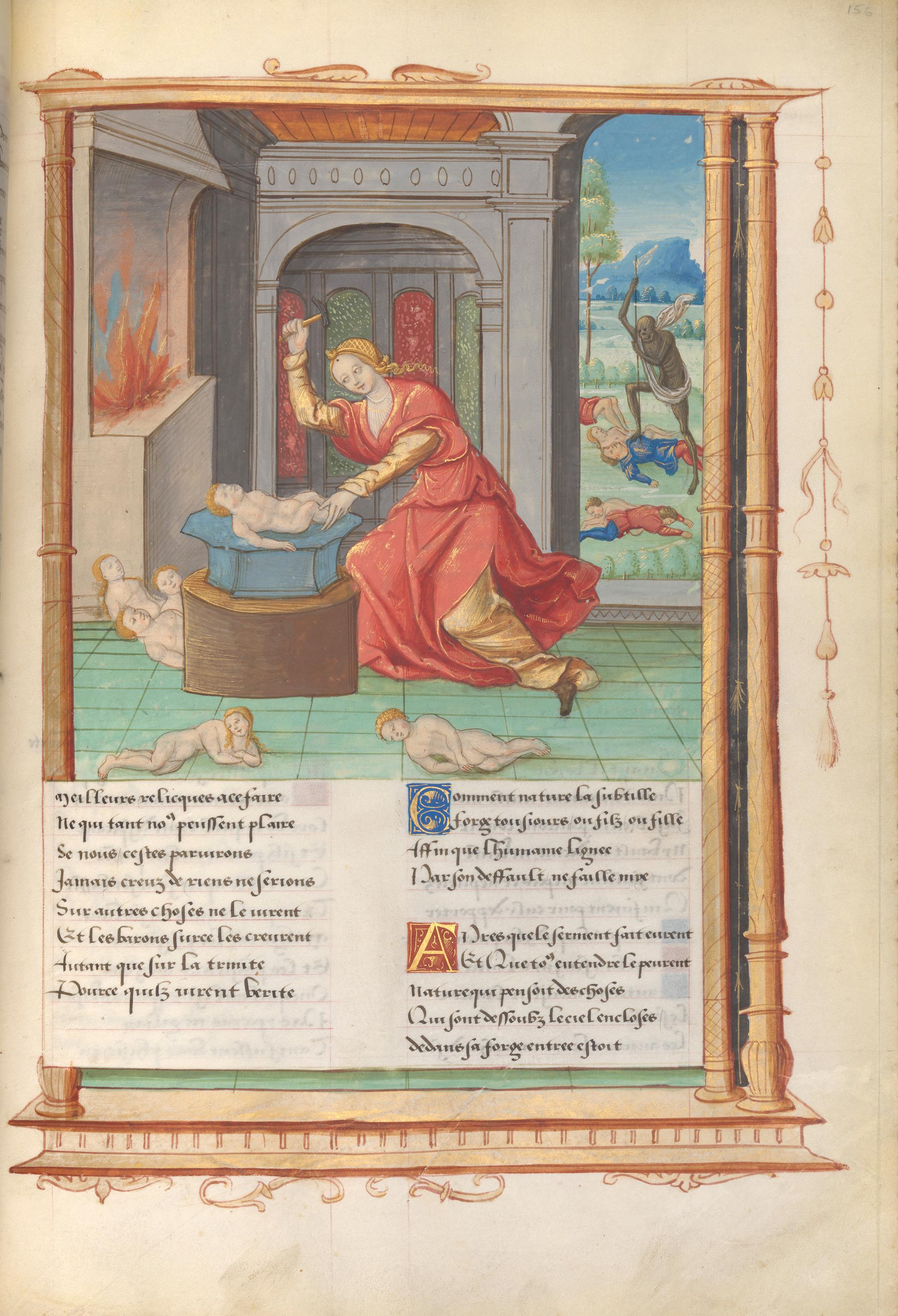
Fig.2. Guillaume, de Lorris, Roman de la Rose. Rouen, France ca. 1520-1525. The Morgan Library & Museum. MS M.948, fol. 156r. Gift of Beatrice Bishop Berle, in memory of her father, Cortlandt Field Bishop, 1972.
Among the scenes often illustrated from the Romance, we find versions of Natura at her forge, wielding an anvil, a tool for metal working. Conventionally, she is surrounded by the scattered limbs of (indistinguishable) babies. Her arm is raised above her head, a pose that in context represents the potential energy she will need to construct one of her products. But without context, a “naïve” reader might view such a pose, common in early modern visual culture, as a prologue to destruction or fragmentation. Note that in the background of this version, we find Death, also a female, whose actions are said in the poem to mimic those of Natura, but in reverse.
Such imagery does not come into variants of the Romance from nothing. It is ancient.[15]
[15] My thanks to Bjørn Jørund Blikstad for drawing this image to my attention.

Fig.3. Detail of Planche 19, île de Philæ. 1.2. Bas-Reliefs De L’édifice Ruiné De L’ouest. 3 Sculpture Du Grand Temple in Description de l’Égypte (Paris, 1820) by Charles Louis Fleury Panckoucke. Public Domain.

Fig.4. Detail of Barna da Siena, The Mystic Marriage of Saint Catherine, circa 1340. Photograph © [16.09.2026] Museum of Fine Arts, Boston. Sarah Wyman Whitman Fund. 15.1145.
Theater of Cruelty
The Hypnerotomachia Poliphili, a complex work by Francesco Colonna, was published in Venice in 1499.[16] The lengthy “strife of love in a dream,” written in a “macaronic language” (a mix of Italian, Greek and Latin), and illustrated with elaborate woodcuts, owes much to theRomance of the Rose. The protagonist, Poliphilo, falls asleep in the woods. He is shown various images, landscapes and buildings—he moves forward “point by point” (de puncto in puncto) and eventually he conquers his love, Polia. Before that, however, Polia leads Poliphilo to the Polyandrion, a ruined temple of lost loves. The woodcut to accompany the text is quite striking since the text itself, an erudite work of antiquarianism and Egyptology, does not position itself in a “present/future” with respect to a past when the temple might have been built. The temple has always been ruined, in one sense, and it is unique in the text.
[16] The work was reprinted many times during the early modern period. The bibliography is vast, including speculations on the identity of the author and of the (anonymous) artist who designed the woodcut illustrations. The work has been important to me in various contexts, and for one instance, where I consider architecture as fundamental, see my essay “Hermaphrodite Poetics,” Arcadia (2006), vol. 1, no. 41: 91-111. Also see architectural theorist Alberto Pérez-Gómez’s Polyphilo, Or the Dark Forest Revisited. An Erotic Epiphany of Architecture (Cambridge, Massachusetts: MIT Press, 1992). This is an experimental rewriting and rereading of the early modern text as a meditation on architecture.

Fig.5. Francesco Colonna, Hypnerotomachia Poliphili, p. 236, Venice, 1499.
The lovers are seen on the left side of the woodcut, contemplating the fragments. Poliphilo weeps (according to the text) and begs Polia to consummate their love so they can avoid the fate of those buried here, but she puts him off.
Later, Polia herself falls asleep. She dreams that her withholding herself from her lover is a form of cruelty for which she must be punished. A “stony woman” (donna petrosa), she watches (from the woods): again, she is both onlooker and actress in the drama:

Fig. 6. Francesco Colonna, Hypnero-tomachia Poliphili, p. 296, Venice, 1499
She is whipped and then cut apart by Cupid (who holds his instruments of cruelty above his head in the familiar pose), her body fragmented and then feasted upon by wild animals.

Fig. 7. Francesco Colonna, Hypnerotomachia Poliphili, p. 297, Venice, 1499
It is hard—perhaps impossible—given the centrality of the Roman de la Rose for the Hypnerotomachia, not to make the connection between the images of sadomasochism “dreamed” by the resistant lover, and the images of Nature with her anvil from multiple different sources. And the fragmented body parts cannot but recall the fragments of the temple.
Ops, Abundance
We do not want to trace a linear history or a genealogy of Natura. Still, by the sixteenth century, she is often assimilated to the maternal and the Earth. She may be subsumed into the Roman goddess Ops (fertility, abundance), wife and sister of Saturn. In both Roman and early modern art, Ops was often depicted naked, with wheat or a cornucopia or animals.[17]
[17] In the particular images shown here, Ops appears with emblems of the ancient goddess Cybele, the Great Mother (Magna Mater, in Roman cult), who is herself conflated with Gaia at some points in the development of her mythology.


Fig. 9. Melchior Lorck, Allegory of Nature, 1565. © The Trustees of the British Museum. Shared under a Creative Commons Attribution-NonCommercial-ShareAlike 4.0 International (CCBY-NC-SA 4.0) licence.
As an allegory of nature, this sixteenth-century figure has left her forge and stands in a landscape, nourishing “all” (nature) that surrounds her. She is no longer surrounded by human babies. Is this because she would appear too much like the Christian Madonna (who cannot be depicted with full-frontal nudity)? Nevertheless, Ops may still retain her chastity, either because she has merged with the Christian Madonna or, as a clearly pagan figure, she comes from a tradition of (childless) Earth goddesses. Her nakedness is not troubling (she can be exhibited as such) because she is not a real woman; yet she bears undeniable anatomical qualities of a woman. In fact, she exhibits some traits of Diana of Ephesus, a goddess derived from Asia Minor, often depicted with multiple breasts and wearing a headdress.
Ops has lost the tools of the artifex and the pose of the “supposed-to-be-maker who appears about to wield damage.” Note that in the background, the artist has reproduced a typical German town. Natura or Ops can coexist with such images of realism. She is an allegory who inhabits a real space, the kind of contradiction that suggests she has been tamed; the allegorist enjoys a kind of control over her. He has brought together a series of apparently divergent iconographical or morphological traditions: a female body on full display, tropes of fertility, cultural otherness, motherhood and virginity.
Artificial Natura
If we wanted to think about the evolution of the figures from the early modern period, we might turn to A.I. To be clear, I personally view this turn as entirely abject. But inasmuch as this entire essay constitutes a thought experiment that moves in and out of historical context, and inasmuch as A.I. represents a dominant form of our times for this kind of anachronistic play, and in spite of my resistance … I asked Gemini for “an image of the goddess Nature as an architect.” The result was Disney-Princess-meets-Central-American-cenote: a woman lying on her side (in the pose of Andrew Wyeth’s Christina) seen from the back, wearing a diaphanous green gown and staring out into what appear like cavernous ruins overtaken by tropical vegetation.
I next refined my prompt, asking for “an image of the goddess Nature as an architect who should be a productive force but who [like the images from the Romance of the Rose] might [especially for a naïve viewer] appear as a force of destruction.” The result was darker, perhaps an example of “CGI sludge” or “AI-generated muddle.”[18] Natura, this time, seemed to have taken on some of the characteristics of a malevolent “Mother-Goddess.” She seemed to rise like a tree from her own roots, fused with a vaguely Orientalist ziggurat. She shot lightning bolts from her hands (a Marvel superhero version of Diana of Ephesus or Cybele?), with her hair a tangled nest of braided branches not unlike the coiffeur of Lorck’s allegory.
The A.I. did not seem to have been able to negotiate the subtle conditional language I used: “should be,” “might appear.” But then, why should we expect an A.I. image to reflect a (mis)reading of illustrations from a medieval poem? I could have added even more parameters culled from The Complaint or The Romance. For instance, I could have specified that Natura should be “pure” (a figure of Chastity in contrast to Venus). She should represent a force at work against demographic collapse and against homosexual practices or desires. A.I. would likely have trouble pulling together these various threads (and rightly so). There are too many different contradictory terms. And then, if I were to circulate “my” A.I.-generated images, they might, in turn, be recycled for future searches, smoothed over and devoid of linguistic complexity and ambivalence.
[18] For the “new” dark aesthetics in computer graphics in film, see https://www.nytimes.com/2026/04/27/movies/film-lighting-quality.html, accessed 1 May 2026. For the term “muddle,” which comes from a different context, Gregory Bateson’s discussion of “indistinction,” see Andreas Ervik, “The Work of Art in the Age of Multiverse Meme Generativity,” Media Theory, vol. 7, no. 2 (2023): 77-102, p. 82.
Nature, the Architect
With this broader discussion of Natura as allegory in the early modern period, we are a long way—to cite just one example—from a recent exhibition titled, precisely, “Nature, the Architect,” “Naturaleza arquitecta,” at the Museo Moderno in Buenos Aires (April 2026 – April 2027).[19] The curatorial statement invites viewers to “conceive of nature as an artist capable of unleashing all its [in the English, a neutral pronoun] creative, political vital force.”[20] The artists in the exhibit “translate” their perspective into images “through the transformative prism of art,” with a goal of “protecting nature” and awakening “new forms of empathy and responsibility towards the world we inhabit.” In the exhibition text, “Nature,” “naturalness,” “Earth,” “world,” “empathy,” and “care” are intermixed without much distinction. N/nature the architect in the exhibition title is, we might say, not so much a figure as a set of attitudes toward the nonhuman world “out there.” Is there anything of Natura left? Does she haunt current practices or vocabularies, perhaps as trace of the past?
We all speak of nature and we do so often and automatically. At the same time, if we reflect for just a moment, we must admit it is impossible to fully extricate “nature” from active agency and from the sex/gender system surrounding Natura.[21] In the medieval tradition, recall, Natura is a virgin who preserves chastity as an ideal, while Cupid and Venus encourage (reproductive, marital) sex. When we use terms like “pristine” or “untouched” nature, shouldn’t we also be aware that her purity is allowed, precisely, by Venus’s impurity? Natura is an allegorical figure coded as feminine by (male) allegorists—by writers and thinkers who, by wielding the absolute power of their words—tame her and evacuate her of threatening qualities associated with the feminine (for instance, in a series of conventionally misogynistic passages in the Romance, real women are said to be unstable and unreliable gossips). As a figure (of speech), she seems evacuated of any of the potential rancor of the raised arm. She points toward a dream of no ambiguity in language itself: man is man and woman is woman and all is ordered. To recognize this dream is also to recognize what it means to posit nature “coming first,” before we even begin to dig a foundation for a building or plan a structure or choose materials. Her arrival, perhaps at the head of a parade of other figures or commitments, is far more ambivalent and complex than we might think. At first.
[19] See https://museomoderno.org/en/exhibitions/naturaleza-arquitecta/. A key figure for the exhibition is the Brazilian architect Paulo Tavares, known for his work on forests as “natural” built environments.
[20] The Spanish avoids the pronoun issue inasmuch as the possessives agree with the adjectives or nouns rather than with “nature” as agent: “Esta exposición nos invita a reconocer a la naturaleza como la verdadera protagonista de las prácticas creativas y sociales. Sus artistas nos animan a escuchar las historias que cuentan los bosques y los ríos, a ver las huellas que los volcanes dejan como palabras en un poema y a aprender de los animales otra forma de ver el mundo y a nosotros mismos.”
[21] To give just one example, in a book on the origins of architecture, Dwelling on Earth. The Past and Future of the Places We Call Home (New York: W.W. Norton, 2026), Stefan Al, writing about how little evidence survives of early structures, adds, “However, on rare occasions nature preserves a snapshot of prehistoric domestic life” (p. 28). The example he offers is of some remnants of fisher-hunter-gatherer huts on the shore of the Sea of Galilee. A series of “natural” events have protected them from decay.
The publication of this essay was supported by the research project Material Ecologies of Design (2025–2026) at the Center for Advanced Study (CAS), funded by the Norwegian Academy of Science and Letters.
References
Al, Stefan. Dwelling on Earth. The Past and Future of the Places We Call Home. (New York: W.W. Norton, 2026).
Alain de Lille (Alanus de Insulis). The Complaint of Nature (De planctu naturae). Translated by Douglas Moffat. (New Haven: Yale University Press, 1972 [1908])
Colonna, Francesco. Hypnerotomachia Poliphili. (Venice, 1499).
Economou, George. The Goddess Natura in Medieval Literature. (Cambridge, Massachusetts: Harvard University Press, 1972)
Heidegger, Martin.“The Origin of the Work of Art,” in Poetry, Language, Thought. Translated by Albert Hofstadter. (New York: Harper and Row, 1971).
Loris, Guillaume de and Jean de Meun. Romance of the Rose (Le roman de la rose). Translated by Charles Dahlberg. (Princeton, New Jersey: Princeton University Press, 1995).
Newman, William. Promethean Ambitions. Alchemy and the Quest to Perfect Nature. (Chicago: University of Chicago Press, 2004).
Panofsky, Erwin. Abbot Suger on the Abbey Church of St. Denis and Its Art Treasures. (Princeton, New Jersey: Princeton University Press, 1946).
Panofsky, Erwin. Gothic Architecture and Scholasticism. (New York: Meridian Books, 1957 [first edition 1951]).
Pinkus, Karen. Alchemical Mercury. A Theory of Ambivalence. (Palo Alto, California: Stanford University Press, 2009).
Karen Pinkus, “Natura Architecta,” Metode (2026), vol. 5 ‘What if Waste’