Rehearsing the Not Yet: Exhibition Making as Creating Context

Download article as PDF

The Yellow House, Boden, photo by Elias Arvidsson, 2016

To enter an exhibition is to cross into a field of relations: a space where gestures, materials, and meanings are temporarily assembled to test how we might appear together. This text begins at that threshold. It treats the exhibition not as a site to be described but as a question to be inhabited—a mutable situation where form and thought, presence and politics, intersect. What follows is less a theory than a passage through contingent rooms of thinking and practice, an attempt to trace how the act of assembling (spatially, conceptually, collectively) can itself become a mode of inquiry. 

Exhibitions are often understood as spaces of display—containers that gather artworks under a curatorial narrative. Yet I have become increasingly concerned with what else an exhibition might do: how it might operate performatively as a site of relation, testing the conditions through which knowledge, encounter, and imagination emerge. Within the entanglements of our present (ecological, political, social, etc.), I think of the exhibition as a provisional infrastructure for gathering and thinking together, in agreement and disagreement. It is not an endpoint, but a situation in motion, where meaning is formed through proximity and friction: between ideas, works, audiences, engagement, and the specific circumstances that shape them. 

From this position, curating becomes a practice of working with relations rather than organizing objects. It is a process attentive to context, aesthetics, temporality, and modes of engagement. The exhibition then appears less as a fixed format than as a method for working through complexity, a performative situation in which artistic and curatorial gestures test how we assemble, sense, and act in common.  

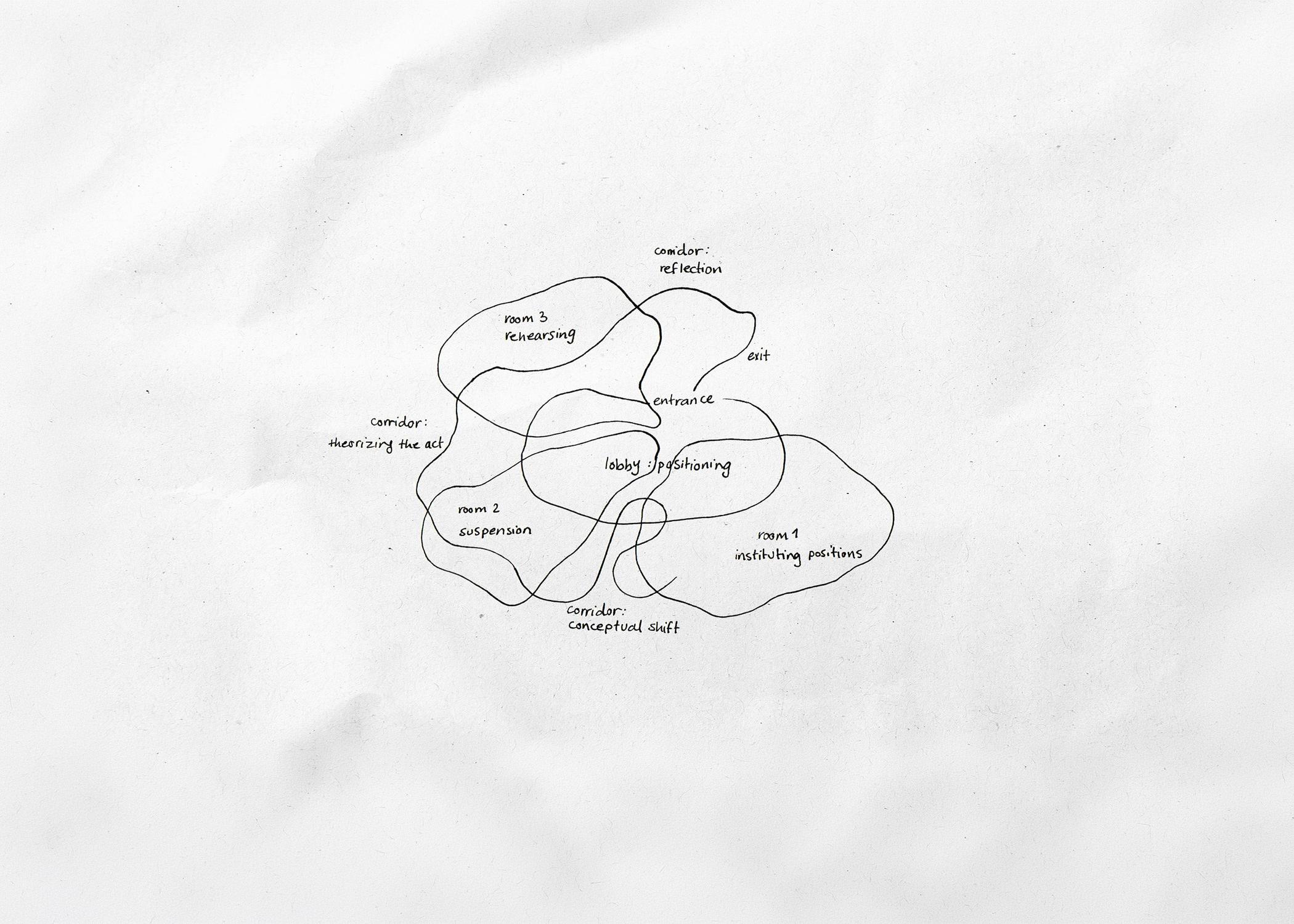
This essay takes that understanding as its point of departure. Writing from the position of an artist working with exhibitions as sites of inquiry, I approach curating not as a professional title but as a mode of practice that can be activated by anyone who shapes the conditions of an encounter. The projects discussed here have been selected because they each engage the exhibition as a performative context: not as a space of representation, but as a situation that produces relations, publics, and modes of thought. Through these case studies, I trace different ways in which exhibitions can institute, suspend, rehearse, or anticipate forms of being together, moving across participatory settings, fictional cinematic worlds, and my own artistic practice as three interconnected modes through which exhibition-making operates performatively. 


 The room was furnished like a traditional living room: a carpet, some designed cushions, a tray with tea and fruits in the middle. Yet, instead of small talk over tea, it became a space for heated discussions about belonging, hospitality, border, and hosting. DAAR’s Living Room unsettled the boundaries between public and private, everyday life and political assembly. In that moment, the exhibition ceased to function as a space of display and became a situation of activation, reconfiguring how people might gather and imagine together. 

In 2016, Palestinian architect and researcher Sandi Hilal was commissioned by Sweden’s Public Art Agency to carry out a project in the northern town of Boden. The town had undergone significant transformation in recent years, shifting from a military zone to one of the primary arrival points for refugees entering Sweden. During her first visits, Hilal identified the direction of her work: to explore refugeedom through the lens of hosting and visiting. She questioned how refugees risk becoming fixed in the position of guests, suspended in a condition of permanent temporariness, and on whose terms the process of integration is imagined to function. At the Yellow House in Boden, she transformed one of the ground-floor apartments into a semi-public living room for the refugees living there: Al Madafeh.1 

Al Madafeh [The Living Room] reimagines the domestic space as a political site. The project begins from the Arabic notion of al-madhafah (hospitality): the room in one’s home dedicated to receiving guests, where coffee or fruit is always ready and where the boundary between host and guest remains in flux. For Hilal, this practice of hospitality is not merely cultural but political—a spatial form that challenges the division between public and private, citizen and refugee, temporary and permanent. 

In Al Madafeh, the act of hosting becomes the curatorial gesture. Rather than curating objects, Hilal curates a situation: a space arranged for conversation, disagreement, and collective reflection. Each iteration of the project has unfolded differently, shaped by its hosts and guests. From Yellow House in Boden (2017) to Abu Dhabi (2018), from the Van Abbemuseum in Eindhoven (2019) to ArkDes in Stockholm (2018), these rooms do not replicate a model but create a network of parallel activations, where the domestic space becomes an exhibition that needs to be lived, not visited. A shift in a space to a site where publicness is produced through use, conversation, and disagreement. 

Sandi Hilal describes this gesture as the “right to host,” which repositions the refugee from a passive guest to an active subject capable of offering hospitality, dialogue, and knowledge. Through this inversion, Al Madafeh destabilizes the hierarchies embedded in hosting and belonging. Precarity is no longer a deficit but a generative condition, a source of what Hilal calls “radical hospitality.” Writing about Al Madafeh, Pınar Tan describes the project as a network of performative, intimate spaces that activate hospitality as a political practice rather than a symbolic gesture. Hilal uses the practice of hospitality not simply in terms of refugees and asylum seekers as subjects of unconditional hospitality, but to subvert the role of guest and host.2 

In August 2023, on the occasion of Gothenburg’s 400th anniversary, Hilal was invited by Prototype Gothenburg to activate Al Madafeh in the newly built cultural center in Bergsjön, one of Gothenburg’s most segregated suburbs and home to residents from a wide range of social, cultural, and migratory backgrounds. Hilal asked me to join the project as curator and coordinator of the four-day activation, drawing on my prior work in this context. The Living Room was subsequently installed within the public library and became a site of continuous conversation for four days. 

Over the course of these days, I observed how relations within the cultural center were gradually reconfigured. Librarians, parents with children, local teenagers, visitors from the university, and institutional representatives entered and exited, shifting positions of hosting. At moments Hilal occupied the role of host; at others, a group of teenagers from the neighborhood took over, pouring tea and setting the rhythm of the room. These transitions were neither staged nor assigned, but emerged through use. The material of the work was not the visual form but the encounter itself: the protocols of hospitality, the transformation of private setting into public, and the possibility of meeting otherwise. 

After the official activation ended, the cultural center decided to keep the installation in place for an additional month, noting that it continued to be activated by different local groups. This persistence revealed something central to how Al Madafeh [The Living Room] functions: not as a container for predetermined meaning but as a condition that reconfigures agency through relational practice—a situation in which subjectivities can shift, roles can be renegotiated, and a temporary public can come into being. The work exemplifies curating as the composition of conditions: a process that produces meaning through situated interaction. 

1 For more about the Al Madafeh project, see https://www.decolonizing.ps/site/boden/

2 Tan, “Unconditional Hospitality,” p. 5. 

Boden Living Room, photo by Andreas Fernandez.

Van Abbemuseum Living Room, photo by Marcel De Buck.

Bergsjön Living Room, photo by Reyhaneh Mirjahani.

Leaving The Living Room, the question of what an exhibition can do continues to unfold. It has already blurred the line between artwork and situation, turning hosting into a curatorial act and relation into material. This approach also challenges how an exhibition is understood. The Living Room is not a display of hospitality but a performance of it. It embodies what Simon Sheikh calls “exhibition-making as the making of a public,” a practice that does not represent the social but institutes it differently.3 The exhibition becomes a counter-public strategy where the aesthetics of space and the politics of assembly merge. It does not abandon the aesthetic, it simply relocates it. 

From here, the corridor opens into broader questions about the exhibition as a method and the shifting figure of the curator. As contemporary curatorial studies have undergone a relational turn, moving the focus from organizing objects to establishing a large network of relations by scholars within curatorial studies, including Beatrice von Bismarck, the curatorial situation is characterized by “transpository processes”—movements, displacements, and entanglements of human and non-human actors—which “situational and temporary constellations” emerge from, and reaching to the “dispositif of hospitality.”4 

If the exhibition can institute the public and their relationality differently, then curating must be understood not as the arrangement of works but as the composition of conditions. The artist’s role expands accordingly, moving from maker to mediator, from producing objects to shaping relations. In this sense it connects to the trajectory outlined in the 1990s by Nicolas Bourriaud, who understood curatorial and artistic practice as the creation of “possible encounters” that operate outside the communication zones imposed by dominant structures and outside the logic of profit.5 Relationality, however, cannot be approached without acknowledging the context and political stakes embedded in these encounters. As Claire Bishop notes, relational aesthetic is less concerned with intersubjective relationships than with “scenarios” and systems of display.6  

Working with the exhibition through the position of an artist introduces other methodologies and sensibilities that can unsettle or extend institutional habits. This shift from content to context also transforms who curates, and how. When the exhibition becomes a method rather than a format, curating turns into a practice of connection—of situating, composing, and holding space, while remaining attentive to the power dynamics that these relations produce. The figure of the artist-curator was redefined within this expanded field, bringing forms of self-organization that test institutional hierarchies and redistribute authorship, moving toward collective and processual modes of knowledge production, creating spaces for shared agency rather than fixed authority. 

I do not wish to return to the familiar question of what curating is or who the curator should be. Instead, I think of curating here as a verb—specifically, as a way of making context. Magdalena Malm proposes that to work in context is to work in relation: between the artwork and its surroundings, between participants and viewers, and in the processes of production where meaning emerges only when the work is situated.7 Building on Malm’s framework, I understand curating as context-making rather than object-focused display: working with spatial arrangements, dramaturgies, and collaborative processes that shape exhibitions as active sites—places where power relations can be made visible, questioned, and reimagined. In other words, curating as creating a contextual space where subjectivity can be exercised and shared.  

When artists take on curating, the exhibition becomes not only a format but also a medium through which they think and work. As Alison Green discusses, it becomes a medium for articulating relations rather than simply presenting results. Yet Green also points to Olga Fernández, who argues that even when artists move beyond the studio and toward socially engaged or participatory modes, their work remains in the realm of representation. These projects do not function as social laboratories, but as stagings of them—spaces that rehearse, rather than resolve, the social. Green explains that for Fernández, sociability itself becomes a medium—a site where the symbolic and the social intertwine.8 This distinction is crucial, as it resists the instrumentalization of art while still recognizing its capacity to act upon the real through gestures of hosting, gathering, and relation. 

While Malm often considers projects beyond the gallery, I am interested in how such relational thinking might even re-enter the exhibition—as something that can unfold in or outside the gallery, as a temporary setting or a site of encounter. Does this necessarily require participation? Or can even static works, through their spatial and conceptual composition, open a field of activation? 

3  Sheikh, “Towards the Exhibition as Research,” p. 181 

4 Müller-Brozović, “Curating Resonances through Creating Relationships,” p. 24. 

5 Bourriaud, Relational Aesthetics, p. 23. 

6 Bishop, Artificial Hells, p. 87. 

7 Malm, “Introduction,” p. 13. 

8 Green, When Artists Curate, p. 246. 

Entering this room, the light dims. A double projection fills the wall, and the split image creates an immediate sense of disorientation, as if two temporalities have been forced to coexist. The scenes are fictional, yet they carry the weight of something uncannily familiar. A conversation unfolds between the two halves of the screen and the space grows heavier, as if thickened by the tension between what is remembered and what is imagined. The split projection feels like a threshold, a limbo suspended between past and future, where memory and speculation press against each other without resolving into a single world. 

The 2019 film In Vitro by Larissa Sansour, co-directed with Søren Lind, brings another perspective on what it means to curate context. Unlike participatory or process-based works, it is static in form yet charged with the intensity of world-building. Set in a subterranean Bethlehem after ecological collapse, the film stages a dialogue between two generations of scientists who debate inheritance, exile, and the possibility of renewal. 

By stepping beyond the determined language of documentary realism and turning to the language of science fiction, In Vitro creates a context where roles and power balances are unsettled. The future it depicts is both imagined and remembered, its ruins inhabited by echoes of unresolved history. The work invites a reflective suspension, a space to dwell in uncertainty. 

In a video interview called “Sci-fi Became Our Refuge,” Sansour and Lind explain that while the work is inspired by the idea of crisis, and its themes connect to historical crises, it is not about crisis in itself. Rather, crisis becomes a kind of tabula rasa—a clearing that opens space for new dialogue to emerge. For them, this is central to In Vitro: the persistent and unresolved question within the Palestinian condition—how to forge a future, how to build beyond the rubble?9 

In this way, In Vitro does not call for action in the physical sense; it activates through consciousness. It takes shape through the language of a context-free fictional space, but it curates a mental and emotional context in which viewers are asked to stay with dissonance, to sit with questions of continuity and rupture, of what survives and what must be re-imagined. Here, stillness can also act; reflection can also gather. Here, the exhibition becomes a site of shared contemplation, a rehearsal of thought rather than gesture, enacted by the artist and continued by the viewers. The room holds us in that suspension—between past and future, image and idea—where the possibility of another world begins to flicker. 

9 Sci-fi Became Our Refuge | Artists Larissa Sansour & Søren Lind | Louisiana Channel, https://www.youtube.com/watch?v=VBJz28pdqbE

Still from Larissa Sansour & Søren Lind’s video work In Vitro, 2019. Courtesy of Larissa Sansour & Søren Lind

Leaving the dim space of In Vitro, the eye needs time to readjust. In Vitro pushed the boundaries of my own imagination around national identity, loss, memory, and trauma, inviting a sustained engagement with questions of inheritance and rupture. The stillness of the previous room lingers, yet the corridor opens toward questions that reach beyond any single work. What does it mean to institute differently, to imagine publics and worlds through the form of the exhibition itself? Simon Sheikh reminds us that transformation is not only a matter of changing institutions but of changing how we institute—how subjectivity and imagination take form: 


This can be done by altering the existing formats and narratives, as in the queering of space and the (re)writing of histories—that is, through deconstructive as well as reconstructive projects, and by constructing new formats, and by rethinking the structure and event of the exhibition altogether. Either way, I would suggest that curating in the future should center around three key notions, articulation, imagination, and continuity.10 


To think of exhibition making in this way is to see it as an act of articulation: the positioning of a project within its social and political field, and the proposal of a way of being in relation. Articulation, as Sheikh describes, is  


the positioning of the project, of its narratives and artworks, and its reflection of its dual public and placement both in and out of the art world [...] It’s a proposal for how things could be seen, an offering, but not a handout. Articulation is the formulation of your position and politics, where you are and where you want to go, as well as a concept of companionship: you can come along, or not.11 


If, as Sheikh writes, “all exhibition making is the making of a public, the imagination of a world,”12 then each curatorial gesture becomes a political act of address. This sentence has stayed with me. If exhibitions imagine worlds, they also imagine the publics who might inhabit them. Exhibition-making is therefore not simply the arrangement of works or the production of visibility; it is a process of instituting—of projecting other worlds and inviting others into a shared, though temporary, space of recognition. For Sheikh, the exhibition is not a neutral mediator between art and society. It is itself a political act: a way of shaping the mode of address through which art speaks to its audience. “It’s the mode of address that produces the public,” he writes. To imagine different publics is thus to reconfigure these modes—the gestures, voices, and spatial formats through which exhibitions call us into relation. In this sense, every exhibition is both aesthetic and political: a negotiation of visibility, access, and relation.13 

10 Sheikh, “Towards the Exhibition as Research,” p. 183-184. 

11 Ibid., p. 183-184. 

12 Ibid., p. 182. 

13 Ibid. 

Stepping into this unfinished room, the questions of context and activation return to my own practice. The room is cold, bright, yet somehow without focus, looking like an industrial room with bricks. It seems empty, except for silver tape tracing lines across the floor like a provisional map, and around 30 sheets of paper suspended from the ceiling, each carrying a fragment of text. As I move through the grid, I choose a path and stop beneath the first hanging paper. Other visitors enter behind me, taking different directions. They pause, read their questions silently, and glance at one another. I observe a moment of hesitation between them—a small choreography of decision. Back in my position, I read the text hanging above me: “In an election: You participate, making a choice between the lesser of two evils—turn Right. You boycott the election when there is no good choice—turn Left.” 

An Experiment on Agency (2021–) is my ongoing, inquiry-based participatory project that investigates the notion of agency, aiming to comprehend the complexities of how agency is constrained by intricate networks of economic and socio-political conditions. These forces compel individuals and communities to navigate, embody, and negotiate their political agency on a daily basis. The project focuses on agency within dilemmatic political situations, where actors find themselves in a “lose–lose” predicament.14 

Through a series of incremental discussions and participatory–sensorial installations, the project seeks to fundamentally revise and redefine dominant understandings of agency, bringing forth the embodied, sensuous, and intersubjective dimensions that shape how agency is enacted and perceived. These encounters privilege informal discussions and shared reflection as methods of inquiry. It raises an open question: if in certain situations we lose agency, which systems are depriving us of it

14 Mervyn Frost defines a lose–lose predicament as a tragic moral dilemma in which an actor is caught between multiple valid but directly conflicting responsibilities, such that no possible action can fulfill all obligations simultaneously. This situation represents an “ethical agon”—a competition or duel between choices where each has a legitimate claim on the individual, making a compromise impossible and ensuring that any action taken will violate at least one valid ethical claim. Frost, “Tragedy, Ethics and International Relations,” p. 482. 

Reyhaneh Mirjahani, An Experiment on Agency #5, Skogen, Gothenburg, Sweden, 2022, photo by Reyhaneh Mirjahani.

Upon entering the room, participants were invited to explore their imagined agency by walking through a floor map marked with branching paths. According to their answers to a series of questions along the way, each participant traced their own route through the map. Political conflicts, questions of ethics and responsibility, and the shifting relations between oppressor and oppressed unfolded through these questions, echoing the dilemmas that play out on the world stage—without easy answers, without clear winners. Afterward, participants were invited to join an open, informal discussion. 

The sixth iteration of the project took place in Riga in 2022, seven months after the Russian invasion of Ukraine, in a climate charged by political fatigue and social tension. The work was presented a week before the Latvian parliamentary election that year and therefore took a specific direction: A Discussion on Civic Participation. Within this atmosphere, and amid the visible traces of war in the city and everyday life, the project asked what forms of participation remain possible when the frameworks of democracy themselves appear eroded. It generated questions around the role and responsibility of the civilian, and the relationship between citizen and state. 

An Experiment on Agency #6: A Discussion on Civic Participation, discussion with a group of school teachers, RIBOCA (Riga International Biennial of Contemporary Art) Repository of Knowledge, M-Gallery, Riga, Latvia, 2022 (photo by Renārs Koris).

An Experiment on Agency #6: A Discussion on Civic Participation, discussion with a group of school teachers, RIBOCA (Riga International Biennial of Contemporary Art) Repository of Knowledge, M-Gallery, Riga, Latvia, 2022 (photo by Renārs Koris).

As a setting, An Experiment on Agency operates as a temporal structure, a space curated to facilitate discussion rather than to produce outcomes. Each iteration unfolds in two movements: an activation, and the collective analysis that follows it. There is no end result, no moment of display, no final product to be assessed. Instead, the work functions as a rehearsal—an exercise in the symbolic gestures of agency and their shared interpretation. At the same time, it seeks to illuminate the frictions within these discussions, holding open the space where antagonism can be reimagined not as division but as relation. In this way, disagreement itself becomes a mode of coexistence, a practice of thinking and being together through conflict rather than beyond it. 

By foregrounding dialogue over resolution, the project positions the exhibition as a testing ground for collective sense-making. It exposes the fragile interplay between decision and doubt, between agency and structure, between reflection and action. What remains is not a conclusion but a temporary constellation of thoughts, experiences, and encounters—an unfinished conversation that continues beyond the room. 

Leaving the room, I notice the silence that follows collective reflection. The traces of dialogue, movement, and hesitation still seem suspended in the air. Walking through these rooms, I begin to think of curating context as inseparable from the idea of exhibition as method. Both are temporal, evolving, and situated ways of thinking—not fixed frameworks, but ways of learning through doing, of sensing through relation. 

These three projects operate through distinct forms, yet they share a methodological commitment: to curate context as a way of making power relations visible, of suspending resolution, and of creating conditions where subjectivity can be exercised collectively. The exhibition, in this sense, becomes more than a format of display. It turns into a method for research, for thinking collectively, and for encountering difference. Through the rooms I have just described, I approached curating context from the position of an artist: as a way to arrange relations, to hold space for the unexpected, and to anticipate what does not yet exist. These three aspects together form what I now understand as a methodology—a way of practicing the exhibition as a site of inquiry. 


Composing relations 

Returning to The Living Room project, the tangled relation between host and guest becomes central. A room is set for people to come, sit, eat, drink, and talk, yet what stands at the forefront is the question of who hosts that room—the artist, the mediator, the institution, or the collective—and how each of these positions carries its own social implications. Reflecting on the dynamics of their position in society, whether as host or guest, reveals the shifting power relations embedded in acts of gathering, belonging, and representation. To curate context here is to ask what forms of belonging or exclusion are produced in society. It is also to understand how the act of hosting shapes participation, authorship, and the experience of being together. 

During a discussion as part of An Experiment on Agency, one of the activations (a session held with a group of teachers), a participant began to speak, her voice trembling: “How can I raise a question around agency in my classroom, where Latvian, Russian, and Ukrainian students are sitting next to each other?” What followed was not an attempt to solve her question but a shared effort to map what she called the ecosystem of impossibilities—the limits of action and speech within lived, conflicted realities. It was a moment when subjectivity asserted itself precisely through its contradiction with the logic of the work, exposing how the attempt to curate context can itself surface what cannot be easily reconciled or contained. 


Hosting the unexpected 

The discussion that unfolded in An Experiment on Agency revealed how the exhibition as a curated space can never be fully contained or predicted. Even with carefully structured frameworks, what takes place within them often escapes intention. The teacher’s trembling voice and the momentary tension shifted the direction of the conversation entirely. It was no longer about the work as designed, but about what the situation had enabled to surface. In that instant, the project ceased to represent a question and became the question itself. 

Curating context in an exhibition, in this sense, is also about leaving space for what cannot be foreseen. It is about constructing environments where experiences may unfold in ways that challenge both the work and its maker. In her essay “Beyond the Era of the Object: Towards the Aesthetic of Anti-commodification,” Cecilia Sjöholm emphasizes that “works of art present particular forms of agency, and are less interesting for what they are than for what they do.”15 She describes how a work of art can “represent a reckless mode of being in terms of its sensible appearance and spontaneity that kills the predictability of aesthetic forms.”16 

The exhibition, therefore, can open a space for something to happen that neither artist nor audience could have entirely anticipated. This openness introduces a particular kind of vulnerability. The curator or artist who works with the exhibition in such a way must be ready to relinquish control, allowing the work to become porous to the social, political, and emotional realities that enter it. The event in Riga reminded me that what happens in such a space is never entirely of one’s making; it depends on those who inhabit it. The exhibition as a method of curating context thus becomes a practice of responsiveness. It is about hosting without knowing what will arrive, and about recognizing that the unexpected can itself be a form of knowledge. 

Returning to the second room, In Vitro, I am reminded that the moment of rupture, the moment of the unexpected, is not necessarily spatial, physical, or discursive. It can also be narrative, or a stance taken toward a subject. In the sci-fi film by Sansour and Lind, an intentional reflective suspension is created—a space in which to dwell within uncertainty. The film’s unexpected flow of narrative pushes us to reimagine our relations to history, to the present, and to the future. 


Anticipating the yet-to-come 

If the unexpected breaks into the present, anticipation gestures toward what has not yet arrived. To curate context is also to work in the register of the possible—to prepare a ground for what might emerge. Then the exhibition does not only respond to a situation but anticipates its unfolding. It looks toward what could take shape through collective thought and encounters. 

Raqs Media Collective, working as artists, curators, and philosophical agents, describe curating as “an act of anticipation.” For them art becomes a place as it gathers layers of unresolved relations and tensions to itself. In this gathering, distinction between different kinds of protagonists, between the unfinished and the finished, between art and non-art, spectator and participant, are held in suspension.17 For Raqs, the curatorial today stands as a critical protagonist—a site—for exploring the potential of this moment.18 It suggests that the exhibition is not a mirror but a threshold: a porous interface between what is and what might still come into being. 

This sense of anticipation extends to how participants inhabit a work. Maria Magdalena Malm, in conversation with Elvira Dyangani Ose, reflects on how a work of art can create a context that “affects its participants by allowing them to become subjects.” She clarifies that this does not mean subjectivity can only emerge in participatory practices, but that certain contexts can enable such experiences of becoming.19 This distinction feels crucial. It shifts the focus from representation to activation, from displaying subjects to creating conditions where subjectivity is exercised and shared, and therefore the anticipation for yet-to-come can happen. 
15 Sjöholm, “Beyond the Era of the Object,” p. 104. 

16 Ibid., p. 105. 

17 Raqs Media Collective, “The Play of Protagonists,” p. 44. 

18 Ibid., p. 46. 

19 Dyangoni Ose and Malm, “How About This? On a Sense of Togetherness,” p. 55. 

Leaving the exhibition, I am struck by how fragile the conditions for thinking together actually are. The rooms have shown that assembling people, narratives, and positions inside a curated space does not resolve conflict or generate clarity. Instead, it exposes the limits of our frameworks, the unevenness of our agencies, and the tensions we often prefer to leave unspoken. If the exhibition operates as a method, it does so not by providing answers or reconciling differences, but by making visible the very structures that constrain how we think and act together. 

Stepping outside, I am aware that nothing here gestures toward resolution. The questions raised in these rooms persist: how to sustain multiplicity without dissolving into relativism, how to host without reproducing hierarchies, how to anticipate without imposing. The exhibition ends, but its method continues to demand something from us—an attentiveness to the structures we inhabit and the relations we create, intentionally or not.  

References 

Bishop, Claire. Artificial Hells: Participatory Art and the Politics of Spectatorship. London: Verso, 2012. 

Bourriaud, Nicolas. Relational Aesthetics. Translated by Simon Pleasance and Fronza Woods. Dijon: Les Presses du Réel, 2002. 

Dyangani Ose, Elvira, and Magdalena Malm. “How About This? On a Sense of Togetherness.” In Curating Context: Beyond the Gallery and into Other Fields, edited by Magdalena Malm, 51–64. Stockholm: Art and Theory Publishing, 2017. 

Frost, Mervyn. “Tragedy, Ethics and International Relations.” International Relations 17, no. 4 (2003): 477–95. https://doi.org/10.1177/0047117803174005.  

Green, Alison. When Artists Curate: Contemporary Art and the Exhibition as Medium. London: Reaktion Books, 2019.  

Malm, Magdalena. “Introduction.” In Curating Context: Beyond the Gallery and into Other Fields, edited by Magdalena Malm, 11–22. Stockholm: Art and Theory Publishing, 2017. 

Müller-Brozović, Irene. “Curating Resonances through Creating Relationships.” In “No Cure: Curating Musical Practices,” edited by Anja Wernicke and Michael Kunkel. Special issue, On Curating 57 (October 2023): 22–36. https://www.on-curating.org/issue-57-reader/curating-resonances-through-creating-relationships.html#n28.  

O’Neill, Paul, and Mick Wilson, eds. Curating Research. London: Open Editions, 2015. 

Phillips, Andrea, and Ressa Greenberg, eds. Curating and Politics Beyond the Curator: Initial Reflections. Berlin: Hatje Cantz, 2015. 

Raqs Media Collective. “The Play of Protagonists.” In Curating Context: Beyond the Gallery and into Other Fields, edited by Magdalena Malm, 39–50. Stockholm: Art and Theory Publishing, 2017.  

Sheikh, Simon. “Towards the Exhibition as Research.” In Curating Research, edited by Paul O’Neill and Mick Wilson, 181–89. London: Open Editions, 2015. 

Sjöholm, Cecilia. “Beyond the Era of the Object: Towards an Aesthetics of Anti-Commodification.” In Curating and Politics Beyond the Curator: Initial Reflections, edited by Andrea Phillips and Ressa Greenberg, 99–110. Berlin: Hatje Cantz, 2015. 

Tan, Pelin. “Unconditional Hospitality: Art and Commons under Planetary Migration.” Journal of Aesthetics & Culture 14, no. 1 (2022): 1–12. 

Reyhaneh Mirjahani, “Rehearsing the Not Yet: Exhibition Making as Creating Context”, Metode (2026), vol.4 ‘Exhibition as Method’