
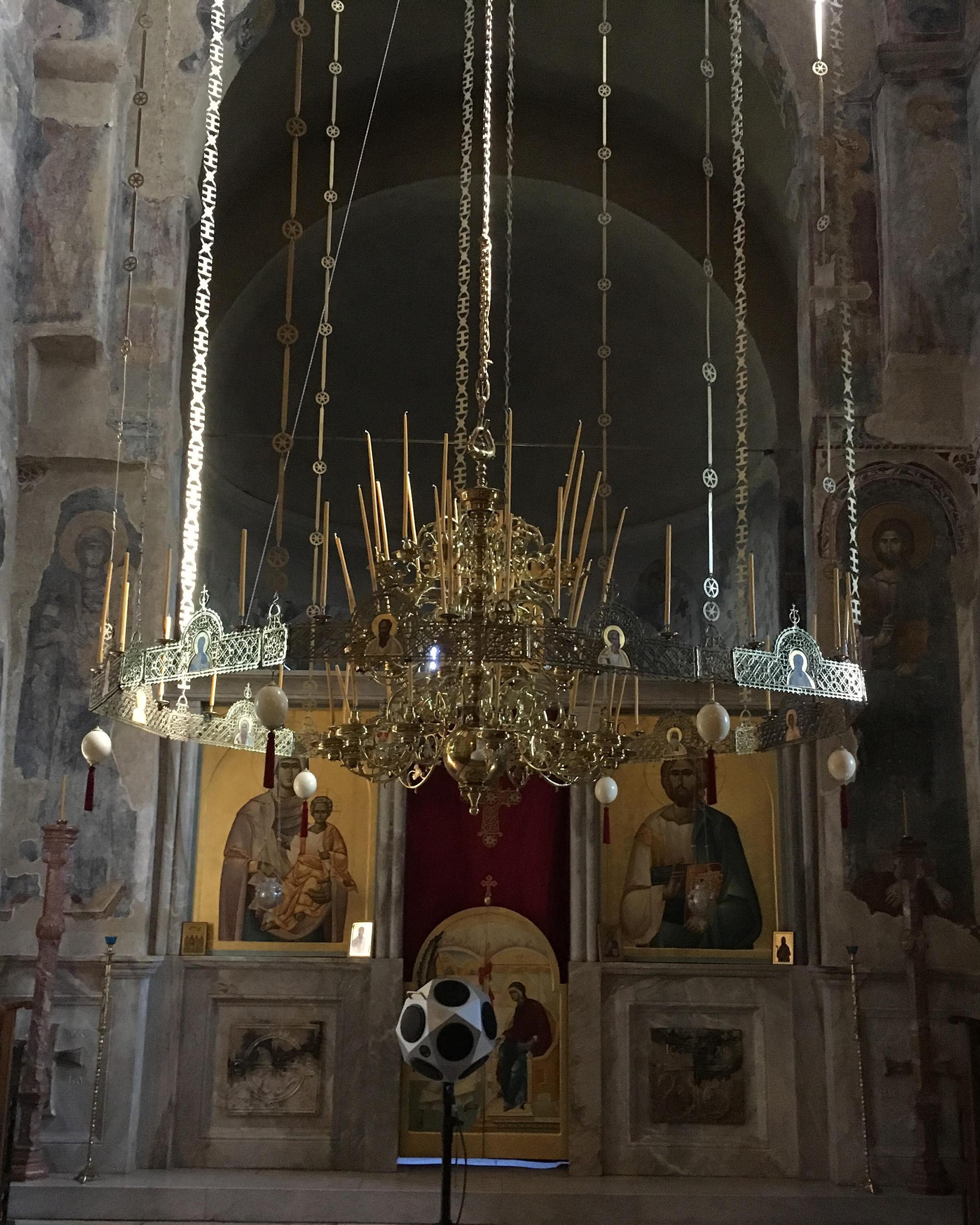
The Pavlovac monastery, Serbia. Photo by Zorana Đorđević.
The Pavlovac monastery, Serbia. Photo by Zorana Đorđević.
The Pavlovac Monastery, Serbia. Photo by Zorana Đorđević.
Sound is an inherently temporal phenomenon that only occasionally appears in cultural-historical exhibitions, where it is most often used to add an auditory layer to otherwise silent narratives. Even more elusive than sound itself is the acoustics of a space—the subtle yet powerful ways in which it shapes the experience of music, speech, and other sonic events. What happens, then, when acoustic heritage becomes an exhibition’s primary focus? Drawing on curatorial practice, this essay argues that exhibition-making can operate as a method of research—not only while preparing and holding the exhibition, but also by serving as a “research map” long after it has closed.1
In the 1980s, Iegor Reznikoff and Michel Dauvois (1988) suggested that ancient people may have selected the locations of cave art based on acoustic properties—zones of striking resonance, echo, or reverberation within caves. This hypothesis highlighted the potential of examining sacred spaces through the lens of acoustics. The idea proved influential, prompting further exploration of how sound shaped human engagement with ritual spaces in the past. These early insights ultimately gave rise to a distinct field of scientific inquiry now known as archaeoacoustics (Scarre and Lawson 2006).
Archaeoacoustics is an interdisciplinary field that combines archaeology with room acoustics (which studies how sound behaves in enclosed spaces), while also drawing on music archaeology, sound studies, psychoacoustics, anthropology, and the history of art and architecture (Díaz-Andreu 2025; Díaz-Andreu and Santos da Rosa 2024). It examines how sound and space interact in environments from prehistory to the modern period. While employing onsite acoustic measurement and acoustic modeling methods, it captures the acoustic signature of enclosed spaces, such as prehistoric caves (Till 2019; Fazenda et al. 2017), medieval churches (Đorđević et al. 2019; Girón et al. 2017), and modern concert halls (Farina 2001; Iannace et al. 2000), as well as semi-enclosed spaces, like Roman theatres (Manzetti 2018) or prehistoric shelters (Alvarez-Morales et al. 2023).
Common questions in archaeoacoustic research include how music or ritual sounds would have been heard in a particular space, whether people could communicate clearly in that space, and how the acoustics changed over time with architectural modifications. It is especially valuable for reconstructing the acoustics of spaces that have been altered, damaged, or repurposed to the point that their original sound environment can no longer be experienced. A well-known example is Hagia Sophia in Istanbul: built in the sixth century as the most important early Byzantine church, converted into a mosque in the fifteenth century, transformed into a museum in the 1930s, and recently reverted to a mosque. Because of these changes, the Byzantine chanting, a core element of worship closely intertwined with the building’s acoustic environment, can no longer be heard on site. Archaeoacoustic research enables revisiting such spaces sonically across different historical moments, experiencing their lost sounds, and better understanding how construction techniques shaped those acoustics and, in turn, the sounds once performed there.
In 2017, the exhibition Archaeoacoustics: Sacred Architecture of Medieval Serbia opened at the Museum of Science and Technology in Belgrade. The exhibition followed my doctoral dissertation on the historical relationship between architecture and acoustics, which included a case study of medieval Serbian churches. The exhibition’s focus on the acoustics of these churches was motivated by the idea that a subject not immediately visible or tangible, such as acoustics, could be made more accessible to a local audience by linking it to the widely recognized Serbian medieval monastic heritage. Given the project’s scope, I curated the exhibition with a multidisciplinary team, including acoustician Dragan Novković and ethnologist-anthropologist Marija Dragišić. Working with a modest budget, we focused on demonstrating the overall significance of medieval acoustic heritage. In addition, we wanted to provide a visual and experiential glossary of concepts relevant to medieval monastic soundscapes.
This exhibition deconstructed the acoustic heritage of medieval churches while isolating the sonic dimension from other sensory inputs. Although chanting has been a central part of the medieval Orthodox church, serving as a spiritual bridge between heaven and earth, it is not experienced equally by everyone. Monastics, who chant for many hours each day, develop highly attuned auditory perception, whereas for lay visitors to monasteries the acoustic dimension is typically blended with—or even masked by—other sensory experiences, such as visual and olfactory stimuli from walls and domes fully covered in frescoes, and the heavy scent of incense during religious services. In the exhibition, we therefore foregrounded sound by muting non-auditory elements as much as possible, a principle also reflected in the exhibition’s minimalist aesthetic.
The exhibition guided the visitor from one aspect of the monastic soundscape to the next, echoing not the monastery’s spatial layout but the progression of its sonic worlds. As the audience proceeded linearly through the exhibition, each section introduced a different acoustic layer of monastic life.
*
The entry installation aimed to immerse visitors in the outdoor soundscape of a medieval monastery through an audio installation that blended natural sounds with the powerful auditory signals of large percussion instruments, whether a bell, semantron, or sideron. As one of the few preserved medieval Serbian bells kept in the National Museum in Belgrade was unavailable, a large semantron from the Kovilj Monastery was borrowed. This instrument—a massive wooden plank suspended from the ceiling and struck with mallets—offered visitors a rare tactile and auditory experience. An audio-video recording of a nun playing a semantron and sideron completed the scene. The percussion instruments, particularly bells, are noted in historical records as being heard across a vast area surrounding a monastery. Thus, preparing this installation sparked my fascination with sound propagation. How far into the landscape could these instruments be heard? What role did the surrounding topography play? Did monasteries communicate with each other with the sound of bells?2
*
The dome has been the defining architectural and acoustic feature of Serbian medieval churches. For this reason, the exhibition’s centerpiece was a suspended plaster dome model, positioned at ear level so visitors could explore its acoustics by singing or speaking as they moved their heads up and down inside it. As a generalized representation, the model effectively demonstrated the acoustic principles of concave forms, such as domes, apses, and niches, elements widely used in medieval church architecture. Despite its conceptual clarity, we observed during the exhibition that many visitors felt uncomfortable using their own voices to test the dome’s acoustics.
This hesitation may have stemmed from the dome’s central placement and the exhibition’s restrained, minimalist design, but such feedback invites more profound reflection. If the goal is to communicate acoustic principles clearly, relying on visitor–object interaction that pushes participants beyond their comfort zones did not prove to be the most effective strategy. One might even wonder whether recreating church acoustics within the exhibition space itself would have a more substantial impact on visitors than presenting the architectural elements that contribute to those acoustics.
Initially, the use of church acoustic reconstructions within the exhibition seemed unnecessary. Many medieval churches in Serbia remain accessible and continue to host active monastic communities; their acoustics can still be experienced firsthand by attending a religious service or, outside liturgical hours, by vocal experimentation. For this reason, the exhibition focused on deconstructing acoustic heritage, guided by the idea that a museum should offer a mode of exploration unavailable within the church itself. As a result, the sonic experience of the dome was deliberately simplified, emphasizing a scientific demonstration of how sound behaves within concave geometry. Yet in an actual church, sound is never isolated from other sensory inputs. Through this process of exhibitionary simplification, a significant dimension was lost—most notably, the primary purpose of sacred space: spiritual experience. This leads to a more fundamental question: how, and indeed whether, an exhibition can meaningfully convey the spiritual dimension of church acoustics.
1 This essay was written during my work on the CULT-AURAL project, fully titled “Aural Culture: Decoding the Sacred Soundscapes of Medieval Europe,” which received funding from the European Union’s Horizon Europe program under the Marie Skłodowska-Curie grant agreement No. 101064323.
2 These research questions became the seeds of my Marie Skłodowska-Curie Postdoctoral project CULT-AURAL (Đorđević et al. 2025; 2024).
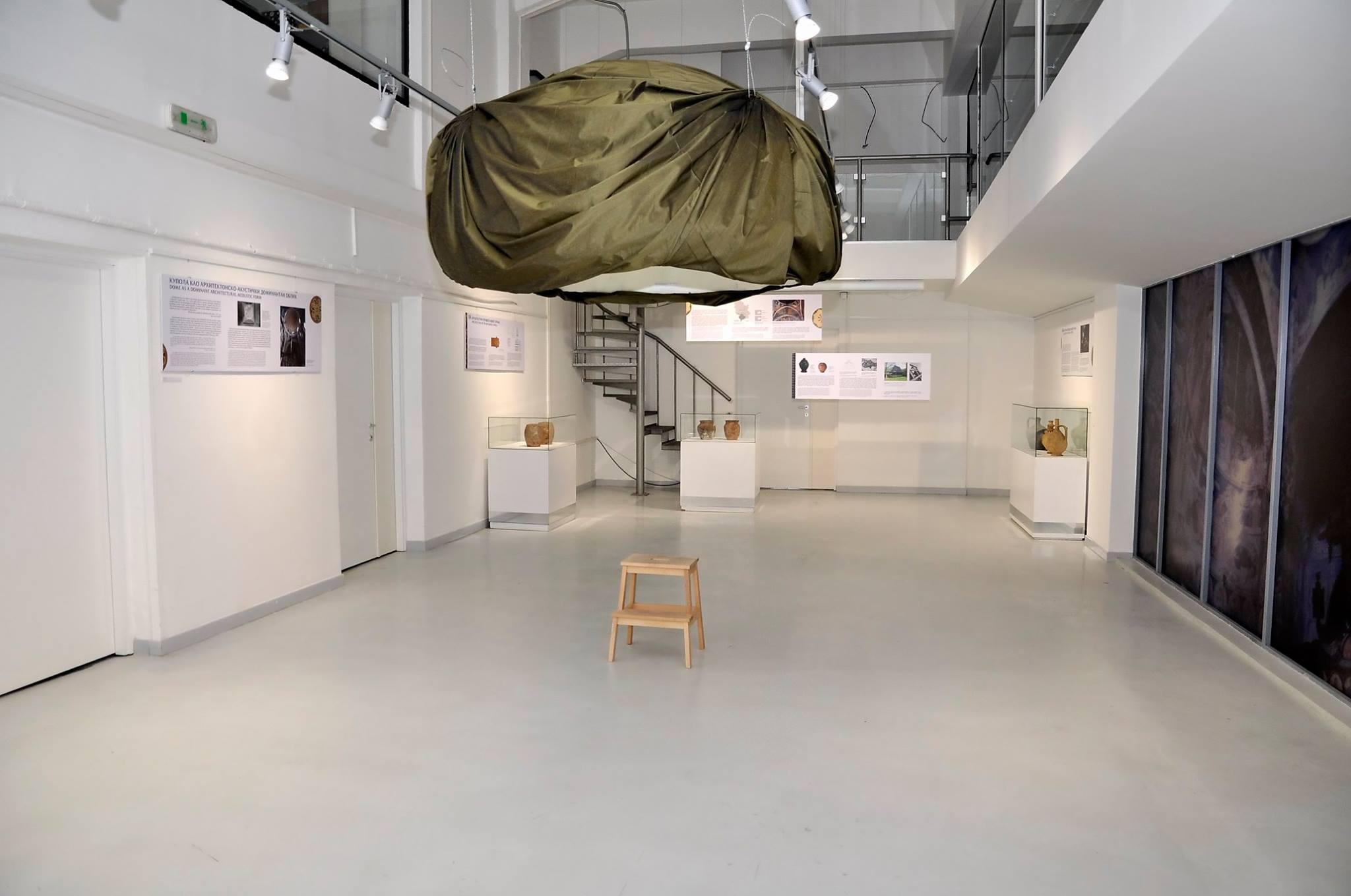
Centerpiece dome model. Photo: Miloš Jurišić.

How visitors interacted with the central dome. Photo: Miloš Jurišić.

How visitors interacted with the central dome. Photo: Miloš Jurišić.
Within the Byzantine worldview, the earthly and celestial liturgies are concelebrated, with humans and angels sharing the church space during the Divine Liturgy. This belief is not merely symbolic, but also reflected in the behavior of sound itself. Chanting does not simply occupy space but activates it. Sound rises, reflects off the dome, and cascades downward, creating the impression that voices emanate simultaneously from above and below, from heaven and earth (Gerstel et al. 2021; Gerstel 2015). This subtle acoustic effect can only be fully perceived within the liturgical setting itself. Once such an acoustic phenomenon is removed from the ritual space and relocated to a museum, it inevitably becomes simplified. Detached from its original context, the acoustics lose their cultic value. Yet this very detachment signals the emergence of what Walter Benjamin (2008) calls exhibition value: acoustic heritage becomes something to be displayed, circulated, and studied rather than lived as a medium of worship or contemplation. Benjamin’s framework helps articulate the shift from lived, sacred acoustic experiences (rich in aura and tied to cultic value) to its research-based, museological representation. When an exhibition attempts to reactivate historical acoustics, it must negotiate between these two poles—seeking to evoke something of the original aura while simultaneously translating it into a reproducible, public, and pedagogical form.
*
For the first time, the exhibition brought together and displayed all known acoustic vessels extracted from medieval Serbian churches (Đorđević et al. 2017). These ceramic objects were embedded within the thick masonry of church walls and domes, presumably to shape or enhance the acoustic environment. Found in sacred architecture across Europe and parts of Asia, acoustic vessels have been variously interpreted as resonators, absorbers, or symbolic elements, and their functional role remains unclear (Palazzo-Bertholon and Valière 2012).
Because these vessels were typically installed high above ground—embedded in walls or domes and visible only as small circular openings among vividly painted frescoes—the exhibition offered a rare opportunity to bring them into full view, freed from their architectural concealment. Detached from their original context and reassembled within an exhibition display, they become objects of knowledge rather than components of lived ritual practice (Bennett 1995). However, in Archaeoacoustics we placed the acoustic vessels under glass, preventing visitors from engaging with them sonically. In our enthusiasm to present the whole corpus of available vessels, we underestimated the risk that visitors who did not read the accompanying texts would perceive them simply as inert ceramic objects.

Acoustic vessels as they were exhibited in the museum. Photos: Miloš Jurišić.

A close-up of acoustic vessels from two churches. The black vessel on the left has a pierced hole in its bottom, emphasising its acoustic purpose. Photo: Miloš Jurišić
In retrospect, the exhibition should have adopted a strategy similar to that used for the dome: an interactive model that visitors could explore independently, allowing the vessels’ acoustic effects to be perceived intuitively rather than explained discursively. Such an approach would have enabled visitors to see how medieval builders integrated the vessels into masonry structures, to hear how they respond when tapped or spoken into, and to observe how their acoustic behavior varies according to size and shape. This kind of experiential knowledge cannot be gained within the church itself, where the vessels remain visually inaccessible and acoustically inseparable from the overall reverberant environment. As sound studies scholars have noted, sonic phenomena are most effectively communicated through embodied engagement rather than visual display alone, because architectural acoustics shape perception, emotion, and behavior only through lived, experiential encounter (Blesser and Salter 2007). When reduced to a static visual display, acoustic heritage therefore loses much of its communicative power.
In this sense, the exhibition functioned as a space of analytical exposure, transforming hidden architectural elements into legible acoustic artifacts. This aligns with broader museological debates about the role of exhibitions as sites of epistemic reconfiguration, in which objects are removed from their original contexts in order to make particular forms of knowledge perceptible (Kirshenblatt-Gimblett 2007; Bennett 1995). By isolating and foregrounding the acoustic vessels, the exhibition enabled a form of acoustic literacy that is unavailable in situ, even as it inevitably reframed these objects outside their original liturgical and architectural settings.
*
The largest share of the exhibition budget was allocated to an interactive listening station that allowed visitors to hear how the same Byzantine chants would sound in churches of different sizes, shapes, and construction materials. By listening to identical chants transformed by the acoustics of distinct architectural spaces, visitors could directly sense and compare the acoustic differences between churches. The installation was produced using a rigorous scientific methodology: each church’s acoustic fingerprint was captured in situ through impulse response measurements, which then served as the basis for auralizing pre-recorded Byzantine chants. In this way, the same chants could be experienced as they would resonate in various historical spaces.
The listening station was conceived as a self-guided experiment, inviting visitors to actively compare church acoustics rather than passively receive information. Its purpose was not only educational but also critical: to challenge the widely held assumption that medieval Serbian churches possess uniformly “magnificent” acoustics. To interrogate what such claims might mean in acoustic terms, the installation presented four churches with interior volumes ranging from approximately 400 to 4,000 cubic meters, encompassing both the smallest and the largest surviving medieval Serbian churches.3 At the exhibition, visitors’ responses to these listening tests were not systematically recorded. Only later did it become apparent that the listening station could have functioned as a valuable tool for gathering insight into how audiences perceive church acoustics when sound is isolated from other sensory inputs, such as visual and olfactory cues. This realization raises an important question: could visitors become active participants of a scientific experiment, using the exhibition itself as a laboratory for acoustic perception?
Recent curatorial theory increasingly understands exhibition-making as a form of research—one that generates knowledge through spatial, material, and sensory configurations rather than through discursive argument alone (Bjerregaard 2020). To curate an exhibition, particularly one concerned with acoustic heritage, is to think through space and experience, allowing research questions to unfold through perception, movement, and listening (Obrist 2008). From this perspective, an acoustic heritage exhibition should not merely represent knowledge but perform it, enacting new modes of understanding through embodied encounters (Hantelmann 2010). Curating thus becomes a form of inquiry grounded in collaboration: between researchers and audiences, between scientific methods and curatorial concepts, and between tangible artifacts and intangible phenomena (Möntmann 2006).
Accordingly, the exhibition can be understood as an experimental practice in which knowledge and experience are generated through the act of exhibiting rather than merely communicated as fixed content. In Archaeoacoustics, knowledge emerged not prior to the exhibition, but through curatorial experimentation, sensory engagement, and reflexive practice in the aftermath.
3 For comparison, Chartres Cathedral has approximately 100,000 cubic meters, while Duomo di Milano has approximately 440,000 cubic meters. Although far smaller than the medieval cathedrals in Western Europe, Serbian church architecture was developed to accommodate the monophonic Byzantine chanting and Orthodox religious services.
Žiča Monastery (13th century)

Manasija Monastery (15th century)

Wooden church in village Brzan (19th century)
Click on each photograph to play the auralizations. Use headphones: these are binaural recordings, and only headphones reproduce the intended 3D spatial effect. You will hear an excerpt of a chant performed by the male Serbian Byzantine choir “Mojsije Petrović.” Byzantine chant is monophonic (a single shared melody) and supported by the ison, a sustained drone on a single pitch.
Listen in a quiet environment and let your attention shift from the music to the space. Begin by listening briefly to each file to compare its acoustic character. You may perceive one church as clear, another as reverberant and warm, and a third as very dry and close. These impressions reflect the real acoustic properties of the spaces.
Then listen to each track in full. Pay special attention to the moment when the choir stops singing. The fading resonance reveals the church’s acoustic signature. Notice also how the ison adds depth and makes the interaction between voice and architecture more perceptible.
The key question you should focus on is: how does the space sound through the chant?
Hartmut Rosa’s concept of resonance offers a productive framework for understanding how an acoustic heritage exhibition can enable meaningful encounters with the past without claiming to reproduce historical experience. For Rosa, resonance is a bodily mode of relating to the world that unfolds through four interrelated moments: affection, in which something touches us from the outside; response, through which an emotional or corporeal connection is established; transformation, in which the subject is altered by the encounter; and an intrinsic element of unpredictability, since resonance can never be fully produced or controlled (Rosa 2019). Resonance, in this sense, remains elusive: it can be invited, but never guaranteed.
The Archaeoacoustics exhibition sought to create conditions for such resonance rather than deliver fixed meanings or stable reconstructions. For instance, when visitors chose to vocalize within the plaster dome model, sound returned to the body in an unfamiliar way, opening a dialogical relationship between voice, space, and listener. At the same time, the reluctance of many visitors to use their voices underscores Rosa’s central claim that resonance, understood as a relational mode of engagement, cannot be engineered (Rosa 2019). Similarly, the interactive listening station enabled affective and emotional engagement through comparative listening, allowing visitors to hear how identical chants were transformed by different architectural acoustics. Although mediated, this encounter had transformative potential, challenging assumptions about medieval church acoustics while preserving resonance’s inherent unpredictability. Instead of reconstructing medieval acoustics as a stable or immersive reality, the exhibition approached sound as a process that emerges through interaction, comparison, and embodied listening. In this sense, the semantron, plaster dome, and listening station functioned not as representations of the past, but as tools for sounding it anew—foregrounding the interpretive, speculative, and transformative nature of acoustic heritage.
Although an acoustic heritage exhibition can never fully recover the auratic, spiritual dimensions of historical acoustics, it can still generate meaningful encounters by fostering responsive, embodied relationships with sound. Resonance reframes the exhibition not as a site of reproduction or loss, but as a space of possibility—where acoustic heritage is neither preserved intact nor dissolved into abstraction, but activated through contingent, experiential encounters. Curating resonance thus becomes a form of research that operates at the intersection of art, science, and spirituality, producing knowledge not before the exhibition, but through the unpredictable resonances it sets in motion.
While resonance foregrounds visitors’ experiential and contingent engagement with sound, the translation of acoustic phenomena from ritual spaces into the museological setting highlights the institutional and epistemic transformations involved in curating acoustic heritage. This shift of context prompts questions about aura, mediation, and the cultural classification of sound, revealing what is lost, gained, or reconfigured when historical acoustics are exhibited.
Video of a nun playing semantron in Žiča Monastery.
Understanding the exhibition as a mediated, experimental, and resonant engagement with the past also situates it within a broader landscape of archaeoacoustic practices that seek to reach audiences beyond the academy. In recent years, scholars and artists alike have developed diverse strategies for translating medieval acoustic heritage into experiential formats. These efforts share a common challenge with acoustic heritage exhibitions: how to present historically situated architectural acoustics without collapsing them into fixed or totalizing claims of authenticity.
One influential example is Icons of Sound, a project exploring the acoustics of the aforementioned sixth-century Hagia Sophia in Istanbul. Central to debates on the reactivation of acoustic heritage outside its original liturgical context, the project addresses contemporary constraints on live vocal performance within the monument by employing real-time convolution based on onsite measured impulse responses. This allowed live Byzantine chanting to sound as if it were performed within the sixth-century cathedral, even though it was performed in a concert hall on another continent. Although removed from their original architectural context, such research-based performances create a collective, spatially immersive experience that highlights both historical investigation and contemporary interpretation (Pentcheva and Abel 2017).
Virtual and mixed-reality technologies have further expanded the reach of archaeoacoustics to broader audiences through animated films and mobile applications. The project The Past Has Ears at Notre-Dame examines changes in the historical acoustics of the Notre-Dame cathedral in Paris and their influence on musical practices from the twelfth to the twentieth century. These findings are communicated through the animated film Vaulted Harmonies (Poirier-Quinot et al. 2025) and the mobile app Ekko of Notre-Dame de Paris, which offers research-based reconstructions of historical soundscapes as immersive, geolocated audio experiences. By combining scientifically grounded acoustic modeling with narrative storytelling, the app enables users to engage with the cathedral’s sonic past through embodied, site-specific listening (Katz et al. 2024).
Finally, the upcoming exhibition The Reverse Journey. A Sonic Fresco of Romanesque Art will open at the Museu Nacional d’Art de Catalunya (MNAC) in Barcelona in November 2026 (Museu Nacional d’Art de Catalunya 2025). It aims to bring the soundscapes of medieval sacred sites to wider audiences by situating acoustic experience within the museum’s Romanesque collection. MNAC houses one of the most important ensembles of medieval mural painting in Europe, including apse frescoes from sites such as Sant Maria d’Àneu and Sant Climent de Taüll. Removed from their original walls using the strappo technique—by which only the painted layer is detached, leaving the underlying plaster in situ—the frescoes were transferred to the museum between 1919 and 1923 in response to growing concerns over their preservation in rural contexts. As a result, they were separated from their original architectural and sensory environments and subsequently mounted on new supports for exhibition, even as the museum spaces were arranged to evoke aspects of their former spatial configurations. In The Reverse Journey, sonic installations placed within selected apses invite visitors to actively seek out and engage with sound. As the curator Ona Balló notes, the sounds associated with each apse are drawn from the original churches, not as archaeological reconstructions, but as sonic materials that continue to exist there today. Their selection foregrounds the aged, resonant qualities of these sound environments, allowing acoustic heritage to be encountered as a mediated, temporal presence rather than as a reconstructed past (email communication).
Taken together, these initiatives reveal a growing interest in activating acoustic heritage not as a recoverable past, but as a resonant relation in the present. Architectural forms, impulse responses, audio recordings, and digital acoustic models do not function as ends in themselves, but as mediators that shape how sound is encountered, felt, and interpreted.
The exhibition that once emerged from my archaeoacoustic research has become a guide to it—a reminder that curatorial practice and scholarly inquiry are not separate pursuits, but two voices within the same resonant field. Returning to the initial question of what it means to exhibit something as elusive as acoustics, it becomes clear that such exhibitions do more than translate space into sound. Instead, they create conditions under which new forms of research questions and resonances can emerge.
Situated at the intersection of tangible and intangible, acoustic heritage exhibitions enable diverse audiences to apprehend both the richness and the vulnerability of historical sound worlds. Through embodied listening, comparison, and interaction, visitors encounter sound not as a stable historical object, but as a contingent phenomenon shaped by architectural, material, and cultural conditions. In this process, the exhibition itself functions as a resonant chamber: a space that not only amplifies acoustic phenomena but also exposes their limits, uncertainties, and transformative potential. Exhibition-making thus operates not merely as a mode of research dissemination but as a site of knowledge production in which resonance emerges through unpredictable, situated encounters.
From a methodological perspective, this approach reframes archaeoacoustic research as an ongoing process that extends beyond documentation and modeling toward activation, mediation, and experiential inquiry. This opens productive trajectories for future work, in which exhibitions, performances, and digital platforms function as experimental laboratories for testing hypotheses, refining methods, and exploring how historical acoustics are perceived, negotiated, and transformed in the present. In this sense, acoustic heritage exhibitions do not conclude archaeoacoustic research; they allow it to linger, reverberate, and evolve—across disciplines, publics, and modes of listening.
Alvarez-Morales, Lidia, Neemias Santos Da Rosa, Daniel Benítez-Aragón, Laura Fernández Macías, María Lazarich, and Margarita Díaz-Andreu. 2023. “The Bacinete Main Shelter: A Prehistoric Theatre?” Acoustics 5 (1): 299–319. https://doi.org/10.3390/acoustics5010018.
Benjamin, Walter. 2008. The Work of Art in the Age of Its Technological Reproducibility, and Other Writings on Media. Edited by Michael William Jennings, Brigid Doherty, and Thomas Y. Levin. Harvard University Press.
Bennett, Tony. 1995. The Birth of the Museum: History, Theory, Politics. Culture : Policies and Politics. Routledge.
Bjerregaard, Peter, ed. 2020. Exhibitions as Research: Experimental Methods in Museums. Routledge Research in Museum Studies 29. Routledge.
Blesser, Barry, and Linda-Ruth Salter. 2007. Spaces Speak, Are You Listening? Experiencing Aural Architecture. MIT Press.
Díaz-Andreu, Margarita. 2025. “Archaeoacoustics: Research on Past Musics and Sounds.” Annual Review of Anthropology 54 (1): 113–30. https://doi.org/10.1146/annurev-anthro-071323-113540.
Díaz-Andreu, Margarita, and Neemias Santos da Rosa, eds. 2024. Exploring Ancient Sounds and Places: Theoretical and Methodological Approaches to Archaeoacoustics. Oxbow Books.
Đorđević, Zorana, Lidia Alvarez-Morales, and Dragan Novković. 2025. “Sonic Heritage of Medieval Bells from the Valdres Region of Norway.” Heritage 8 (9): 359. https://doi.org/10.3390/heritage8090359.
Đorđević, Zorana, Xavier Costa-Badia, Natalia González Vázquez, and Lidia Alvarez Morales. 2024. “Unveiling the Historical Significance of Santa Maria d’Àneu: Can Soundscape Studies Illuminate Its Role within the Medieval Ecclesiastical Structure?” Studia Universitatis Hereditati 12 (2): 65–84. https://doi.org/10.26493/2350-5443.12(2)65-84.
Đorđević, Zorana, Dragan Novković, and Uroš Andrić. 2019. “Archaeoacoustic Examination of Lazarica Church.” Acoustics 1 (2): 423–38. https://doi.org/10.3390/acoustics1020024.
Đorđević, Zorana, Kristina Penezić, and Stefan Dimitrijević. 2017. “Acoustic Vessels as an Expression of Medieval Music Tradition in Serbian Sacred Architecture.” Muzikologija, no. 22: 105–32. https://doi.org/10.2298/MUZ1722105D.
Farina, Angelo. 2001. “Acoustic Quality of Theatres: Correlations between Experimental Measures and Subjective Evaluations.” Applied Acoustics 62 (8): 889–916. https://doi.org/10.1016/S0003-682X(00)00082-7.
Fazenda, Bruno, Chris Scarre, Rupert Till, et al. 2017. “Cave Acoustics in Prehistory: Exploring the Association of Palaeolithic Visual Motifs and Acoustic Response.” Journal of the Acoustical Society of America 142 (3): 1332–49. https://doi.org/10.1121/1.4998721.
Gerstel, Sharon. 2015. “Monastic Soundscapes in Late Byzantium: The Art and Act of Chanting.” In Resounding Images: Medieval Intersections of Art, Music, and Sound, edited by Susan Boynton and Diane J. Reilly. Studies in the Visual Cultures of the Middle Ages 9. Brepols.
Gerstel, Sharon, Chris Kyriakakis, Spyridon Antonopoulos, Konstantinos T. Raptis, and James Donahue. 2021. “Holy, Holy, Holy: Hearing the Voices of Angels.” Gesta 60 (1): 31–49. https://doi.org/10.1086/712644.
Girón, Sara, Lidia Álvarez-Morales, and Teófilo Zamarreño. 2017. “Church Acoustics: A State-of-the-Art Review after Several Decades of Research.” Journal of Sound and Vibration 411 (December): 378–408. https://doi.org/10.1016/j.jsv.2017.09.015.
Hantelmann, Dorothea von. 2010. How to Do Things with Art: What Performativity Means in Art. With Freie Universität Berlin. Documents Series 4. JRP/Ringier.
Iannace, G., C. Ianniello, L. Maffei, and R. Romano. 2000. “Objective Measurement of the Listening Condition in the Old Italian Opera House ‘Teatro Di San Carlo.’” Journal of Sound and Vibration 232 (1): 239–49. https://doi.org/10.1006/jsvi.1999.2696.
Katz, Brian F.G., Cécile Cros, Stéphanie Peichert, and Julien De Muynke. 2024. “The Past Has Ears at Notre-Dame: Acoustic Digital Twins for Research and Narration.” Digital Applications in Archaeology and Cultural Heritage 34 (September): e00369. https://doi.org/10.1016/j.daach.2024.e00369.
Kirshenblatt-Gimblett, Barbara. 2007. Destination Culture: Tourism, Museums, and Heritage. University of California Press.
Manzetti, Maria Cristina. 2018. “An Interdisciplinary Approach for the Study and the Valorization of the Roman Theatres of Crete.” PhD Thesis, Technical University of Crete, School of Architecture.
Möntmann, Nina, ed. 2006. Art and Its Institutions: Current Conflicts, Critique and Collaborations. Black Dog Publishing.
Museu Nacional d’Art de Catalunya. 2025. “Programa 2026.” Museu Nacional d’Art de Catalunya. https://www.amicsmuseunacional.org/wp-content/uploads/2025/12/PROGRAMA-2026-MNAC_CAST.pdf.
Obrist, Hans Ulrich. 2008. A Brief History of Curating. Documents 3. JRP-Ringier les Presses du réel.
Palazzo-Bertholon, Bénédicte, and Jean-Christophe Valière, eds. 2012. Archéologie du son: Les dispositifs de pots acoustiques dans les édifices anciens. Bulletin Monumental, Suppl. 5. Picard.
Pentcheva, Bissera V., and Jonathan S. Abel. 2017. “Icons of Sound: Auralizing the Lost Voice of Hagia Sophia.” Speculum 92 (S1): S336–60. https://doi.org/10.1086/693439.
Poirier-Quinot, David, Jean-Marc Lyzwa, Jérôme Mouscadet, and Brian F. G. Katz. 2025. “Vaulted Harmonies: Archaeoacoustic Concert in Notre-Dame de Paris.” Acoustics 7 (4): 66. https://doi.org/10.3390/acoustics7040066.
Reznikoff, Iegor, and Michel Dauvois. 1988. “La Dimension Sonore Desgrottes Ornées.” Bulletin de La Société Préhistorique Française 85 (8): 238–46.
Rosa, Hartmut. 2019. Resonance: A Sociology of Our Relationship to the World. Translated by James C. Wagner. Polity Press.
Scarre, Christopher, and Graeme Lawson, eds. 2006. Archaeoacoustics. McDonald Institute Monographs. McDonald Institute for Archaeological Research; distributed by the David Brown Book Co.
Till, Rupert. 2019. “Sound Archaeology: A Study of the Acoustics of Three World Heritage Sites, Spanish Prehistoric Painted Caves, Stonehenge, and Paphos Theatre.” Acoustics 1 (3): 661–92. https://doi.org/10.3390/acoustics1030039.
Zorana Đorđević, “Resonance and Silence: Displaying Acoustic Heritage”, Metode (2026), vol. 4, ‘Exhibition as Method’