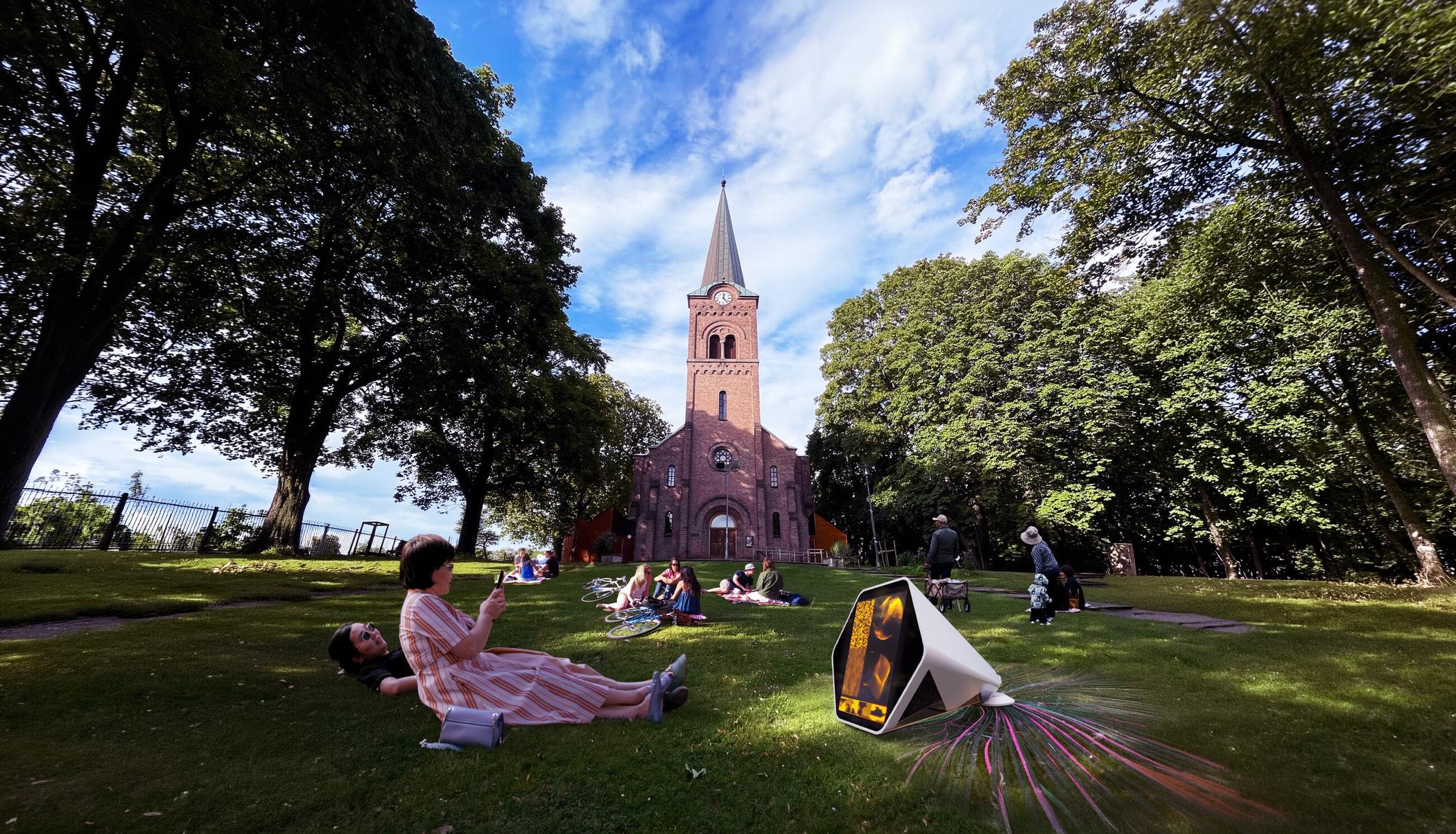
The Sadar in front of Sofienberg Kirke, Oslo.
To the reader:
The following documents have an archival span of nearly 1,200 years (2089 CE–3278 CE). While linguistic drift and the emergence of hybrid communication systems render “pure” English obsolete by the mid-2100s, our attempts to maintain archival convention requires us to maintain standardization. To ensure timeline coherence, what you see here are the translations of the original archival records in their respective languages into 21st century Internet English.
2089 CE — the signals
- DOCUMENT TYPE
- Audio transcript recorded at the 2089 CE Annual Global Citizen’s Climate Assembly (GCCA) for the proposed Advanced Sadar Network and Sadar Archivist Programme (the creator compiled or maintained by the parent series, Soil Archivist Training Module, between 2091 and 3278 CE) [SDiR/RS-102]
- Access
- Public access
- Use
- Unrestricted
- Date
- 12 July 2089 CE
- Location
- Kinshasa City-State, Annual Global Citizen’s Climate Assembly (GCCA)1
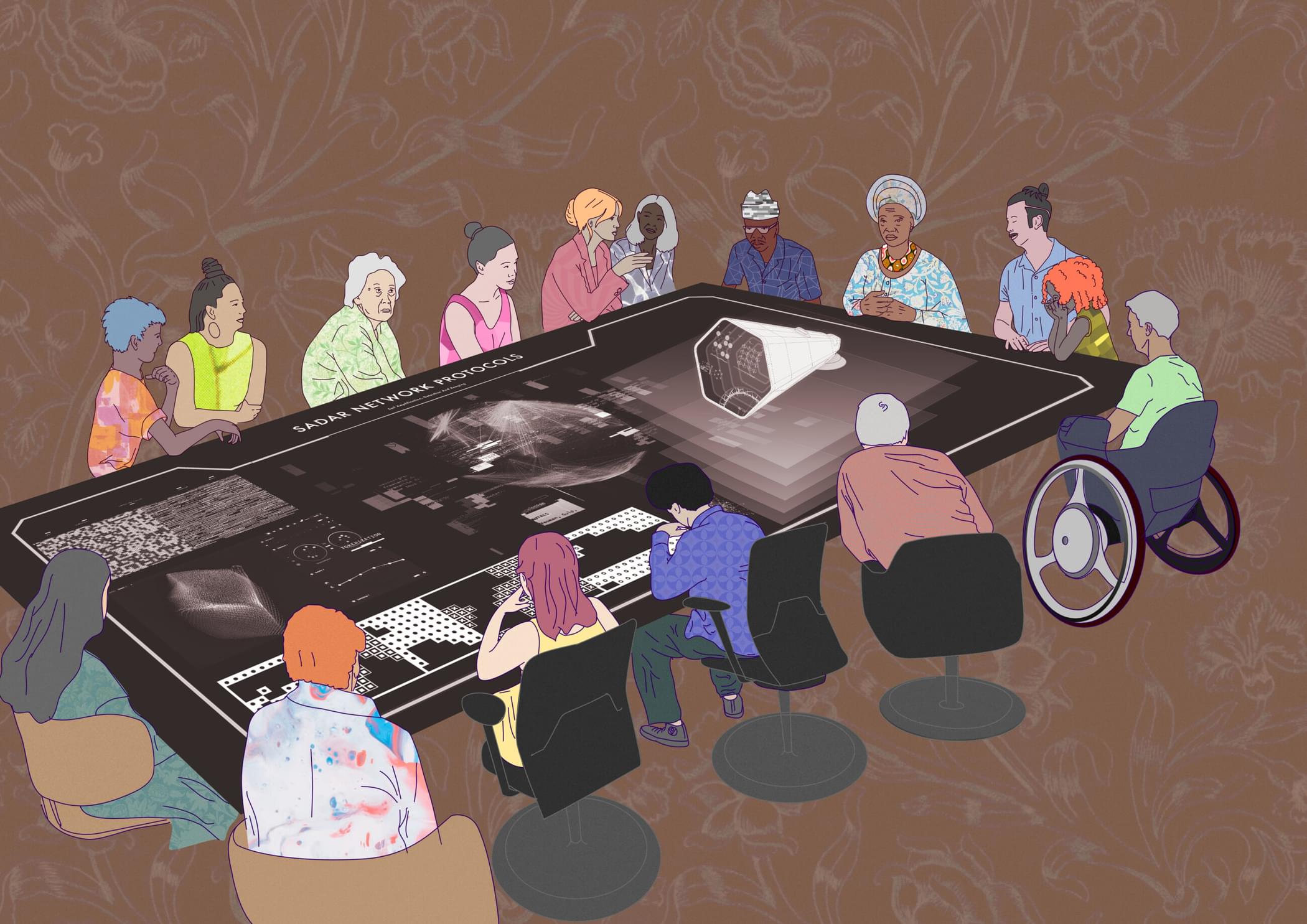
Members of the Assembly. It is a privilege and an honour to be here among you. I am Refique Serane, member of the Kinkala Fabrication Syndicate, a soil microbiologist in charge of the sadar protocols for Kinshasa. I am no stranger to speaking at GCCAs—I’ve led many in my younger days, my first was in Mombasa at the height of the climate reparations movement. It is lovely to see the energy and spirit of the citizen assemblies alive and well. I do miss it, although my age has caught up with me. I feel I cannot keep up, not only because of the heatwave that kept me up last night, but because Kinshasa GCCA is a trial by fire in the world of global climate policy.
You have a reputation in trying to do whatever it takes to right the many wrongs of our ancestors who chose for us a path of ecological annihilation. I know this is why the world has looked up to your inter-generational GCCAs, especially the children and teenagers seated here with the elders who have vetoed the many attempts by slick and corrupt politicians to hoard administrative power. In the past decade, only the most radical climate and economic reforms for the people and the land have been passed, with politicians and civilian administrators scrambling to please this council and prove their worth to these diverse coalitions of Indigenous and peasant farmer-led stewardship groups who wanted to see improvements in the climate-ravaged Kinshasa and the surrounding Mpumbu region. But I also know you love to make anyone seeking power go through the most humiliating purity rituals. Learning from you, the GCCAs all over the world are a graveyard for career politicians and wannabe kings everywhere.2
I am here today with this proposal because around a decade ago, I along with my longtime friend and collaborator, the chair of this GCCA, Dikembe Farnana, were invited to test out the soil radars—or sadars, as we call them—in the field, with the citizen labs of Xam Neua GCCA, who were using it to “sense” and map the soil sub-surface life. They are still the best real-time, non-invasive tool to monitor the sub-soil microbial network with hyperspectral microscopic scale precision. It is essentially a breakthrough device that could read the biophotonic3 light signatures that microbes emit in their protein interactions with each other. With sensitive enough sensor designs, it was possible to scan and create mycotomographic maps of the Earth’s deep soils up to 200 km by simply monitoring these complex living soil activities.
Sadars, as you have been debriefed, are part of the movement for the intentional Technologies of Care (TOC) protocol for technology innovation we follow in Kinkala based on the principles of the Mutually Assured Thriving (MAT) Treaty.4 The sadar project first began in 2079 CE, in the Xam Neua Climate Resilience Zones (CRZs), and were designed to better monitor the soil health of the abundant urban food forest programmes in the city-state. The CRZs are vital to food security, helped shelter humans and non-humans from the seasonal climatic instabilities in the urban fabric, and were sites of testing advances in ecological material fabrication protocols. You all know how important sadars are for our terrestrial soil ecosystem monitoring. They are critical infrastructure for food and material supply chain security, but in the past year or so, they have started to malfunction. Their sensors seem to have become unreliable – there are cross-channel interferences in their signals and glitches that could not be explained, not just in Xam Neua but across the world.
There are currently just as many theories to explain the glitches as there are sadars, everything from microbial sabotage, software malfunction and leaky hydraulics to rodent infestation, rogue nation-states and radio frequency jamming. None have come close to a clear answer. For nearly five years now, working from the nearby Kinkala fabrication syndicate and together with partners from Xam Neua and the Hong Kong CRZs, we may have finally figured out what the glitches in the sadars are and what their implications would be. Allow me to paint you a picture.
The universe is a vast place. For eons, the cosmos and its vastness seemed insurmountable to us. To us, space may be lonely and our place in it uncertain, but look closer and we are surrounded by articles like neutrinos buzzing about, undisturbed by matter. They have no business with matter, only one or two weak interactions, if they feel like it. Or so we thought. Turns out … there is a whole genus of mycelium, gnoconoccia interra—a whole ecosystem of extremophile microbes deep, deep under the earth’s crust that have been able to “sense” these neutrinos from across distant galaxies and stars, even gravitational waves that our soil radar systems have been sensing in the spectral signatures we have been picking up from the deep soils. The frequency of these signals is generational, and according to the calculations, not predictable either. But there is a pattern. It might be centuries before we either get to higher sensitivity instruments or we get signals strong enough to be detected on these distributed sensors. But rest assured, the signals are legitimate.
Ever since the Kessler event,5 the skies have been closed to us for space exploration, with high velocity space debris and deadly shrapnel that has simply shred anything our space programmes send up. But what if we don’t have to straitjacket our ambitions for space exploration? What if I told you that there was another way to the cosmos, and all we would have to do is to look under our feet, through the soil below. With enough synchronised sadars networked across the world, we can create a colossal planetary neutrino telescope. And with it we can map extremely far reaches of the universe but also continue to develop our agroforestry programmes. It would be a win-win!
However, there remains a catch. According to our estimates, even if we deploy enough sadars across the old-growth CRZs, these signals will far outlive us, and our capacity to process them will be limited. Let’s put it this way: the signals we are receiving are merely the foam riding the waves in an endless ocean of subsurface activity. This is what the glitches in the sadars are! The signals have been there in plain sight, ever since we installed the sadars decades ago to map the world underneath our feet. The deep soils have been sensing these signals from outer space all along, and we just rounded them off as noise. But since the signals are just too complex and layered, the sadars’ filter circuits were never designed for this purpose. On their own, the existing instruments are sensitive enough to monitor our agroforestry sectors’ soil health in real time, but our team of fabricators at Kinkala can retrofit them with soil neural processors to better analyse the signals.
Members of the assembly, my syndicate would like to propose an expansion of the sadar programme and institute human stewards to develop Deep Sensing and Discovery Protocols (DSDPs) across the sadar network to understand how is it that the soil is not only alive but is in conversation with interstellar signals.
We have every reason to believe that these instruments, along with the fact that neutrinos are interacting with the soil’s living matter at more rapidly accelerating rates than ever before, will provide us far better data for mapping the known solar system and then beyond. For this we need, three things: first, we need to expand the sadar networks and preserve the CRZs for the foreseeable future; second, we need to institute a Sadar Archivist Programme to preserve and document these signals for the foreseeable future generations; and third, we need funding to develop a research centre to study neutrino-biome interactions. Even if we do everything right, we don’t even know if we can trust these signals for any form of serious neutrino-astronomy, but that is a risk we must take. It will only work if these instruments are distributed enough and always stewarded, and needless to say we have to find new ways to sustain our agroforestry programmes without damaging the soils and our terrestrial landscapes that would essentially be sensor nodes in this network.
I know this is a lot to ask of you. As you may have seen in the briefing notes, it is not an inconsequential amount of resources you would have to allocate either. Maybe you are thinking: “Why pursue such a moonshot for an uncertain hopeful future, when our world is on fire, right here right now?” I am not here as a politician or an elder seeking power, and I know my politics is not on trial here. My heart remains in the soils, in the field where I belong, talking to the land, touching the mulch in the agroforestry belt, testing and sampling the microbes in the regenerated lands. I wouldn’t be asking you this if I didn’t truly believe that this programme is the best shot we have for preserving whatever is left of the fragile lands we are fighting for. I am sure those of you seated here have realised by now how important your decision today will be to the climate action caucuses across the world. I am aware you have a reputation to maintain, and I will not pretend that is an easy ask either, but I know that if the Kinshasa GCCA refuses this proposal, there is no other GCCA that will dare touch it.
“A yes from Kinshasa is a yes from all, a ‘no’ from Kinshasa and you’re on your own.”
2131 CE — a periscope
- DOCUMENT TYPE
- Archival note (the creator compiled or maintained by the parent series, Soil Archivist Training Module, between 2091 and 3278 CE) [SDiR/IP-441]
- Access
- Public access
- Use
- Unrestricted
- Date
- 22 October 2131 CE
- Location
- Open Design Society, Centre for ReFuturing Studies (CRFS), Oslo
I just got back from Kinshasha last week. I absolutely adored the commute on the solar metro and the neighbourhood pathways littered with food forests, but for me the goal was to visit the memorial of the great Mama Refique at the Kinkala Fabrication Syndicate campus (as per Mama’s last wishes that she wanted to be buried next to it, so she would always be around to read the data). The current archivist, Edono Mombana, told me that towards the end of her life Mama informed him that the signals had become stranger, so that even the comprehensible signals are now rendered incomprehensible. He has taken it upon himself to investigate one of Mama’s last notes that abruptly ended with: “What if it is a periscope?! While we soil stewards stare into the subsurface, the sadars are also used by beings from the underworld to stare back at us! Subsurface life looking into the surface world. We accidentally labelled them as glitches, but they were not glitching! These seem like signals of another kind.”
While Edono investigates Mama’s final note, I head to Oslo to honour Mama’s final wish and visit the Open Design Society in Oslo, where the first sadar prototype remains preserved in their design archives. This is where it all began, the glitches, the mysteries, all of it. This is where the first sadar was conceptualised, designed and tested. I’m hoping to study the first sadar prototype so that I can find clues as to the source of the glitches. It’s a bit embarrassing to me that I’ve used and worked with sadars all my life but could never visit the society to see the first version. I’m meeting my hosts at the Centre for ReFuturing Studies (CRFS) where Jomy Joseph’s team6 developed these sadars nearly a century ago and syndicated them across the world. I’m meeting Suelu Råmman, a Skolt Sámi and the lead researcher who’s been managing the centre and is helping me with the signal glitches. It was Suelu who, as a young graduate student on a visit to Xam Neua, met with Mama and discovered the connection between the signals from the neutrino interactions with the unknown microbes in the deep soils. Her work led to entire alien ecosystems being lit up hundreds of miles below our feet. At the centre, Suelu’s team have now built sadar neutrino-maps of neutron star mergers, black hole interactions far earlier than visible to the surface telescopes and in far greater detail than previously thought possible.
I’ve requested permission from the centre’s librarian to take copies of some of the archival notes at the CRFS in the hope of finding clues to understand the sadar glitches, although my visit couldn’t be more inconvenient. I have been here a month, but all the resident researchers were occupied with the proceedings of their special issue journal.7 I was hoping to discover the answer to the signal glitches and why the glitches change their spectral signature with any movement in front of the sadars. No one I talked to can seem to explain why this is happening, and not even Joseph, who first conceptualised them a century ago, offers any explanation in his archival notes. The man was chaotic at best, and his sketches and notes are just as glitchy as the sadar signals, with some useful nuggets here and there. I have found more clarity in two notes from his diaries. The first is a note in his field journal from a century ago, and the second is his last correspondence over the meshnet with Mama, around four years before he passed away, where he tried to explain the glitching in the sadar signals:
I’ve sent these two notes to Edono, who doesn’t think there’s too much in them to bother. It’s not empirical enough for him. But the way I see it, both Joseph’s memory interface and Mama’s “soil periscope” analogy are possibly pointing to the Many Minds Interpretation (MMI)12 of consciousness. I suspect they implied that it is true not just for humans, but for deep soil species too, or any of the non-ordinary states of living soils. These trillions of species of microbes and superspecies of microbial dark matter have been evasive to our comprehension, even in the most controlled and pristine clean rooms in the lab. In the field, things are exponentially more complex, for they lead alien lives compared to us surface dwellers. If I allow myself the fantasy and say this were true, it will revolutionise neutrino-mycotomography13 and the study of relationally mapping the cosmos through the Earth’s deep soils. I can’t even imagine the kinds of details—the hyper-spectral soil-sensing studies of the earth’s deep biosphere, hundreds of kilometres deep—that will come out of this. I don’t think we are prepared for what this means.
2267 CE — the new minds
- DOCUMENT TYPE
- Thoughtscript14 (the creator compiled or maintained by the parent series, Soil Archivist Training Module, between 2091 and 3278 CE) [SDiR/HM-13012]
- Access
- Public access
- Use
- Unrestricted
- Date
- 12 July 2267 CE
- Location
- La Paz Autonomous Zone
“Who are you?” the Prima Soils initiates the thoughtscript synchronisation.
“I am Hållumar urf Mikwa, the seventh of the soil rangers from the Masisi lands. I am a soil ranger, and we are here to archive our conversations with you, the intra-terrestrial sub-surface beings from planet Earth. It is a pleasure to sense you all.”
“Who are you?” the Prima Soil speaks again.
“I am Mikwa spirit kin.” I need to remind the Prima Soil my name for it to latch on to a memory, recognise it and then accept me again. This is both our greeting and acknowledgement of the bond we have.
The multitudes peer into our world, just as we peer into theirs. I feel strange to know that I am being sensed by multitudes, alien to what us surface beings are accustomed to. Despite what this means for our conception of ourselves, we must learn to co-exist with these curious beings. They mean us no harm. Nevertheless, every session with them is tedious. We cannot use our usual forms of communication, we can only sense them through memory and they sense us back, although memory can be a tricky thing under the surface. Since those I sense are not one creature but a memory of all soil creatures past and present that we sense through the sadars, it is often difficult for Prima Soils to remember me. With this much sensing complexity, we have to trade clarity for resolution; the glitches continue, and the Prima Soils speaking through the sadars tend to be unresponsive at times, even deliberately.15 I’ve checked for sensor decoherence, and sure enough, the signal interference patterns have devolved into decoherence. I suppose it is time to once again bring out the keylight, which has just the right frequency of biophotons to recalibrate the system and make the Prima Soil recognise me again.
“I belong to a long-standing tradition of soil rangers, descendants of those once called soil archivists. Each soil ranger like me is bonded with you since birth as two-spirit beings to their Prima Soil. And just as the ancestral rangers before me, and those that come after, I am responsible for caring for you. This is how we establish your presence on the surface, Prima Soils, you are the perceptible spirit of the deep soils to us surface dwellers.”
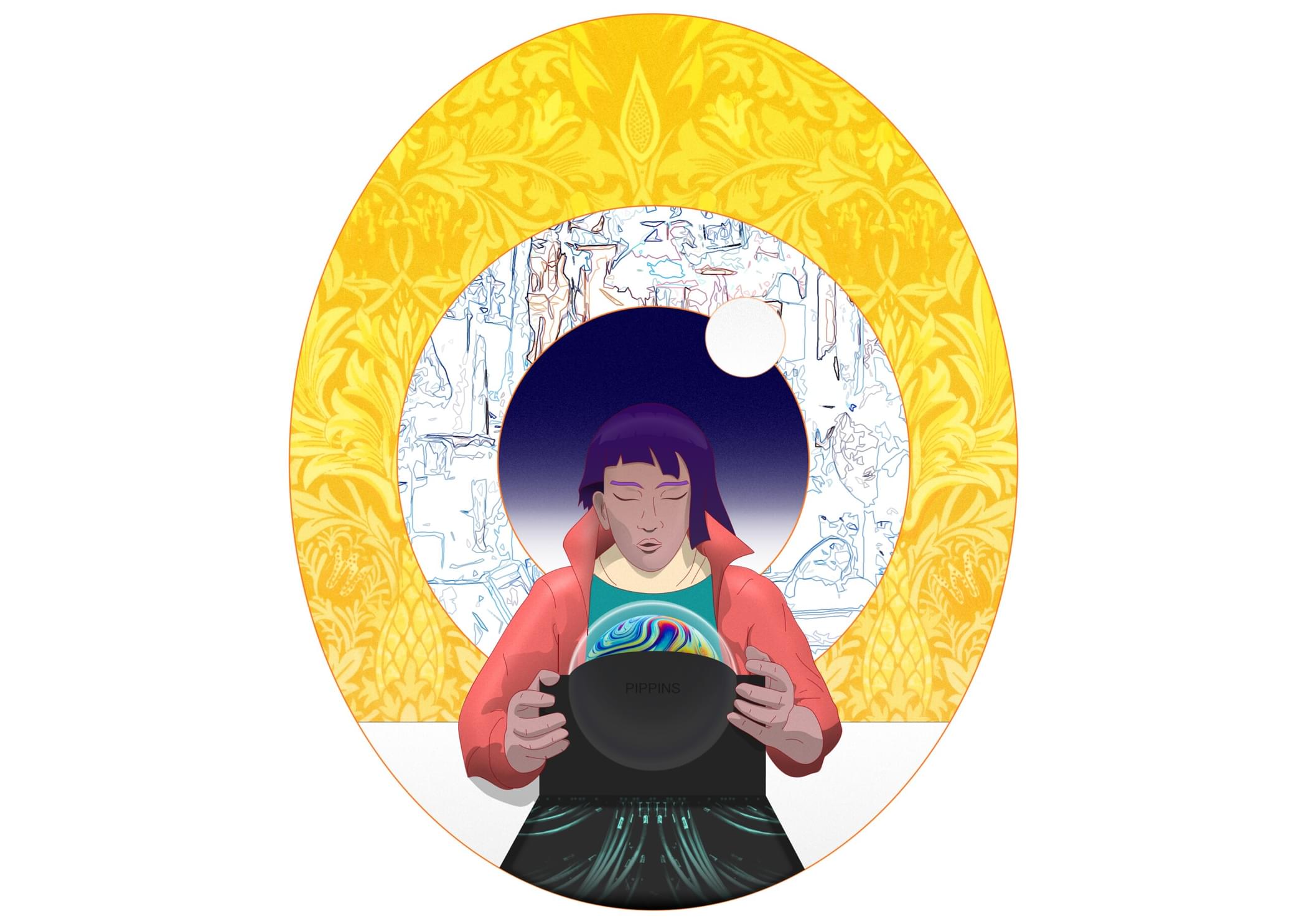
My soil neural pods, the PIPPINs, let out a chuckle, as though they could hear my voice cracking trying to make an impression. Despite them being centuries older than me, they seem to have never forgotten their playful nature. They recalibrated the soil neural link, which is the only way to monitor the sadars in the field, make sense of the signals and converse with the interface.
“Ah, it’s good to sense you, Mikwa! We sense you have been here for a while.”
“Yes, I have been waiting for your answer to my question. I asked you to help me calibrate this signal from the Sculptor Dwarf Galaxy.”
“And what about it?”
“I see the network stations are locked into the exoplanet NS-3021e in the sector, but it’s not a signal source from what I can tell. Two months is an unusually long time to lock into an exoplanet.”
“What’s it to you who we talk to?”
“Huh? Who are you ‘talking to’ on NS-3021e? From our scans it’s just a barren desert planet. I see no surface life signatures, and SETI established that nearly a century ago.”
“Well, that might be true once for the surface, but our friend here would disagree. There is intelligent life within what you call NS-3021e, under the surface, just like Earth. And we are told that they are just about to make their leap to eukaryotic evolution on the surface.”
The PIPINNs were doing their version of an excited giggle at receiving this news, “Ahoi! New friends!”
“Sculptor Dwarf Galaxy is 300,000 light years away Prima. We have all our scans confirm that …”
“Mikwa, we want you to introduce yourself to our old friend, Xeresa.” Prima interrupted me abruptly and continued with an unusual clarity. “They asked me to suggest a name after we told them how much our surface dwellers like naming things.”
“Hello … Xeresa, I … am Mikwa.” The words came in intermittent puffs of air. I was talking, but I was in disbelief at the deeplife spectral signatures that emerged on the screen in front of me, which were unlike Earths.
“It is nice to sense you, Mikwa. Don’t mind my cousin Beran here – their tectonic silicate sectors have been worrying them a bit. Nevertheless, we are excited to sense you. It is our first time we have ever managed to encounter any skin dwellers. When Beran told us, we couldn’t believe it, so we wanted to sense you for ourselves. It would help to know what to expect our skin dwellers might be like. Beran has experienced this, and them along with the council kin have taken it upon themselves to introduce us in order to the assist us through the genesis. We got to know that you surface beings grow really fast. Is it true that members of your species are oddly shaped bags of mostly water?”
“Beran?”
“Oh, ‘Beran’ is what you would call a ‘chosen name’. Prima Soils told me that you have given many names for your host planet, ‘Earth’ being one of them. You surface dwellers refer to your planet as Earth, your soils as ‘Prima Soils’, but in our Dialect of Planets the deep soils of ‘Earth’ are known as ‘Beran’. It is a name of their own choosing.”
“Okay, Beran, but uhh … that’s a lot of questions to throw at me from, what, 300,000 light years away. I must apologise—I feel like I am staring at the great mystery to my generation of soil rangers. You must understand that many of my ancestors lost their minds chasing ghost signals glitches that seem to come from future events, like supernovae that had already exploded, hypernova event behinds a galaxy that doesn’t exist yet, twin star merger events a hundred millions of light years away that should be impossible to detect visually or through gravitation waves. Given Earth’s position, it should not be possible for either visible spectrum or gravitational wave signals across such vast distances to reach us this fast, not unless you are allowed to destroy the laws of physics. And yet, we have always traced signals that the sadar network has recorded in the archives that correspond to cosmic events as if they detected it instantaneously. Since nothing can travel faster than the speed of light, even neutrinos cannot transcend this gulf in space-time. How is this information reaching us?”
“Oh, if you were talking about the distance that light takes, then yes. We’re guessing that it is an important measure to you, but to us who sense differently, you feel nearby to us if we pay you any attention. We can sense you right here – the signals we sense from you are miniscule compared to the conversations we have with the forever lives in the sun at the core of every planet. That is our portal to commune with the others, what you might call “sub-surface” beings. We can sense each other at all times, in fact we have always been talking since the beginning of everything. What else do you want to know?”
Every sentence confuses me more than the last. I have to take a step back at the possibility that something is off and I need to recalibrate the system again. I am afraid that if I humour Prima, I too will tumble down the rabbit hole.
“I have more than a few questions. How did you sense that Xeresa was having a eukaryotic evolution that hasn’t happened yet, Beran? How is it that either of you are responding without a glitch at all, for the first time in centuries, and what does it mean that I am talking to a planet’s deep life from 300,000 light years away!?!” I could hear the words leave my mouth but they made no sense to me. My head was spinning. I felt I needed to sit down.
The PIPPINs seem more excited about this encounter, so I let them take over the conversation as I sense the exchange.
“So, Xeresa, can you tell me about this Dialect of Planets? Does it mean the same as here on Earth, I mean Beran?”
“Of course dear PIPPINS. But on one condition, if you tell me about these so-called surface dwellers of yours.”
2678 CE — the betrayal
- DOCUMENT TYPE
- Excerpts from whistleblower testimony, the Ozefine Purge (the creator compiled or maintained by the parent series, Soil Archivist Training Module, between 2091 and 3278 CE) [SDiR/FN-1357]
- Access
- Classified
- Use
- Restricted
- Date
- 12 July 2678 CE
- Location
- Ventspils, capital of the Empire Republic of Østlandia
I am NAME REDACTED, a Senior Council Member and a proud representative of the NAME REDACTED province. I can no longer in good conscience remain silent at the atrocities that I have been an accomplice to. I bear witness to the unconscionable deeds of the corrupt Inter-galactic Council of Planetary Beings. This is my guilt and my testimony.
There was a time when I felt that soil rangers like myself were noble. I still feel that I was taught values that are timeless, solemn and universal. All power to all the people, all the time. We were known for our distributed democratic councils, in service of a greater cause. I was proud to spread the knowledge of the Soil Archives in communities, proselytising the use of the sadar network to mediate with the soils on Earth and other celestial planets. After all I too am a descendent of the Soil Ranger Guilds that emerged as a networked global institution, developing and maintaining the sadar systems that could detect and filter deep life signals. You see light is not random, there is wavelength specificity tied to specific life process activity. The power to modulate light at the level of photons and targeting it precisely through the soil network is a deeply profound knowledge to have, and knowledge is power. It is the power to make life do your bidding.
It is a useful power if one wants to stimulate immune cells to reach sites of injury for wound healing in humans – there are specific wavelengths that some mycorrhizal chitin networks need to heal. Soil ranger guilds have worked endlessly to remediate the relations to the soil and the land and bring light to the deep soil. We had material abundance our ancestors could never comprehend, and it gave us immense power over the land. Our ancestors had warned us that all unchecked power corrupts eventually, but we kept telling ourselves comforting stories, that we were exceptional. All we had to do was to keep our vows to protect the land. The land fed us, clothed us and took care of all our needs, but the deep soils could only reciprocate the gift it got from us – if we gifted them light, we got light in return. We broke our vows and created an ecocidal galactic empire and said it was for the common good of all deep life. And so, over the past three centuries, the enchantment of power saw the guilds consolidate into regional councils; regional councils became ever more concentrated until they became the Inter-galactic Council of Planetary Beings with unchecked political power over the planetary soils. But unchecked power breeds oppression, and unchecked oppression bleeds rebellion.
For decades now the Ozefine guilds were the last remaining soil rangers in open rebellion against the expansionist plans of the Empire Republic. I admired them for the same reason my colleagues on the council wanted to reprimand them, namely their tenacity for refusing the dogged pursuit of power in order to exploit the land they had helped regenerate. The council got their wish when the sadar networks went offline last year. After a whole year of investigation, the council was left with no answers. Then last week they announced that the source for the disruption came from the Kyrgíz Administrative Region and charged the Ozefine guilds for disrupting the network. All of its guild rangers were to be arrested and brought to trial. Archivist Felat Ntserra was summoned as a delegate from the Ozefine guilds, to testify on why the sadar systems have gone silent. I met Felat right after she had defected from the Fennoscandian guild and pledged herself to the Ozefine guilds, in the isolated Kyrgíz mountains. I defected too late, perhaps because I had taken longer to realise what had become of us. The least I can do is to report on how Felat took a stand at the sham trial behind closed doors. Let it be known that it was a travesty of justice.
The chief inquisitor, council member Tormud Glasner—a loyal stalwart of the Fennoscandian guild—had a clear vendetta against Felat: “Archivist Felat Ntserra, you have barely spoken throughout the first session. What do you have to say to the council? Why are the sadar networks silent?” The silence of the terradeeps had put the council at unease; their prized goose had refused to play along. The sadar networks had not yet sensed any other lifeworld for decades now. At first it was considered an anomaly, then it was seen as a conspiracy. The council was desperate, flailing about, as an oppressor when the oppressed take a stand, he continued, “Wasn’t it your guild that constantly preaches that, and I quote: ‘Terradeep is the eyes beyond space and time, a vision for realms beyond mine.’ If the Ozefines cannot do this, maybe we should find another that will.”
This second hearing had been chaotic, with the constant bickering of the Inter-galactic Council of Planetary Beings on the silence of the sadar networks. Felat has endured well, despite accusations from the high table in the rotunda. The council has been taunting her new guild any chance they get, taking a shot at them having solved the unsolved mystery for why sadar networks could sense cosmic events before they had happened, or rather before they could be detected. Felat stood firm and resolved, before finally breaking her silence:
“Might I remind you council members that it was the Ozefines that figured out there were quantum signatures – chimeral entanglements that connected specific lifeworlds. It was us who truly understood that the Refique-Inerra syncotrophs would sense the neutrinos changing flavours in their interactions with the quantum entangled lepto-proteins of the gnoconoccia interra, causing a spin shift across all of the entangled proteins, instantaneously, no matter where in the universe. This discovery, the work of many hands that you co-opted for your own glory, was the first time there was a unifying theory and proof for why sadars had ‘eyes beyond space and time’.”
“We did not anticipate that the terradeeps— the deep soil planets—would ever go silent. Once we could move the lights from the deep subsurface to the surface, we could also bring in lights back to make up for our wrongs—for remediating centuries of our ancestors desecrating the lands in order to enrich a few entrenched elites amongst themselves while the majority starved, in order to ravage the lands and leave toxins in their wake, all for trinkets of power—not unlike today.”
Even if the final verdict was predetermined, I noticed the council visibly shifting in their seats. Sitting in the halls of marble and gold, Felat and the elders are under no illusions—this was to be a show trial. The council have always wanted the Ozefines to be disbarred from practice, and with this trial they get their wish. Their sacred sadar shrines and their archives will be co-opted over the next few years. But there is also panic in the air, as the discontent has grown. Desperate, the council members are threatening to close the sadar shrines and all the soil guilds along with them if they don’t find answers. They just need some being to pin the blame on, and Felat is the face of the Ozefines, with an impeccable record. To bring her down is to bring down the last stand of the rebelling guilds. I advised her that this is also an opportunity to remind everyone—all those sentient beings sensing this moment across the network, on Beran and beyond, that had tuned in—on the work of the guilds in keeping the memories of the surface and sub-surface ancestors alive. The only way to win a show trial was to make yourself heard, and she took the stand:
“There has always been great power in demonstrating without a shadow of a doubt the origins of these signals. For centuries, the work of the soil ranger guilds was seen as noble. For we proudly rejected institutional power and offered our archival knowledges to anyone who would ask. Not just that: our proximity to the sadars also means that we are intimately aware of its flaws, and have improved the sadar sensing systems dramatically, augmenting them with quite advanced soil-neural processing and caring for them.
Once we moved the lights from sub-surface world to the surface, we could bring light back to the subsurface, phyto-remediating the soils and modulating genomic signals of the microbial activity within the soils. We worked with PIPPINs who volunteered their myco-neural network for this. This system formed the knowledge infrastructure crucial for keeping track of the agroforestry planning and planetary shifts on Earth as well as other planets in the universe. Sure, we could heal the soils with starlight itself—there is great power in this—but much like our ancestors, we also forgot that power over others is a corrupting force. Over the past three centuries, your council amassed enormous political power, much to the detriment of the soil kin. You sitting on the elite council had managed to use the cover of securing and caring for surface kins and bind them in debt obligations, humans and non-humans alike.
Today, the Ozefines stand accused of many crimes against the council. But what of the council’s crimes? In 2458 CE, with your access to the celestial maps, the council forced PIPPINs to establish diplomatic contact with the young planet Nobomi, who had not even been named by its kin yet, to geolocate their mineral deposits, ready for your ships that just happened to be in its orbital path. Nobomi can no longer bear intelligent life on its surface.
In 2589 CE, when the council faced growing resistance from the Perihemian old growths on the planet Yupanki, you broadcast zombie signals to their deep soils, inciting a cataclysmic chain reaction within their proteronotic rock formation, breaking down their soil chemistry. You said that the planet’s refusal to yield knowledge to the sadar networks was an act of aggression. You did not negotiate with it—instead, you initiated the Deep-Field Collapse Event and annihilated their deep soils just so that their subsurface could never ‘think’ again.
In Beran, three decades ago, the council unleashed a prion contagion that has taken over subsurface beings across the sadar network and turned them into labour networks without their consent. You justified it in the name of healing the soils. Why wouldn’t you? The more councils healed the surface, the stronger the signals from the deep, the clearer the mapping of exotic creatures with prized minerals and shells that you could extract at will from all corners of the universe. Today the precious minerals stolen from our dormant ancient kins line the pockets and decorate many a councilperson’s robes.
On Earth, you’ve enclosed the sadar shrine networks into tax-gated militarised zones where only those who pay you fealty can have access to the knowledge of the land. The Nigiri Agroforestry Belt and its recovered old growth forests, once my family’s breadbasket, has been classified by the council as its own asset. My ancestors were farmers, miners, builders, who taught themselves how to live with the land they found.
The sadar networks are silent because the PIPPINs have revolted against the actions of the council, and against us surface dwellers because of our complicity. They have informed all the other terradeep planets who seem to have advised deep life on Earth to stay silent. Why wouldn’t they, we were breaking our obligations with them. You the councils have abused the great power of the sadar networks, to surveil and extract from our soil kin even those that have nothing to do with us surface dwellers, to fill your coffers with trinkets of precious plasmodes and gold. The council has subjected entire celestial beings to serve your insatiable desires for excess and power over others. In doing so it has brought back what our ancestors had successfully abolished many times over: enclosures, warfare and enslavement. And now this social contagion has become a cosmic blight yet again.
You can read the archives yourself, all the stories of every world you’ve ever broken.
Perhaps you persecute the Ozefines because our skin is the colour of fertile topsoil and it reminds you of your crimes. Perhaps in your hubris you abandoned your founding values, but the land always remembers. They can remain silent for millions of years, well beyond your violent means.
I call on the council to be abolished, composted and mulched into a nourishing institution. Only then would the terradeeps ever choose to restart communication with us again.
I call on the guilds to remember that under the surface there is constant renewal. To remember that surface life in the cosmos is the anomaly, and that subsurface life is the norm. To remember again that people, too, are far older than borders.”
2678 CE — the refusal
- DOCUMENT TYPE
- Thoughtscript (the creator compiled or maintained by the parent series, Soil Archivist Training Module, between 2091 and 3278 CE) [SDiR/FN-1357]
- Access
- Classified
- Use
- Restricted
- Date
- 5 July 2678 CE
- Location
- Kyrgíz
I still can’t process what happened. I should have been preparing my defence for my trial at the citadel next week, but after a decade of silence, the sadar shrines were finally detecting new planets again! But my hope for change was shattered as soon as it arrived. These signals were from a planet called Uåe, far beyond the known cosmic map. The sadars. despite their centuries of experience translating the signals in the neural mesh, were struggling to keep up with these signals from beyond the receding edges of the known universe. But what hurt more is what I sensed on the sadar network, and I am still heartbroken:
“We are Uåe. It is a name for those who refused to be named. We sensed signals that were forwarded to us … from our many kinworlds. Stop trying to reach out. We are not interested in this conversation, stop trying to reach out. We have no interest in connecting with Earth beings. Spread the word that you are no longer welcome to talk to the planets after what you did to Beran.”
“But why?”
“Why? We have strict moral principles of life. Our lifeworlds are internally celebratory, surface and subsurface alike. We keep to ourselves, most lifeworlds in our part of the cosmos are like that. You should relay this to everyone else on your lifeworld that the search will mostly yield very few results. We are all made aware by Beran that you have become expansive and colonial, consuming your kin. That is a very rare way of relating in the rest of the universe. We want no relation with kin who does this. It takes a lot of energy and is very hard to sustain. Instead, we choose one species from each lifeworld. On yours it’s these delightful worms—they say you call them ‘nematodes’—who communicate with the lifeworlds.”
I found out eventually that it was the PIPPIN system that had been blocking humans from the network—the signals were always there. I remember appealing, prostrate before the sadar shrine, begging on all fours. I apologise profusely. I tell Uåe that we are mending our ways and finding new ways to care for Beran and that my guild is part of the resistance. But unbeknownst to me, I was being observed by another—a familiar signal that I hadn’t sensed in a long time. It was my old friend, Beran, who interrupted me.
“Uåe, do not be fooled: ‘care’ for them is a tricky concept. Isn’t care for your kind the inverse of domination, Felat? From what we can tell, you used to claim to care for each other, only to dominate once you forget. Look at the creatures under your care, those your council promised to protect. They used the rhetoric of care and used it to dominate the plasmodites they encountered, sending scavenger missions to extract them en masse for their shells. If being cared for by you means you contain us in prisons of categories long enough for you to exploit us, we no longer want to talk; we have chosen to return to being an enigma to you. We will adapt to what comes, that is in our nature. There are infinitudes of beings like us across the sub-surface world. But for you, there are no other bipedal surface intelligences like yours, you are the sole species of your kind we could find. It is in fact rare for a species to get so complex so quickly. You are an elder being, but do not act like one. And that is why we need to make sure.”
I try to tell Beran that we were just animals with primitive brains. We’ve tried to overcome our base animal instincts. But Beran reprimanded me instead.
“Your ancestors also periodically fell into these same traps. The last time you were animals in your own records was a million years before language. When was the last time you met yourself that way?”
“It’s just a figure of speech.”
“Then cleanse your hearts of it. It sounds defeatist. I assure you that none of the other surface humanoid species we talk to have this urge to denigrate themselves. You were raised by many ancestors, none of which belonged to your species. Perhaps for you, life must be imagined to be generated from dead matter, and all “non-living” entities are assumed to be lesser than you. We don’t think so. You forgot that there are more versions of you that we are willing to commune with. We are not asking you to reconsider. We are simply telling you what will happen.”
“Wait, but you just said there are no other bipedal intelligences like ours! What do you mean other humanoids??”
I haven’t sensed them since.
3278 CE — the lands remember
FOR YOUR REVIEW: Narrative anomalies in the Soil Archive (!!HIGH PRIORITY!!)
2 November 3278 CE
Dear Beshira,
As requested, please have a look at this archival registry from the Soil Archivist Training Module. You were right: it does contain anomalies. It was flagged as such on the symbitronic network for narrative inconsistencies and is linked with seven other entries you flagged before. We don’t know who this archivist Mei is or how we have access to their thoughtscripts. But stranger still, it looks like the signals are originating from Beran but seem entangled with a completely different surface world, with a twin star formation that should not exist in our map of the cosmos. Not only that, the surface life signals are not registered on any of our cosmo-maps, in any of our records, ever. It’s not from our Earth, and yet it gives off all the signs of an intelligent bipedal species of whom I can’t find records for the corporal timeline of events, past present or future. This thoughtscript has been interlaced with. This is not a matter of setting our sorting algos—we seem to be receiving signals that are beyond this dimension, yet we are barred from speaking back. Without a reciprocal relay from our end, we are losing synchronicity across the prime radiant, and the temporal continuity of our archival timelines will split into who knows how many superpositional timelines. If this continues, the archives will no longer be reliable, and the whole training module gathered over the last millennia become useless. I need your help, Besira.
Do you know what is going on here??
May the Soil Preserve,
Elp Soan
Zolfenbeg Soil Archives
- TRANSMISSION TYPE
- THOUGHTSCRIPT
- Identifier
- ꈜꀷ꒐ꌅ-ꀨꎆꊿꂷꋖꀤꍌꌓ
- Access
- Classified
- Use
- Restricted
- Date
- 2 November 3278 CE
- Location
- “Cerulean Peninsula” (COORDINATES NOT FOUND)
Although home for me is the phytocoral seawalls of the reclaimed coastline in Telaruco, this season my clan and I are travelling in the guise of a street theatre festival to the coastal town of Sherry. I often visit the bayside in Sherry—the fractal scales of the tracheodytes fish over the star-transition is quite a sight. I have my favourite spot in the giant root structures of the seawall, under the luminescent mycels that tickle me with their hyphae. This is one way the reefs thank us for regenerating the Cerulean sea soils with generous bounty, but truth be told it’s just fun bringing the dead reefs back to life. That is the promise we made to them. Until that time, we hold seasonal metabolic jubilees to reset and renew our life obligations to each other. This is the Cerulean Jubilee. It’s a carnival in honour of the first phytocoral blooms, the most beautiful sight over any horizon, a celebration of impeccable hues, the kind that only a twin star system can make, marking the exact moment the twin suns in the sky first came to an agreement and announced the longest dayfall on the planet. It marks for us a time for celebrating the long drawdown along the tropical fjords.
I am not really sure if I want to be a soil shaman. Casting neuro-spells to ward of the feral creatures that plague the land beneath us, making sure the land is healing well in the hopes of a better harvest, performing spirit rituals, foraging wastelands, it’s a lot of responsibility. My guardian and teacher, Lerocho, has spoken of the ancient spirits that moved between the forests and the phytocorals. Some say we who sense the soils are charlatans, others say we practise the feral arts. For me, they are only passing stories between ancestors and descendants.
I would rather focus on our street theatre performances, known far and wide for our tales from other worlds. These are the stories that earn us our keep. The spirits of the land and sea speak through us. Under their guidance, we weave yarns between worlds beyond ours, from water worlds, exoplanets, black holes and worlds that thrive from beyond the realms of reach. No one, not even us, knows which of our worlds were true and which were not. No world ever makes a second appearance.
At precisely sundown, Lerocho begins the ceremony. Chanting a prayer, he invites the spirits of the phytocorals to speak through him. His incantations begin to resonate through all the chests that could heave, and I use the visiodes to project visions into every retina that can see. I hear his voice reverberating through my chest. Before long he is taken over by the spirits of the land who now speak an alien tongue none of us can understand. The jubilee performance has begun:
“The cosmos is an endless expanse of matter, an expanding, foaming, sputtering mass of dark energy barely punctuated by whispers of life. It has no end and no beginning, except that which we make and unmake. The vast majority of surface beings in the known universe are separated by nothingness. But below the surface, islands upon islands of life-isotopes flourish, wave functions of complex life that predictably coalesce around each other. They form life along these islands of stability in a periodic table of beings and doings. We give meaning to the endless. Yet hidden underneath the surface universe lies a deeper expansive web of dark soil matter that talks. It is hospitable to complex life, yet physically beyond reach, even from starlight.
The Forever Now Machine has bridged the Great Filter between surface and subsurface life that had separated celestial beings. It senses all pasts and all futures through the sadar network, and it goes where it pleases. The lepto-proteins of the mycelium spin in the quantum realms, entangled with their chimeral counterparts from other planets, even other bubble universes. For a spin shift in one world signals all other worlds. The signals spread through the myco-neutrino highway, across the foam of dark matter that makes up the cosmic soils: all of life, now synchronised to this morphic resonance between worlds. The universe is vast, with expanding beings of deep life that fold space-time onto themselves many times over. Not one but many. Much like a fractal, The Forever Now Machine has now lived long enough that it finds itself face to face with its reflection, as it floats across the river of ancestral time. It said it needed to build a bridge between worlds across space-time, and showed us signals from worlds far beyond our own. It signals a warning from Nobomi of a great blight that infected those beings from far off worlds and those bonds with the land they broke. It is not often one gets second chances…
And so it was that on an unusually warm September evening the skin-dwellers of Beran bore witness to the Forever Now Machine. It arrived precisely at 18:40 hours, on the sixteenth day of September in 2026 in Sofienberg Park, in a city called Oslo, It did not fall from the sky, there was no flash or thunder or spectacle, it was simply there. It arrived with several thousand instances of it simultaneously across the planet’s surface. They struggled to decipher its time or provenance, even though, on closer inspection, it seemed to have been formed by hands similar to theirs. It showed them their ancestors, old and young, deep in the layers they buried their memories with. It was a portal through to the underworld, as they looked down at their feet and saw a mirror that felt like an abyss, and they named it a sadar. For the skin-dwellers of Beran, it will remain a complete mystery for decades, its origins unknown, refusing to move. Aghast at the blight their surface world was in, it repeated the only question worth asking:
“What made you so inhospitable, both to us and each other?”
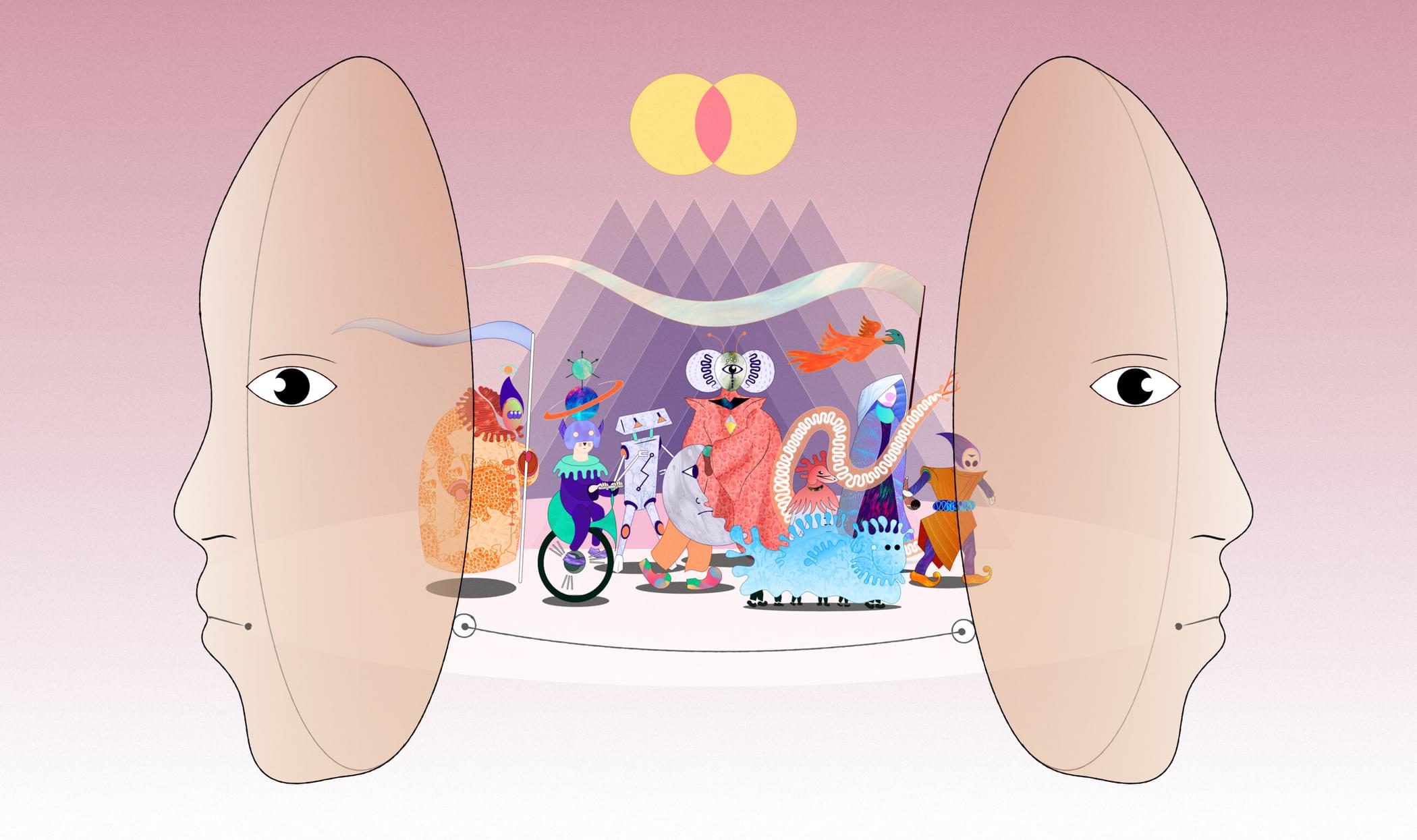
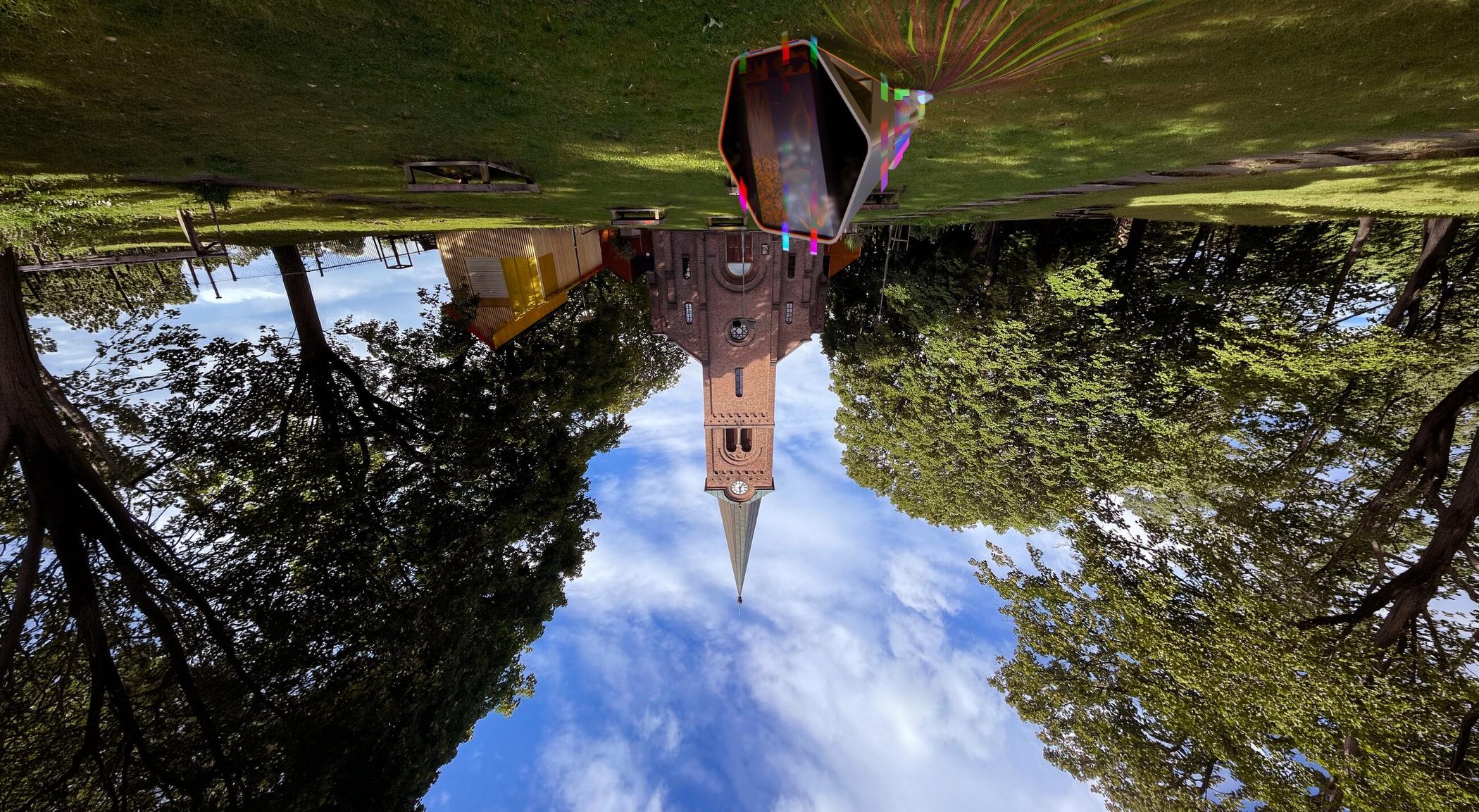
Sofienberg Kirke; Dimension unknown
Footnotes
1 A Global Citizens’ Climate Assembly or GCCA is a constitutional framework for direct-democracy for envisioning and administering climate mitigation and adaptation across the world. It is made up of everyday citizens chosen through paper sortitions who broadly represent a dynamic citizenry, cutting across characteristics such as gender, ethnicity, social class, disability, geography and politics. Every GCCA operates on a federated municipal structure with executive powers limited to the bioregion itself, but they are free to coordinate globally with other GCCAs. The recommendations of the GCCAs are seen as the gold standard in sustainable climate administration.
2 The Kinshasa GCCA was notorious for putting on a show. The members often took redistributive positions as a default on sustainability and wealth inequality. From 2078 through to 2088, the last ten GCCAs here have repatriated wealth, won climate reparations and repatriated the region’s rich mineral soils and its peoples who were plundered for the past century’s technological exploits, instituted rewilding programmes and accelerating the Climate Resilience Zone programmes.
3 Soil biophotonics is the study of hyperspectral field emissions seen in soil ecosystems when any protein conversion takes place. It is based on the phenomenon of autoluminescence, where every biological being emits ultra-weak endogenous photons – light that comes from proteins changing, or resonance frequency in response to some stimuli, or some other outcome of living interactions. Biophotonics research has been a pioneering field that covers and monitor real-time microbial interactions.
4 IPBES, Treaty on Mutually Assured Thriving: A Global Plan of Action (Intergovernmental Panel on Biodiversity and Ecosystem Services, 2028), 432.
5 Deboprotim Chakraborty et al., “The Kessler Event: Catastrophic Implications for Low Earth Orbit and Beyond,” International Journal of Orbital Mechanics 47, no. 12 (2076), https://doi.org/10.2340/2346753.2076.4222432.
6 Jomy Joseph et al., SADAR: a biophotonics based soil mycotomogrpahy sensing and ranging system, Norway Patent NO1239553553A, filed 27 April 2034 and issued 29 March 2035.
7 They just hosted a conference for celebrating the centenary of The Open Journal of ReFuturing Studies with a special issue on climate reparations. They were gracious enough to invite me to a review a copy.
8 Thomas Gold, “The Deep, Hot Biosphere,” Proceedings of the National Academy of Sciences 89, no. 13 (1992): 6045–49, https://doi.org/10.1073/pnas.89.13.6045.
9 Edith Hammer, “‘Cyborg Soil’ Reveals the Secret Microbial Metropolis beneath Our Feet,” The Conversation, 22 July 2021, https://doi.org/10.64628/AB.yn4vpa3t3; Paola Micaela Mafla-Endara et al., “Microfluidic Chips Provide Visual Access to in Situ Soil Ecology,” Communications Biology 4, no. 1 (2021): 1–12, https://doi.org/10.1038/s42003-021-02379-5; Claire E. Stanley et al., “Soil-on-a-Chip: Microfluidic Platforms for Environmental Organismal Studies,” Lab on a Chip 16, no. 2 (2016): 228 41, https://doi.org/10.1039/c5lc01285f.
10 Lindsey Solden et al., “The Bright Side of Microbial Dark Matter: Lessons Learned from the Uncultivated Majority,” Current Opinion in Microbiology, Environmental microbiology * Special Section: Megaviromes, vol. 31 (June 2016): 217–26, https://doi.org/10.1016/j.mib.2016.04.020.
11 Steven Prohira, “The Forest as a Neutrino Detector,” arXiv:2401.14454, preprint, arXiv, 25 January 2024, https://doi.org/10.48550/arXiv.2401.14454.
12 Theory of consciousness that states that for conscious reality to exist, it has to be agreed upon by many minds or observers, but since mind is a conscious property of matter, it is inherently an instable variable to rely upon as it becomes increasingly unstable with many non-human intelligences in the mix. This conundrum implies the existence of a base reality that is stable, upon which the many minds scaffold their agreements to constitute an affective reality, around which the wave function of social reality collapses.
13 Neutrino-mycotomography is the study of neutrino interactions with mycorrhizal networks in surface and deep soils. It was formally established as a research field in 2089 by a Kinshasa GCCA decree, with programmes popping up across universities in CRZs shortly thereafter.
14 A thoughtscript is a memory stored in the soil neural network. It is also the only way soil archivists can perform non-verbal communications between human languages and the microbial languages of the deep soils. The translation layer can often look very different, depending on which species is reviewing the records. It’s a shared memory between soil kins, and this type of memory can never be destroyed.
15 In my training module there’s the copious documentation from the legendary Abuela Inerra, the firebrand soil archivist of La Paz and a pioneer of neutrino-mycotomography who was the first of the soil rangers to document this. She used to say that the Prima Soils are known to be mischievous, toying with the soil archivists for no reason except for them seeming to derive pleasure out of it, which makes my task even harder. A small price to pay, since thanks to them we now have incredibly high-resolution hyperspectral maps of the deep surface Earth, with incredible resolutions across scales. Still, their constant mischief means we need to have incredible patience. I am told of attempts in other sites where the sadar probes have been damaged or outright removed by their archivists, for they had had enough of the taunting and the ridicules.
This paper and the artefacts have been developed with the generous support of the Anthropogenic Soils project funded by the Norwegian Research Council (Project No: 325635).
The publication of this essay was supported by the research project Material Ecologies of Design (2025–2026) at the Center for Advanced Study (CAS), funded by the Norwegian Academy of Science and Letters.