L Y M N A
Words and images by Julia Andersson
Translation by Petter Hellström
All life begins in water. Water moves through our bodies, landscapes, soils and airs. It threads together what we otherwise imagine to be separate. Within the water cycle, there is no waste. As the water continues to flow, it changes into something else, becomes part of something else. What appears to be an end is always a beginning.
Lymna is a speculative tale of a possible future. A world to enter and explore. The story begins with a simple shift in perspective: what if we built our lives on the logic of living systems? What if we let water shape our cities?
What follows are fragments gathered from such a city: stories and laws, rites and observations, moments of everyday life. Together they sketch a world in a constant flow of becoming.


ARRIVING IN LYMNA
You always arrive in Lymna by water.
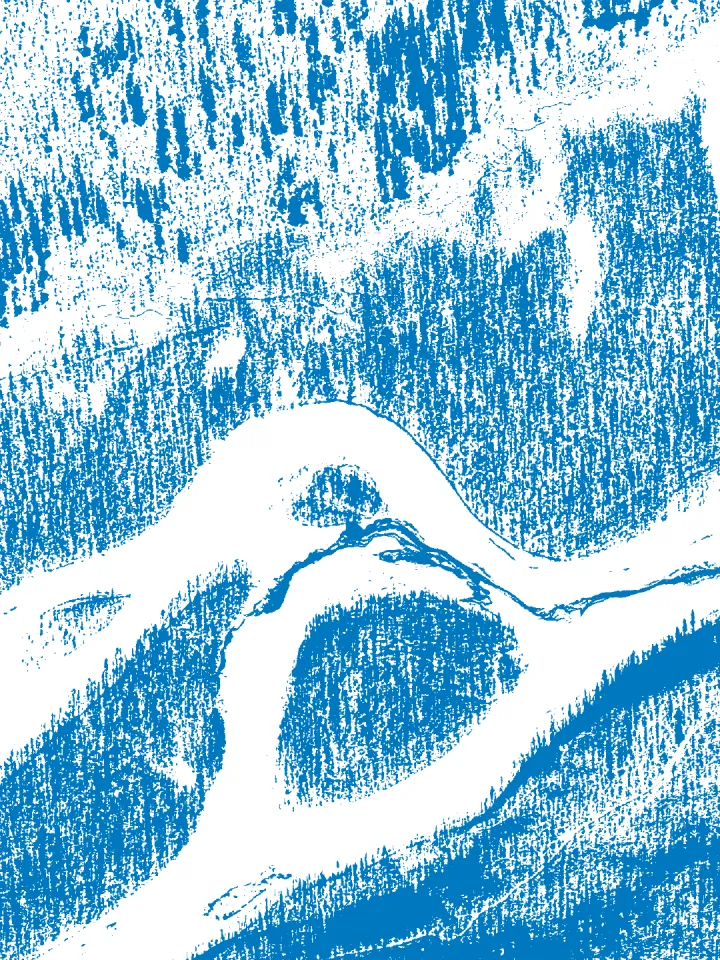
The books describe it as a coastal city, but the people of Lymna think of it differently. The city is not built on the water. It is part of it. Lymna drifts with the tide, feels the touch of the dew, attunes itself to every shift in humidity. The gurgle of channels, the rush of currents, and the splash of breaking water compose the city’s soundscape, as familiar to its inhabitants as the drone of traffic was in the old world.
Lymna lies where the great rivers meet the cold, brackish water, in a waterworld of riverlets, wetlands, and shallow lakes. The city stretches across a low-lying delta of reedbeds and forest. Each spring, fresh meltwater overflows the landscape; each autumn, the sea pushes back inland. The people of Lymna take nothing for granted. What works today may need to change tomorrow.
On early spring mornings, mist drifts through the streets. These curve gently inward, not to shed water but to receive it. When the rain falls, the streets turn into mirrors, reflecting the sky and drawing the world together. The water moves slowly through the city on its way to the meadows and wetlands.
The houses of Lymna are not built to keep water out. They are built to let it through. They have narrow openings in their roofs, inviting the rainwater to enter. Their frames rest on slender stilts that barely touch the ground. Beneath them, water, sediment, and roots move and grow freely. On the walls of the oldest district, a century of changing water levels has left its mark. In Lymna, time is measured not in years but in ebbs and flows.
THE LEGEND OF LYMNA

In the dawn of time, before land and water parted ways, there was a place where all things lingered, where currents slowed, sank, and resurged. Whoever came there found their bodies changing. Their inner rhythm no longer obeyed the heart alone. Another current moved within them: the quiet water circulating through their bodies, the flow of lymph.
From the lingering emerged a figure, neither solid nor fluid. She was Lymne, the water returning to itself. She taught the world to listen to what gathers.
In the wetlands dwelt the Lymnaea, snails that received and purified the waters, carrying within them an ecological intelligence shaped by the flow of the living world.
Then a drought came, and the surface waters vanished. The people fell to the ground and felt, in their hands, the movement continue in the depths below. A whisper rose through the soils, like a pulse that had never ceased. Lympha – the pulsing water, giving life and taking it back again.
And when the waters returned, they gave the place a name that held all these meanings. Lymna – where water does not merely pass through, but shapes all that is.
THE NAME LYMNA
An Anthropological Perspective on Water, Language, and Relationality
The name Lymna should be understood as a site of confluence, where different streams of knowing and living with water meet. Rather than pointing to a single source of origin, the structure of the name suggests an interflux between the term and its environment, each refiguring the other.
One source word may be the Latin word lympha, meaning clear or sacred water. In many ancient cultures, water was more than a resource. It was also a source of life, and a reservoir of meaning. The reemergence of the same source word in lymph invites another reading: a correspondence of circulation within the human body, and the movements of water through the land. Seen this way, the boundary between body and environment appears less solid. Water is the shared medium, it defines our bodies as well as our surroundings.
At the same time, the name suggests a different source – lymne – Greek for quiet waters, ponds, lagoons. Here, water appears in a different role. Not moving but lingering, gathering, holding. From an anthropological perspective, this reading reminds us to consider low-intensity environments, characterized not by movement and circulation, but by retention, care, and sustained presence.
The association with Lymnaea, a genus of freshwater snails inhabiting wetlands, adds yet another layer of meaning. These small creatures remind us that life is sustained by non-human beings. Seen in this light, the name gestures toward a world in which human life is but one current in a powerful river, and where ecological processes such as filtration, decomposition, and circulation are recognized as culturally significant and foundational to collective life.
There is, finally, the sound of the word. Soft on the tongue, fluid in sound, Lymna appears to mimic the flow of water. Anthropological scholarship has noted that language can preserve traces of sensory experience, and in this sense Lymna feels less invented than discovered.
Taken together, these layers of meaning suggest that Lymna is more than a name. It is a relational artifact, binding body, ecology, and hydrology into a single expression. It speaks of a way of being in which water is not merely an object of the world, but a condition of the world itself – a presence through which connections are made, and meanings take shape.
A YEAR IN LYMNA
With the arrival of spring comes the task of reading the land. As melting snows swell the rivers, dwellers, growers, and knowers come together to observe the moving landscape. With the water come the nutrients, silts, and organic matter that will feed the crops. Precise measurements are balanced against observations that have no place in the diagrams: where the soil stays cool, where the current slackens, where sediment settles, where birds return and plants survive. Some beds are moved. Others remain beneath the water for the rest of the season.
Summer is the season of growth and abundance. Reeds rise tall across the meadows, algae propagate throughout the shallows, the grain ripens in the fields. In the weeks before the harvest, the land is read anew. The wealth is assessed: the thickness of the reeds, the abundance of eelgrass, the quality of the fibres, the composition of the clay. This year, the emmer has thrived. Even on higher ground, it has withstood the dry spells with ease. When the grain is harvested, the stalks are gathered too. Sorted and tied into dense bundles, the straw is mounted on buildings as a skin. Protecting the walls from wind and hard weather, the bundles are cut into patterns. Each façade has its own rhythm and density.
The materials are assessed, and construction plans reconfigured in response to the season’s yield. Machines are moved where they are best needed, and calibrated to meet this year’s needs. Straw, reed, and hemp are transformed into building materials. Clay drawn from the immediate surroundings can be made into walls and floors. In the woodlands, trees are harvested with care. Some are called to the city, others are left to grow. The forest remains as it is, even as younger trees rise between the old. Every piece of timber is selected for its qualities and put to use accordingly.
For the people of Lymna, the task is to find the right material in the right place. There is no waste, only by-products examined and evaluated according to their capacity to carry, insulate, and filter. Materials are altered as little as possible and used for as long as they can, before they are returned to the cycles from which they emerged. In this way, the city is built layer by layer from materials, ideas, and care.
As summer turns to autumn, Pacific oysters are harvested from the shallow bays. They have spread rapidly, reshaping the seabed. Instead of fighting the new presence, Lymna has learned to work with it. The meat finds its way to the kitchens. The shells are crushed and mixed with clay to reinforce the new walls and floors.
With the coming of autumn, the shoreline begins to change. Storms tear long ribbons of eelgrass from the seabed and pile them in banks along the water’s edge. Before the next tide can carry them back to sea, the people of Lymna arrive to gather them. The eelgrass is spread across the meadows, where it is washed and dried by rain and wind. When it has turned silver-grey and crisp, it is carried home. There, the eelgrass is twisted, braided, and woven into the fabric of the houses.
In winter, the streets freeze into shining ribbons of ice. City dwellers lace up their skates and glide from one neighbourhood to the next. At certain temperatures, the ice begins to sing, a deep, resonant pulse that travels through the city.
The ice reshapes the built city. Piers rise, joints split, and timber shifts. The buildings respond to the cold and the damp, as they did when they were trees in the forest. When spring returns, the cycle of work begins once again. Structures are repaired, adapted, and altered. What has served its purpose is carefully taken apart and given a new life elsewhere.
The years pass and the city remains. Never the same, always in a state of becoming.
AN AFTERNOON IN LYMNA
Read typed text Show handwritten note
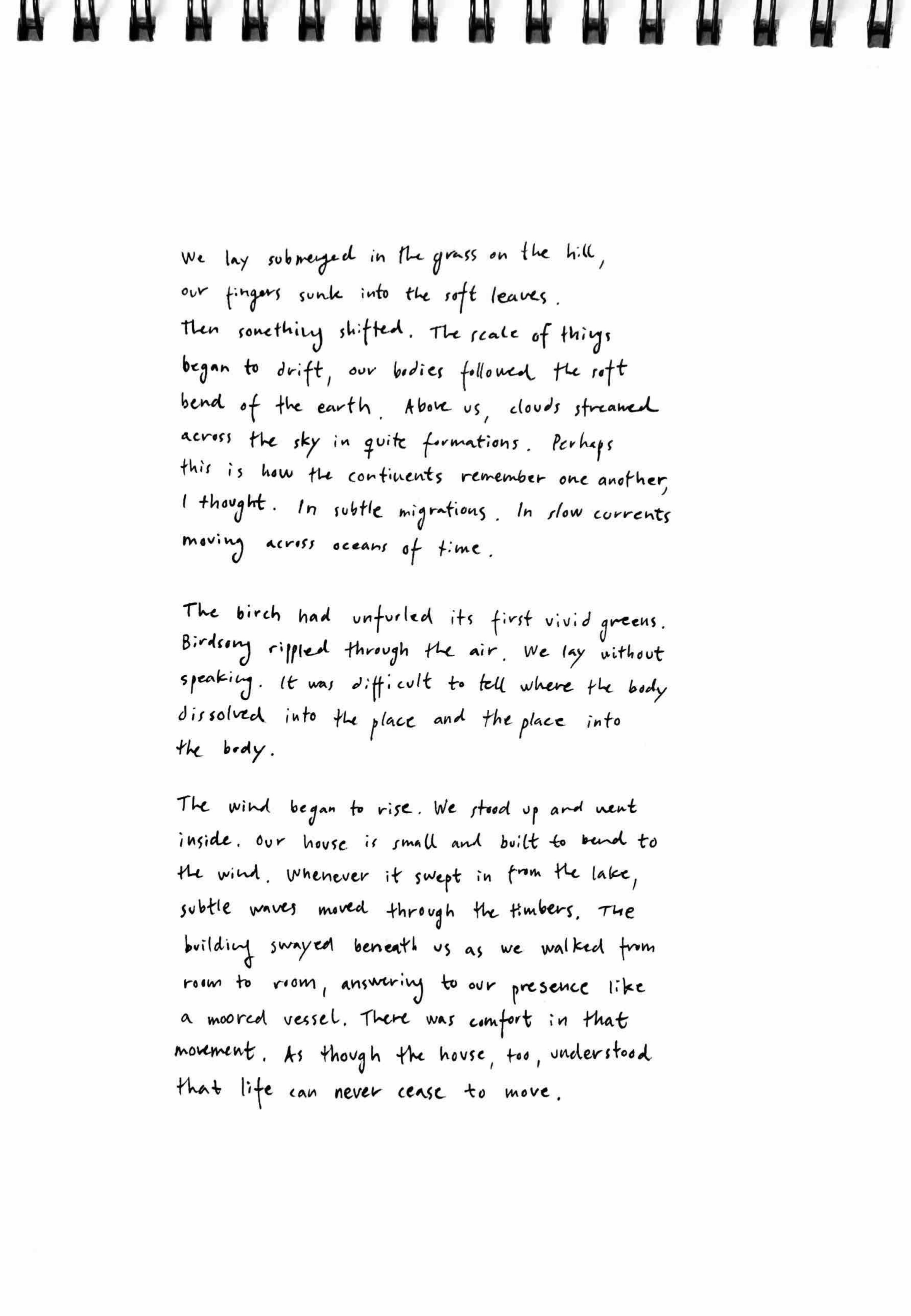
We lay submerged in the grass on the hill, our fingers sunk into the soft leaves. Then something shifted. The scale of things began to drift, our bodies followed the soft bend of the earth. Above us, clouds streamed across the sky in quiet formations. Perhaps this is how the continents remember one another, I thought. In subtle migrations. In slow currents moving across oceans of time.
The birch had unfurled its first vivid greens. Birdsong rippled through the air. We lay without speaking. It was difficult to tell where the body dissolved into the place and the place into the body.
The wind began to rise. We stood up and went inside. Our house was small and built to bend to the wind. Whenever it swept in from the lake, subtle waves moved through the timbers. The building swayed beneath us as we walked from room to room, answering to our presence like a moored vessel. There was comfort in that movement. As though the house, too, understood that life can never cease to move.
 Enlarge handwritten note
Act on the Integrity of Water (IW 1:1-10)
Excerpt from the Legal Code of the City of Lymna
Section 1.1. Purpose and Application
The purpose of this Act shall be to ensure the integrity of water. In this Act, “water” shall mean the interconnected system of surface water, atmospheric water, groundwater and water embodied within living organisms, in any state and location. “Integrity of water” shall mean the capacity of water to maintain its natural state of flow within the hydrological cycle. “Hydrological time” shall mean the temporal rhythms through which water moves, transforms, and returns within the hydrological cycle. This Act shall apply to all sectors and activities affecting the water cycle and hydrological balance within the City’s watershed.
Section 1.2. Legal Status of Water
Water is recognized as a relational system possessing intrinsic value. The agency of water shall be recognized as manifested in its movements, transformations, and relationships and shall be assessed with regard to these processes. Any assessment pursuant to this Act shall be conducted on a case-by-case basis, taking into account the particular manifestation of the water concerned, including its flow, state, ecological relationships, and position within the hydrological cycle.
Section 1.3. Principle of Flow Priority
In all acts of planning, construction and maintenance within the City’s watershed, priority shall be given to preserving the free flow of water. Any act that obstructs, fragments, diverts, or otherwise adversely affects the free flow of water is prohibited unless exceptional circumstances exist and it is demonstrated that no feasible alternative is available.
Section 1.4. Intervention and Restoration
Interventions affecting the hydrological system and balance of the City’s watershed shall be designed to support infiltration, purification, recirculation, and regenerative processes. The effects of interventions shall be monitored, and management measures shall be adjusted in response to observed changes. Any adverse effects shall, where practicable, be compensated through restorative measures within the same watershed.
Restorative measures shall be designed with due regard to hydrological and ecological conditions and may therefore vary according to the site. Where practicable, measures shall be implemented incrementally and in a manner that permits reversal and subsequent review.
Section 1.5. Assessment and Observation
Where a measure may adversely affect the integrity of water or its ecological relationships, all reasonable alternatives, including non-intervention, shall be assessed. The assessment shall take into account hydrological, ecological, and human interests. Any resulting measure shall, where practicable, be implemented incrementally so as to permit observation of impacts and reconsideration of decisions in response to emerging conditions. No determination under this Act shall be treated as final where new observations demonstrate that the measure harms the integrity of water.
Section 1.6. Hydrological Time
The City administration shall, where practicable, take into account variations in water levels as indicators of hydrological time. Hydrological time shall be integrated into all decision-making processes and considered on the same terms as calendar-based measures of time.
Any measure affecting the integrity of water shall, where practicable, be evaluated across multiple hydrological cycles. Where long-term effects are uncertain, the measure shall be implemented incrementally so as to permit observation of impacts and reconsideration of decisions in response to emerging conditions.
Section 1.7. Representation of Water
In any decision affecting water within the City’s watershed, a duly appointed Water Guardian shall participate. The Water Guardian shall ensure that the interests of water are taken into account during all stages of the decision-making process. The Water Guardian shall discharge their duties on the basis of relevant ecological knowledge and the principles laid out in this Act.
Section 1.8. Protection of Wetlands
Wetlands within the watershed of the City shall be recognized as protected hydrological systems of fundamental importance to filtration, water retention, ecological continuity, and biological diversity. Such systems shall not be drained, exploited, or otherwise degraded.
Section 1.9. Duty of Return
Any withdrawal of water from the hydrological system shall be accompanied by a corresponding return of water, or by the restoration of an equivalent ecological function, within the same watershed. Such return or restoration shall contribute to maintaining or enhancing the integrity of water.
Section 1.10. Interpretation
In the interpretation and application of this Act, preference shall, where practicable, be given to such interpretations and applications as are consistent with natural processes. Where uncertainty exists, this Act shall be construed in a manner that best protects the integrity of water.
Principles of Care for Water
Excerpt from the Stewardship Code of the City of Lymna
Principle 1. Interdependence
The hydrological system of the City shall be understood as the totality of interconnected relationships among water, living organisms, and human practices. Management, planning, and development activities shall be undertaken with due regard to these interdependencies.
Principle 2. Integrity
The natural capacity of water to move, infiltrate, transform, and recirculate within the City’s watershed shall be maintained over time.
Principle 3. Reversibility
Interventions affecting the hydrological system shall be designed to allow for adaptation, review, and reversal in response to changing ecological and social conditions.
Principle 4. Long-Term Stewardship
Administrative decision-making shall take due account of long-term processes, including sedimentation, ecological regeneration, seasonal variations, and intergenerational change.
Principle 5. Other-Than-Human Representation
Hydrological and ecological systems shall be represented in administrative decision-making through ecological knowledge, situated reading, and appointed Guardians acting on their behalf.
Principle 6. Situated Reading
Knowledge of water shall be developed through continuous situated reading, in which measurements, embodied experience, local practices, and ecological observations are brought into dialogue.
Principle 7. System Change
Change shall be recognized as an inherent characteristic of hydrological systems. Stewardship shall support the capacity of hydrological systems to adapt and regenerate over time.
General Provision on Interpretation
These Principles shall be interpreted and applied in a manner consistent with the Legal Code of the City of Lymna. In cases of conflict or in decisions affecting hydrological systems, the Working Protocol for Water Care (WPWC) shall be applied as a guiding procedural framework.
Origins of legislation in Lymna
The historians of Lymna are divided as to exactly when the turning point occurred, but many point to the Great Tension, a period during which the city’s relationship with water shifted from one of cooperation to one of control.
In the decades preceding the legal reforms, Lymna experienced an intensifying drive for development. Technological innovations grounded in centralized hydrological engineering and industrial models of water management transformed the city’s planning and development practices. Water increasingly came to be regarded as a resource to be measured, regulated, and exploited rather than a relational flow.
The defining project of this era was the Culvert Line, an extensive network of underground channels designed to “optimize” the movement of water. The project received support from the top echelons of the administration but was criticized by hydrologists, growers, and dwellers of the wetland districts, who reported altered groundwater levels, degraded wetlands, and increasing instability in seasonal flood cycles.
The conflict deepened when water bodies that had long been considered stable, including the reflecting pools of the central district, began to show clear signs of ecological stress. At the same time, a symbolic crisis emerged as the water-level markers etched into some of the city’s oldest buildings began to exhibit irregular fluctuations. To some, it felt as though the flow of time itself had lost its rhythm.
It was during this period that the concept of Other-Than-Human Representation was first articulated. A loose coalition of researchers, artists, and growers proposed that water itself be represented in decision-making processes. The proposal initially met with resistance, particularly from economic elites that viewed water primarily as an asset.
A decisive event, known to later generations as the Absent Flood, became a catalyst for change. For generations, the waters had returned in familiar cycles. Then, one year, they did not.
Instead of spreading through the city’s lower structures as they usually did, much of the flow remained trapped and isolated. The consequences were felt all across Lymna. Some districts flooded while others dried out. Places that had always depended on seasonal abundance were left waiting for water that never arrived.
In response, city dwellers organized a series of open-air assemblies. The public debates that unfolded quickly extended beyond the technical. What was at stake was not only how water should be managed, but how it should be understood.
What is water? Is it a resource? An object of management? Or is it an active participant in the life of the city?
From these discussions, new streams of thought emerged, seeking to reconcile perspectives that had previously been regarded as incompatible. Drawing inspiration from traditional water stewardship as well as from the flow of knowing later known as the Blue Humanities, a new legal current began to take shape. Its central principles included the integrity of water, the priority of flow, the protection of wetlands, and the recognition of water as a relational agent.
The legislation of Lymna did not arise from a single decision. Rather, it emerged through a slow negotiation between systems that had fallen out of balance, between control and feedback, between stability and movement.
An oft-cited protocol entry captures the spirit of the shift:
“It was not we who granted water its rights. It was when we ceased taking them away that we began to understand what rights are.”
And so the laws of Lymna came into being, not as a final settlement, but as an ongoing effort to restore the relationship between the city and the water.
REPORT FROM LYMNA
Excerpt from the field notes and hydrological journal of the Guardian J. A.
Third day after ice-break:
I arrived at the eastern canal shortly after dawn. Mist hung low over the surface, and sound was different from previous days, more subdued somehow.
They want to stabilize the bank here. Last season’s flood cut into the footpath and undermined two buildings. Plan is to reinforce the bank with stone and secure the shoreline.
But something is already beginning to change, I feel it. Current has slowed along the inside of the bend, sediment is settling in thin layers across shallows. Noticed snail trails along the root zones, more than last season.
I sat down, lowered my hand into the water. Temperature shifted against my skin, colder currents moving beneath a warmer surface, groundwater is pressing upward here. If we lock the bank in place, pressure will not disappear, only find another way.
Later that day, I met with the administration. They spoke of safety, stability, costs. I spoke of movement, delay, things not fully formed, but beginning to emerge.
We are not really in disagreement, we are simply looking at different timescales.
I asked them to wait.
Hydrological Journal
1. General Observations
Flow:
Irregular velocity. Reduced movement along inner canal bank.
Increased lateral spread at higher water levels.
Water Level:
Stable, with small but frequent fluctuations. Indicates active connection to groundwater.
Temperature:
Stratification observed. Colder inflows present beneath the surface.
Sediment:
Ongoing accumulation in low-flow zones. Fine-grained material.
Biological Indicators:
Increased presence of snails (Lymnaea).
Observation of wading bird (heron) foraging in shallow areas.
Root zones show signs of expansion.
2. Expressions (other-than-human)
Sediment deposition, tendency toward self-stabilization.
Emergence of microhabitats within low-flow zones.
Evidence of increased biological activity associated with reduced flow velocity.
3. Conflict Analysis
Proposed Intervention:
Stabilization of canal bank through stone reinforcement.
Human Needs:
- Protection of buildings/footpaths
- Protection against erosion
Associated Risks:
- Reduced habitat formation within riparian zone
- Loss of low-flow environments
- Increased pressure on adjacent flow pathways
- Disruption of sedimentary processes
4. Alternative Interventions (Parallel Assessment)
- Full stabilization (control scenario)
- Partial stabilization (permeable structures)
- No stabilization, monitoring natural adaptation
- Rerouting of footpath instead of fixing the canal bank
5. Recommendation
Parallel implementation of two or more alternative measures during a trial period of two to three hydrological cycles.
Continuous observation of:
- flow dynamics;
- habitat development;
- erosion.
A decision on permanent intervention should be postponed until the responses of the system, both human and other-than-human, can be assessed over time.
STREAMS & SOURCES
Lymna is a speculative narrative, but it has emerged from ideas, knowledge, and practices that exist in our own world, some of them stretching back thousands of years.
For millennia, people have developed ways of living with rivers, rainfall, wetlands, floods, and currents. In our own era, much of this knowledge has been lost or set aside. Water has been diverted, confined to pipes and culverts, and held back by walls and dams.
Today, biologists, architects, and craftspeople are exploring how algae, reeds, clay, waste materials, and invasive species can be put to new use. Digital technologies make it possible to read landscapes in new ways and to work directly with materials drawn from a particular place. Lawyers and planners are exploring ways for rivers and ecological systems to be represented in collective decision-making. Researchers are developing new approaches to understanding the flows of landscapes and allowing them to influence how we build and organize our societies.
What follows is a selection of the streams and sources that have flowed into Lymna: ideas, projects, and fields of research that, in different ways, are reshaping the relationship between people, water, and landscape. Together, they form a watershed of ideas from which Lymna has emerged.
2026
Global Water Bankruptcy
In 2026, the United Nations introduced the term Global Water Bankruptcy to describe a new condition in the global water system. The concept marks a shift from understanding water scarcity as a temporary crisis toward recognizing it as a long-term systemic challenge.
2025
John Fullerton – Regenerative Economics
Regenerative economics is articulated as an alternative to economic systems that degrade the ecological and social systems upon which they depend.
2025
Julia Watson – Lo–TEK Water
In Lo-TEK Water, Julia Watson explores how traditional water landscapes can serve as models for the infrastructure of the future. The book brings together water-based technologies through which communities have developed ways of living with the flows of water. Water is understood as a teacher and an active part of the built landscape.
2025–2026
RIFT – Regenerative Ideas For Tomorrow
A Nordic artistic research project exploring regenerative materials, local ecological systems, and the life cycles of materials themselves through the mapping of Nordic actors and the creation of sensory installations.
2023–2025
Djernes & Bell – Hedeskov
A former rural school on Djursland is being transformed into a center for regenerative practice. Local materials such as clay, cattail, and timber are used alongside traditional craft techniques. The building is understood as part of a larger ecological and cultural system. Transformation, material sourcing, and knowledge production become aspects of the same process.
2023
Henning Larsen – Designing with Straw
Henning Larsen investigates how agricultural residues such as straw can be refined into building materials and become part of both the structure and expression of architecture. The examples Feldballe School and Sundby School demonstrate how straw-based materials can be used with modern technologies as a visible component of architectural design.
2021
Mario Cucinella Architects & WASP – TECLA
In Italy, TECLA, a residential house 3D-printed from local clay, is constructed. The project combines an ancient building material with modern digital technology and demonstrates how buildings can be formed directly from materials found on site.
2019–2023
Atelier LUMA, BC architects & studies, Assemble – Lot 8
In Lot 8, Atelier LUMA, BC architects & studies, and Assemble explore how a building can emerge from the materials, knowledge, and production chains of its own bioregion. Within a radius of 70 kilometers, local materials and waste streams are mapped, including earth, stone remnants, agricultural by-products, algae, and straw. More than twenty materials are developed and tested in the renovation of the former industrial building Le Magasin Électrique in Arles. The project functions as a large-scale experiment in bioregional architecture, where material development, construction, and local knowledge transfer occur simultaneously.
2018
Embassy of the North Sea
The Embassy of the North Sea is founded in The Hague as an artistic and political initiative exploring how the sea and its non-human inhabitants might gain representation in human decision-making processes. Through art, design, and research, the project experiments with alternative ways of understanding relationships between humans, the sea, and other species.
2017
Whanganui River Becomes a Legal Person
In New Zealand, the Whanganui River, or Te Awa Tupua, is recognized as a legal person through the Te Awa Tupua (Whanganui River Claims Settlement) Act. The river thereby gains a legal identity and can be represented in legal and political processes. Representation is shared between the Whanganui iwi and the state. The decision becomes a significant example of nature being recognized as a bearer of rights within human legal systems.
2017
Astrida Neimanis – Bodies of Water
In Bodies of Water, Astrida Neimanis develops a feminist and posthumanist understanding of the body as permeated by and connected to other bodies, species, and materials through water. Water is not simply something the body is made of; it becomes a way of understanding relationships, dependence, and exchange among human and more-than-human bodies.
2013
Robin Wall Kimmerer – Braiding Sweetgrass
In Braiding Sweetgrass, Robin Wall Kimmerer interweaves ecology with knowledge traditions from the Potawatomi people. Plants are understood as teachers, and humans as part of living relationships characterized by reciprocity, care, and gratitude.
2010s
Amphibious Urbanism
During the 2010s, ideas of amphibious urbanism emerged within architecture and urban planning. Rather than solely protecting settlements from flooding, researchers and practitioners explored how buildings and urban spaces might be designed to live with recurring and changing water levels. Water thus becomes part of the city's function and form rather than something that must always be kept out.
2010s
Kate Orff – Living Breakwaters
Landscape architect Kate Orff develops a practice in which ecological processes become part of the city's physical and social infrastructure. Through projects such as Living Breakwaters, she explores how wetlands, coastal ecologies, and other living systems can be integrated into urban landscapes while contributing to protection, biodiversity, and public space.
2009
Steve Mentz – Blue Humanities
In 2009, Steve Mentz proposed a shift toward blue cultural studies, a perspective that later developed into the field of Blue Humanities. The focus moves from land as the primary point of reference to the sea as a cultural, material, and political environment. The field examines how oceans and water shape history, culture, economy, and relationships between humans and other species.
2004
James Corner – Terra Fluxus
James Corner formulates Terra Fluxus as a way of understanding landscapes as dynamic rather than static forms. Landscapes are shaped over time through movement, ecological processes, material flows, and human activity. Within Landscape Urbanism, this understanding of landscape-as-process becomes a foundation for seeing the city as something that evolves and is continually renegotiated.
1990
Elinor Ostrom – Governing the Commons
Through extensive empirical studies, Elinor Ostrom demonstrated that common natural resources do not necessarily need to be privatized or centrally managed. Local communities can develop their own institutions, rules, and forms of long-term stewardship. Her research included forests, grazing lands, irrigation systems, and fisheries, and became central to understanding how commons can be managed over time.
1970s
Bioregionalism
A movement emerges around the idea that societies should be organized according to ecological regions, watersheds, and local resources rather than solely through administrative boundaries.
1972
Christopher D. Stone – Should Trees Have Standing?
In Should Trees Have Standing?, Christopher D. Stone asks whether nature can possess legal rights of its own. He argues that trees, forests, and other elements of nature could be recognized as rights-bearing entities and represented legally, much like corporations and other legal persons. The text became an important precursor to what later became known as the Rights of Nature movement.
1971
The Ramsar Convention
Wetlands are recognized as areas of international importance, creating the first global framework for protecting and conserving the ecological functions of wetlands.
1962
Rachel Carson – Silent Spring
In Silent Spring, Rachel Carson demonstrates how chemical pesticides affect entire ecological systems and move through soil, water, and food chains. Humans no longer appear as actors outside nature, but as part of the same interconnected systems they simultaneously transform.
1940
Elin Wägner & Elisabeth Tamm – Peace with the Earth
An early Swedish articulation of the need for a different relationship between humans and the earth.
19th Century
Rivers Are Straightened
In industrializing Europe, many waterways are transformed through canalization, embankment, and regulation. The movements of water become increasingly subordinated to the needs of cities and agriculture.
17th–19th Centuries
Læsø's Seagrass Roofs
On Læsø, a building tradition developed in which washed-up eelgrass was used as roofing material. The island had limited access to timber and straw, while large quantities of eelgrass drifted ashore. The thick material was packed into roofs that could become several meters deep, providing dense and durable protection from wind and weather. The roofs were largely built and maintained by the island's women, while many of the men worked at sea.
c. 3200 BCE
Clay as a Building Material
Uruk in southern Mesopotamia is considered one of the world's earliest true cities. Around 3200 BCE, the city was dominated by monumental buildings constructed from sun-dried mud brick.
c. 3.5 Billion Years Ago
Life Begins in Water
The first life forms emerge in aquatic environments. Water becomes a fundamental precondition for all subsequent life.