A Guide to Being with Buildings in Decay
I. Before Entering
What is the first thought that comes to your mind when you pass a derelict building, one that is in the process of ruin and decay?1 Do you stop? Do you slow down? Do you hesitate? Do you continue living?
Most of us do. We continue walking, subconsciously erasing them from our attention. After all, why would we stop?
We have somewhere to be and something to fix. We have to be productive and efficient. They don’t. We find these buildings in city centres, at the forest edge, behind supermarkets, visible from someone’s window, and we pass them the way we pass everything that no longer fits into our systems of use, value, or control.
But do you think they see us?
Wasted places, as we like to call them, fade into the backdrop of our lives. They are everywhere if we only decide to notice. And yet we have developed a tremendous ability to look through the construction debris and all that commotion, which we ourselves would prefer not to see anymore, and which, we fear, we may have caused ourselves.
We like to give them names: wasted, post-functional, left behind, empty. The language we use positions us as the ones who left, and them as the things that were abandoned. If they are abandoned, then abandoned by whom? Empty of what? Wasted by what measure, and whose?
Over six summers and thirty-two visits, the building I have been returning to has changed. Nature finally took what was always hers. Or wasn’t it? Water arrived first. Then moss entered, drinking the water and slowly consuming the concrete. Then the concrete eroded and sunlight entered through openings that were designed not to let it in. Then everything bloomed.
Before the end.
When I was younger, I used to pass this building on the way to my parents’ house. I could see it from the road. I never went inside.
Years later, I entered it for the first time.
It was a former children’s camp called “Nightingale”, built in 1990, later repurposed as a rehabilitation centre called “Aušveita”. It is surrounded by dense forest, the Neris River, and century-old oak trees in the Trakai district of Lithuania.
The same building carried different stories. For some, it was a place of work. For others, a place of happy summers. For some, it became a pile of rubbish that nobody came back to clean.
For me, it became a place I wanted to return to.
I started meeting people who could tell me about it, knocking on neighbours’ doors, searching old forums and archives, tracking down dozens of former workers and visitors, some of whom invited me into their homes. I met an older man who had worked as a guard at the rehabilitation centre. He lived nearby and still watched over the place out of habit, long after there was anything to guard. He was just rooted to the place.
“It was a nice time,” he said. “The place was thriving. And so were we.”
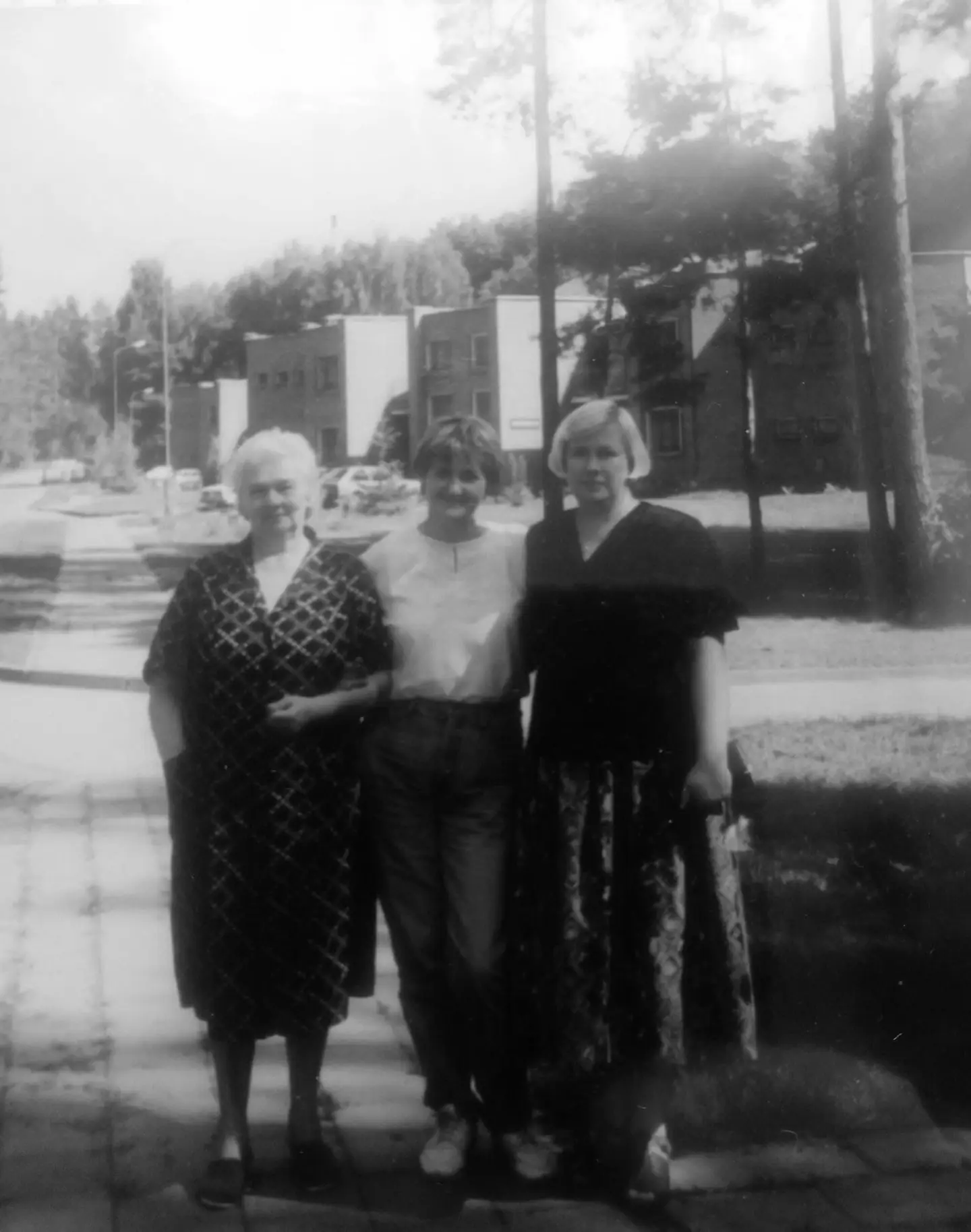
At first, these memories seemed to have nothing to do with me. Gradually, the building became a place to witness the change before understanding what my part here could be. I began to use it as a testing ground for different ways of being with a building after its end.
But there were many questions to be answered. What am I actually doing there?
Before entering, there are things to learn.
If you have never visited an abandoned building, this could be your guide. If you have done it before, these are instructions to do it differently this time.
Notes
- For me, ruination is less a thing than an ongoing condition: something I touch and work with, the surface beneath my body when I lie down, and sometimes the doubt itself. I am less interested in what a place is than in what is happening to it. ↩
II. Instructions for Being There
Choose a figure to begin.
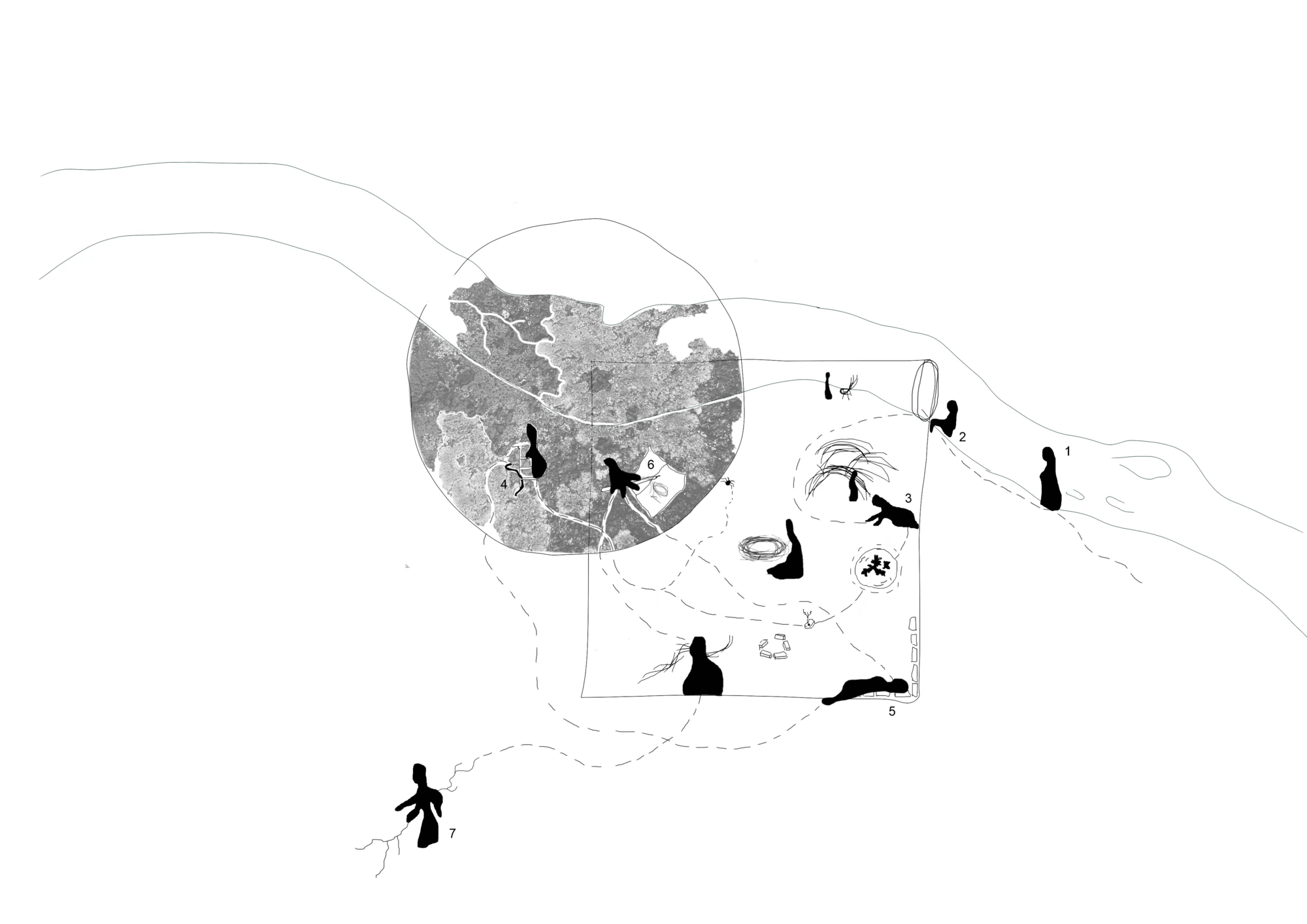
1. Find the Threshold
The very first thing is an entry point. Find the threshold.2
Take a look under your feet. The entry could be right here. If it’s not, then find its traces.
You will know you have found the threshold when you hesitate to enter.3 You are about to enter an unknown territory. Stay there for a moment.4
Trust your body.
How do you feel?
Trust the hesitation.
If you suddenly feel ridiculous, stay.
But do not enter yet.
Notes
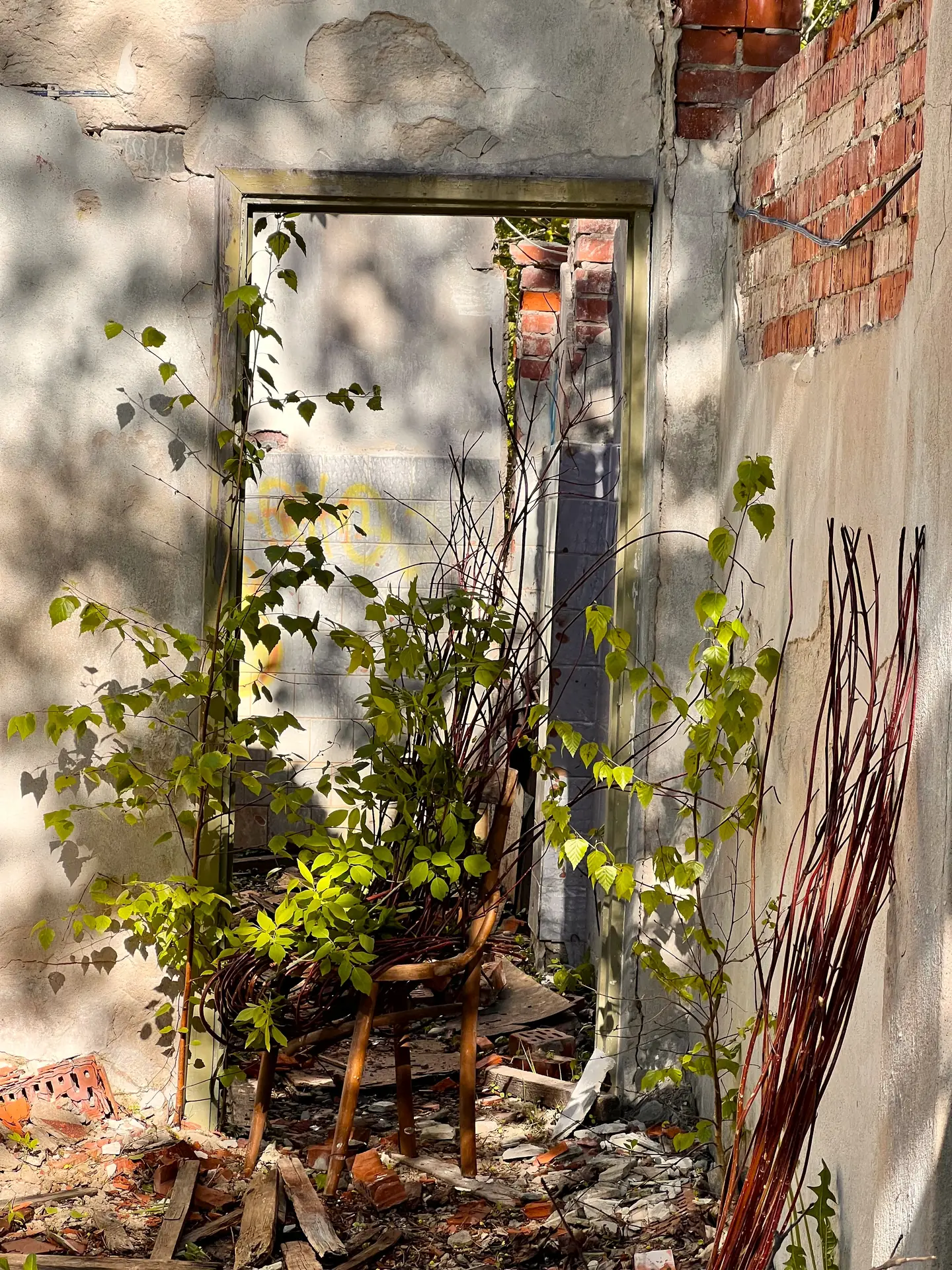
- The threshold is not necessarily the entrance of the space. It could be unexpected, hidden, somewhere you would not think to look. In buildings in decay, a threshold is not always a doorway. It might be anything that makes you stop or trip. The threshold might present itself as a mere doorframe, or an opening made by the branches of a birch tree. It could be found in a puddle, a patch of moss, or some broken glass on the ground. It could even be the particular way the sun falls on the structure at a given time. ↩
- We cross thresholds and boundaries in both physical and social capacities. We use thresholds to mark transitions. We pause right before entering a chapel, we hesitate at a hospital door, we slow down at a cemetery gate. Thresholds separate ways of being. You are neither guest nor intruder, neither claimed by the space you came from nor received by the one ahead, suspended in the interval where the building has not yet decided what you are. The temperature might even be different from one side to the other. ↩
- As discussed by Victor Turner, the liminality of the threshold suspends you between what you have left and what you are about to enter or become. Victor Turner, The Ritual Process: Structure and Anti-Structure (Chicago: Aldine, 1969), 95. ↩
2. Wait
Stop just before you enter the threshold.
Wait. Try to learn waiting.5
Notice the sound. What do you hear? An echo? Birds? Water dropping? Your thoughts asking “why are you waiting” or “what do you even do here”?6
Do not use the waiting to clear your mind. If your mind starts planning what comes next, let it.
Stay long enough for the place to interrupt your thoughts. Wait until waiting becomes embarrassing.
Now you can enter.
Notes
- We wait for a better moment, and when it comes, we wait for another. Waiting with full awareness can stir up tension, even fear. Imagine you decide to wait for five hours for nothing to happen. Because you decided. When you wait, you stop. At least for a bit. To pause means being brave enough to face the unknown and remain within it for a while. Sometimes uncomfortably. ↩
- I first noticed I was whispering when I started practising the waiting. There was nobody around. And still I wanted to be quieter. Michel de Certeau called these small, unplanned gestures “tactics”: the improvised movements of bodies in spaces that were never designed for them. Michel de Certeau, The Practice of Everyday Life (Berkeley: University of California Press, 1984), xix. ↩
3. Lay Your Hands on the Ground
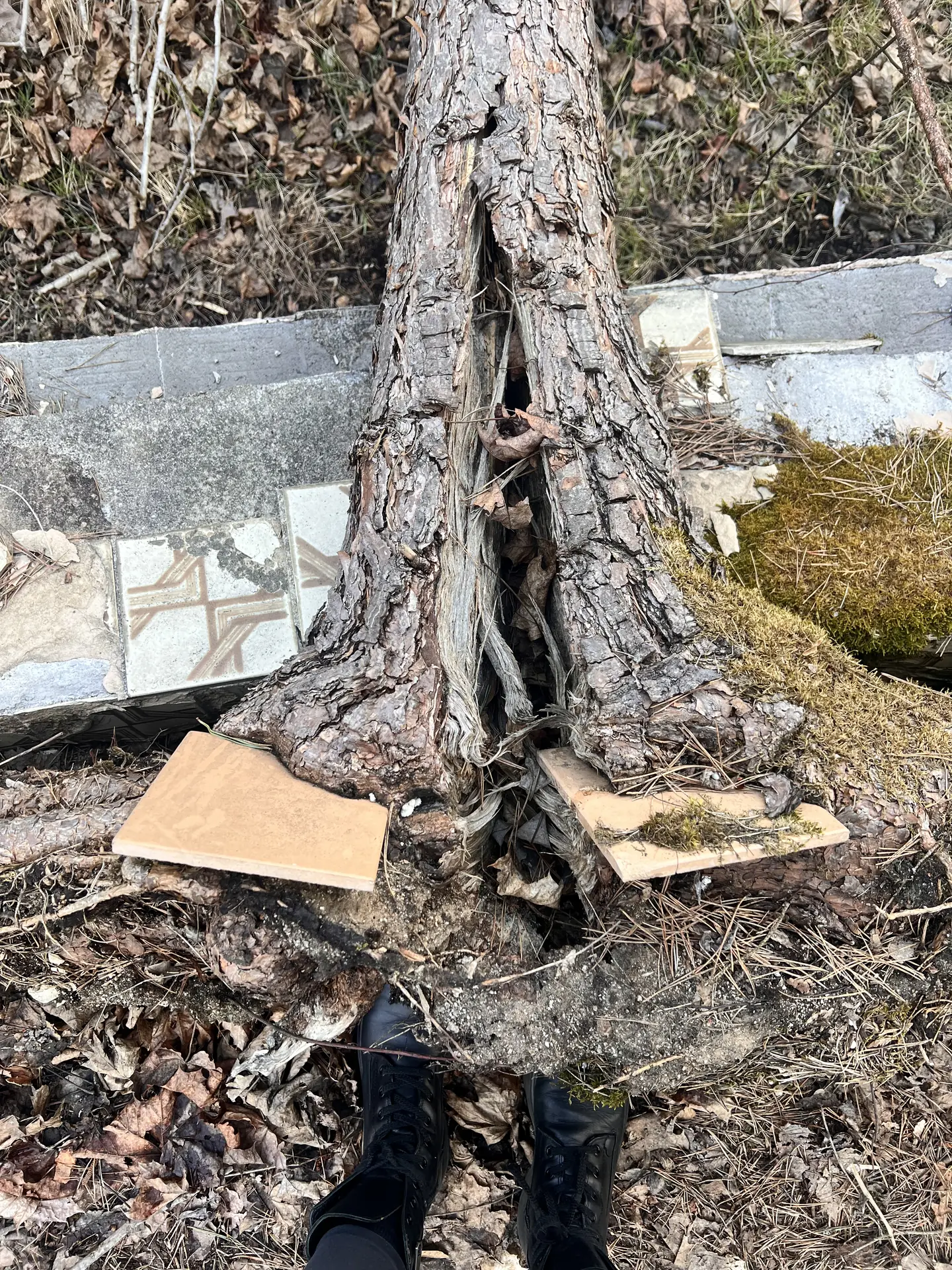
Touch the soil or the concrete beneath your feet as if you were offering something.
It might feel strange. It might feel, unexpectedly, sacred.
The next thing you should do is to ask the building for permission.7
Can I enter? (And what if the answer is no?)
This is a tribute to the place, like entering a church. Ironic, perhaps, but the place requires acknowledgement.
If you feel accepted, continue the journey. If not, it may not be the right time yet.
Wait for an answer.
What would an answer even sound like?
If the answer is no, then leave.
Why do we never ask for permission before entering an abandoned building? Why do we never ask for permission before entering any building?
Notes
- Animism asks us to reconsider the boundary between human and non-human, and to recognise forms of agency beyond the human. It might even greet you, shake your hand, wave, or stop you right there at the threshold. If it were your neighbour, would you knock before entering? Would you say hello? Would you introduce yourself? To ask a building for permission is, in some small way, to give it back its agency. ↩
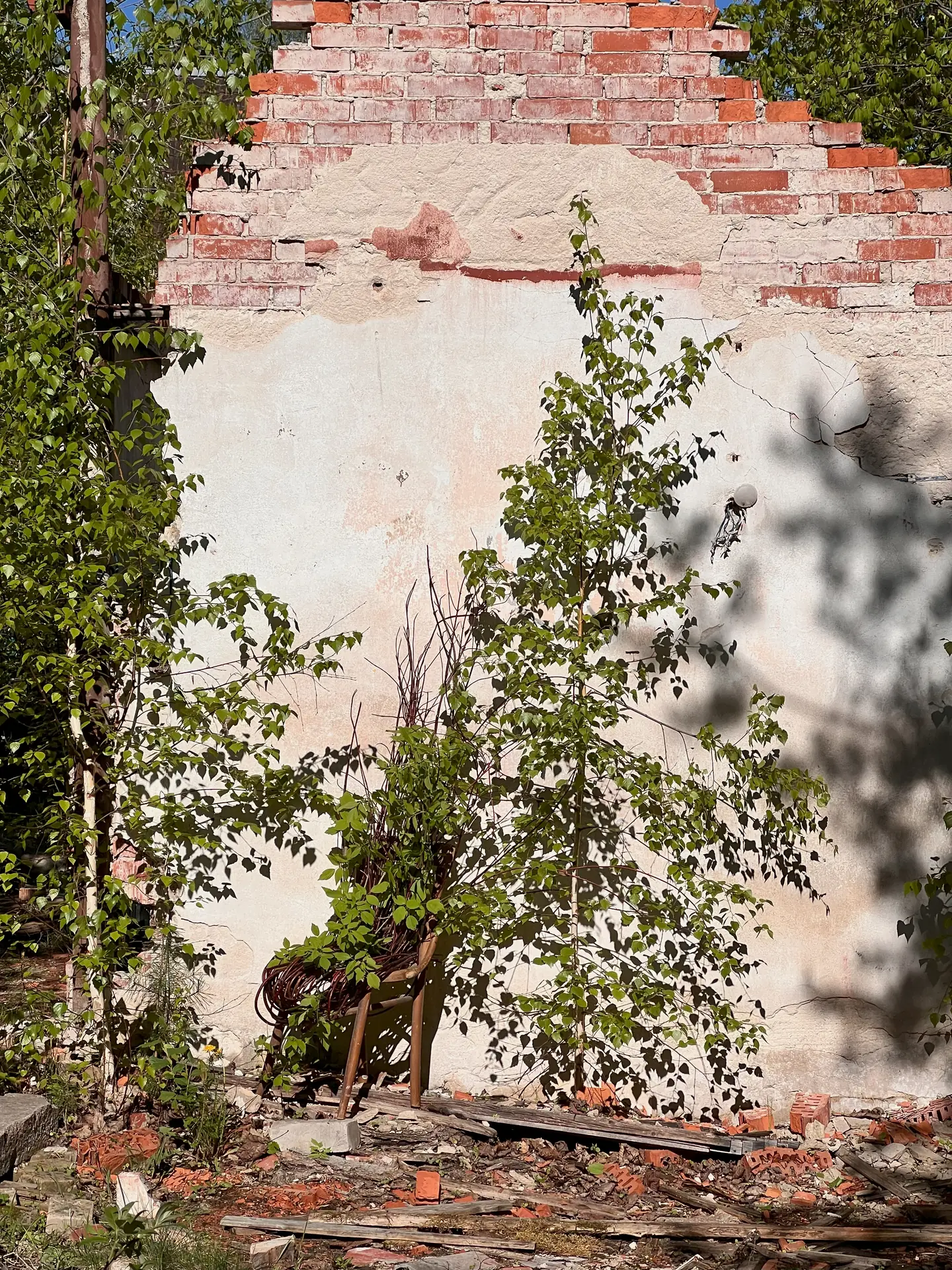
4. Find the Inhabitants
Something is already living in this building. Look for them. Who are they?
Look under the rubble. Look in the wet corner. If something looks back, do not immediately turn it into a metaphor.
Try to find the inhabitants, and when you do, take your time to greet them.8
You may find tiny organisms living in the walls. They could be insects. They could be birds. If you look up, they usually make their nests somewhere in the corners.
You may not like what you find.
If you notice them, you are another visitor to this space. Act like one. Be the guest.
Now encounter the inhabitants.
Notes
- To enter a derelict building is to enter someone’s house—one that has forgotten how to be one. Gaston Bachelard, The Poetics of Space (Boston: Beacon Press, 1994), 4. ↩
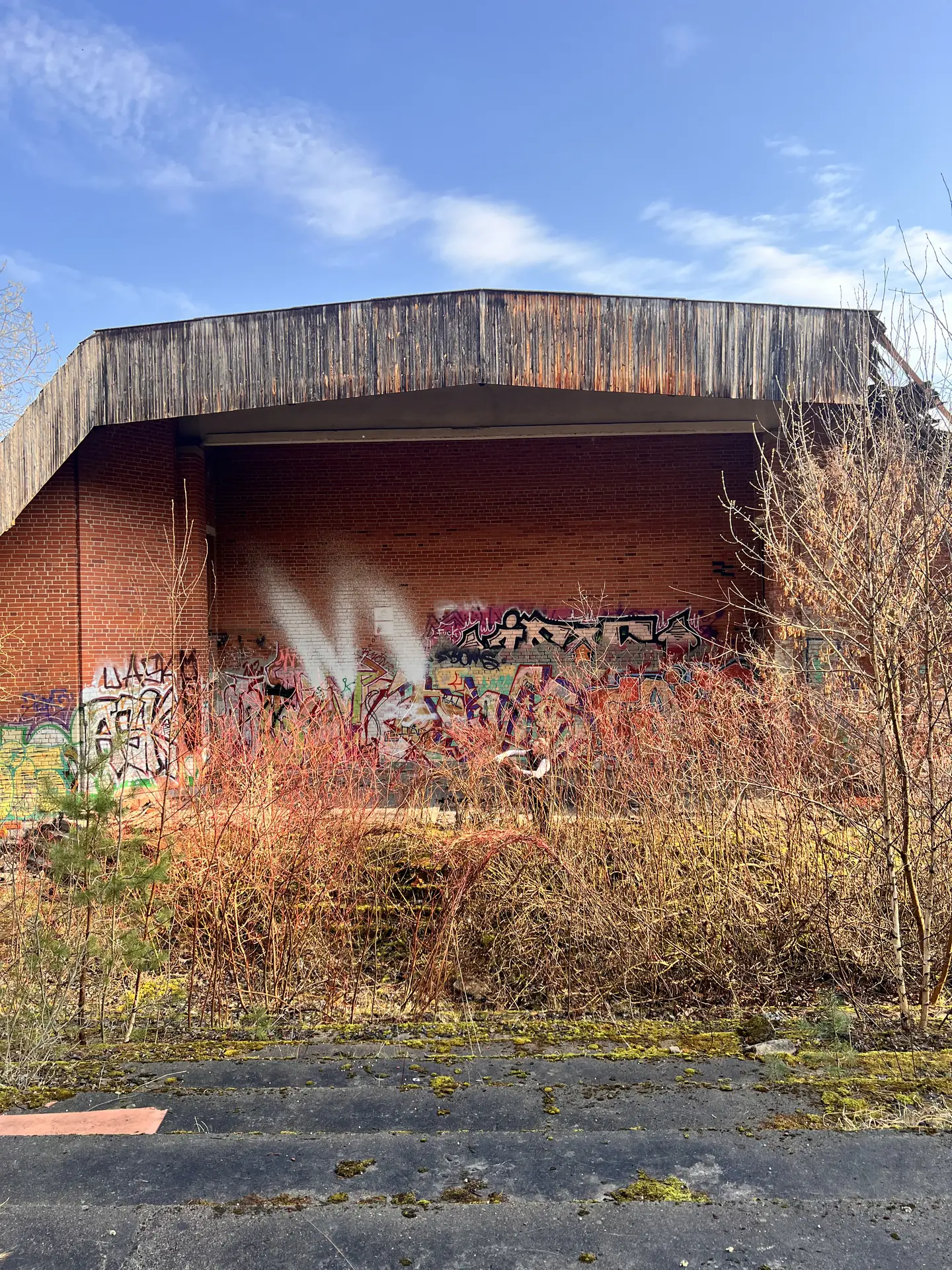
5. Lie Down
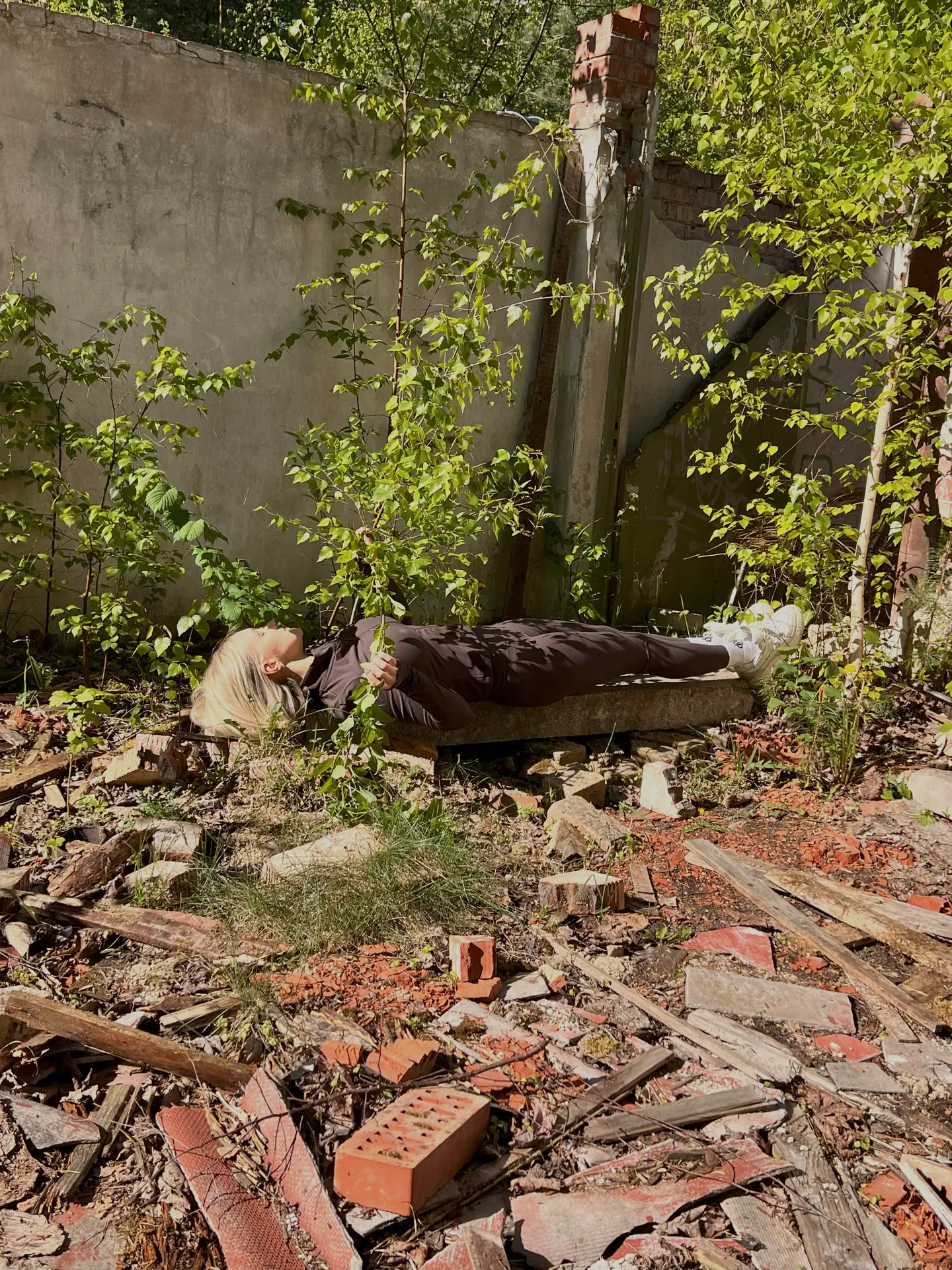
If you feel comfortable enough, you’ll have to lie down. If you don’t, lie down anyway.
Notice what you immediately want to protect: your clothes, your hands, your hair, your face.
Notice what you refuse to touch. Then touch that.
That refusal is part of the encounter too.
Feeling the space means feeling it with your whole body. Close your eyes. Let it affect you.
Let the decay become a feeling.
Do you notice decay? Can you feel it? Isn’t it weird?
6. Draw
Open your notebook. Take a pen. Draw. Draw what is happening now.
Draw a broken tile. Draw the window frame. Draw the damp. Draw because you might not know what you are looking at.
7. Leave
Leave. Will the decay call you back?
Leaving is perhaps another threshold. You never leave a place exactly as you find it.
And it will not leave you exactly as you arrived.9
It was my twenty-fourth time visiting the same building. Twenty-four thresholds. Twenty-four hesitations and doubts about whether I belong here or I do not.
Notes
- As you follow these instructions, you might be somewhere completely different. A forgotten playground. A closed factory. A church between one life and the next. The method travels. The guidebook presented here is not intended as a literal manual. ↩
III. What Happens After the Guidebook?
I began developing this way of working through encounters in the same building. There was never a clear idea of what I had to make here. Do I even have to?
As someone who was struggling to design an actual object, especially in this context, I found myself questioning whether I had to design one at all. The neglected site stopped my urge to actually design. It freed me from the designer’s urge, from the result, and from the fear that everything we create will become irrelevant one day.
The spaces we create will end just like this one.
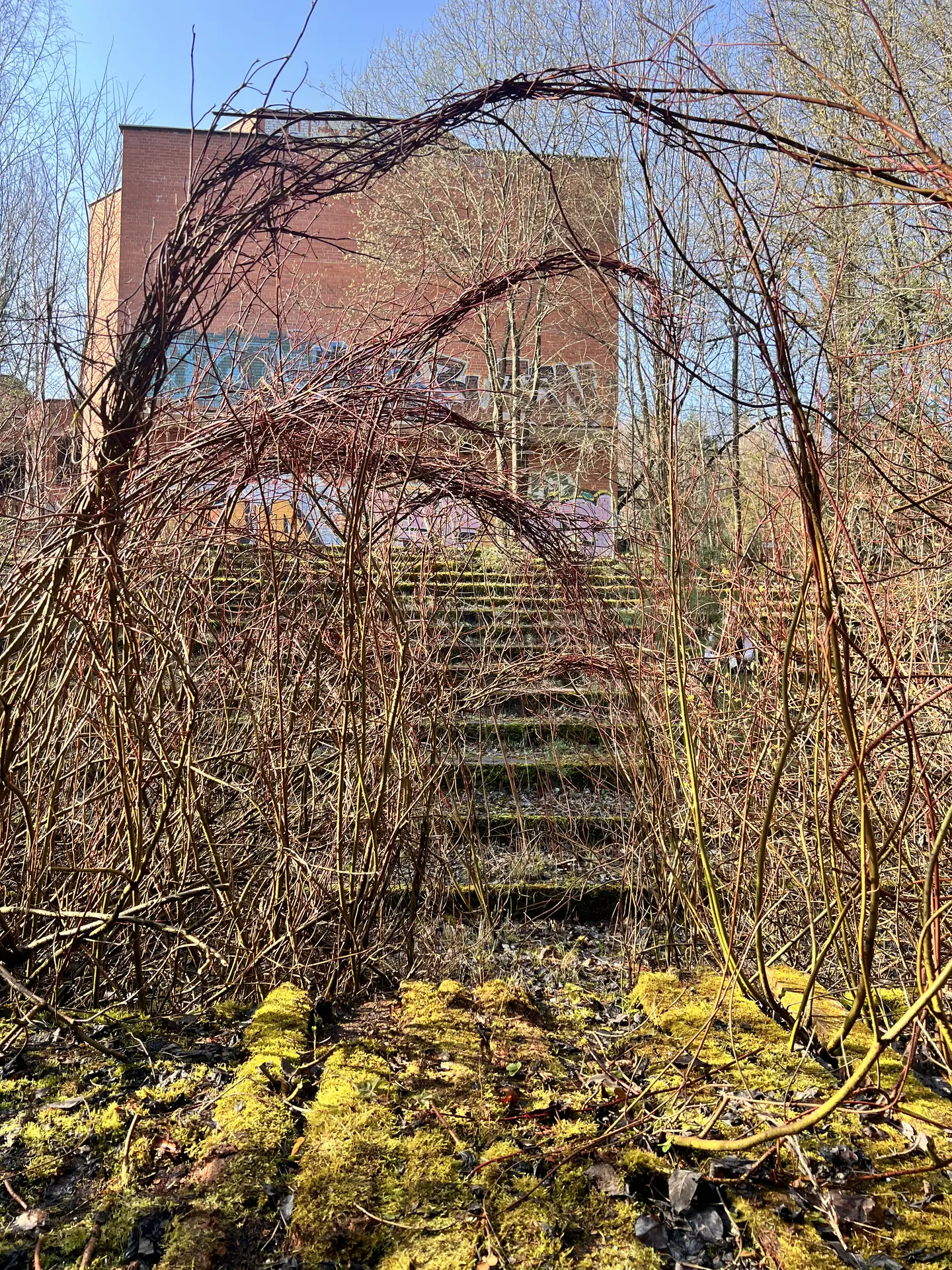
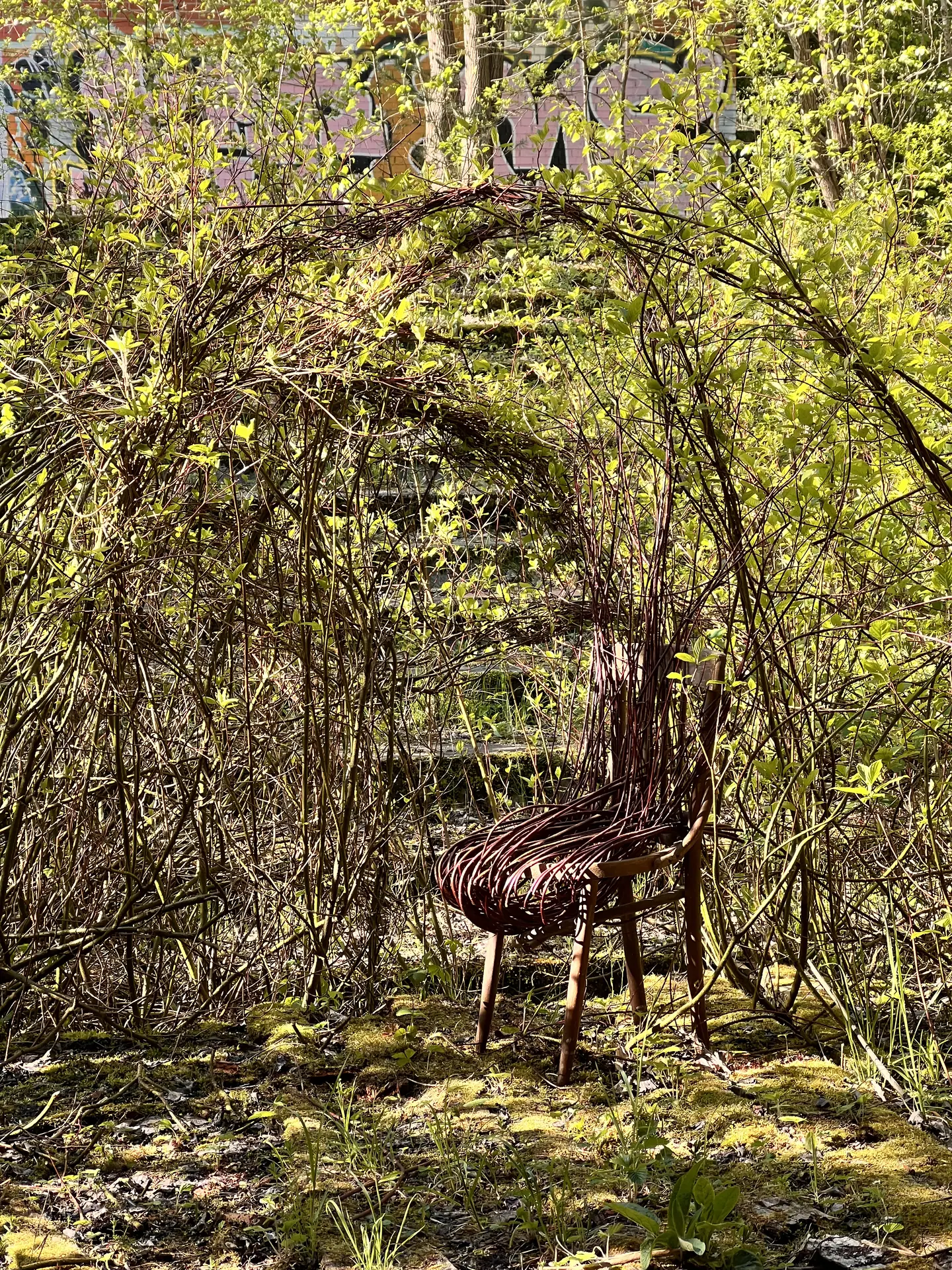
One of the ways of being with the place, for me, was weaving. Weaving came naturally, almost randomly. Everything is woven here: the grass, the roots, the branches, the wires.
In the building, I found old chair frames. I started to weave the growing branches along the frames, guided by the lines of the chairs. The branches bent the way they wanted to. New passages began to open up through the dense undergrowth. The chair was returned to the building. Nothing was taken away.
I was weaving, hoping it would trigger a situation in which design could unfold. Well, it did. Just not in the way I expected.
IV. Ruins of Behaviour
Ruins of behaviour starts at the exact moment when a familiar way to move through the world stops being reliable.
Behaviour also disappears faster than architecture because it doesn’t have a lasting trace. The moment our bodies can no longer rely on that familiar behaviour – this is the moment decay starts.
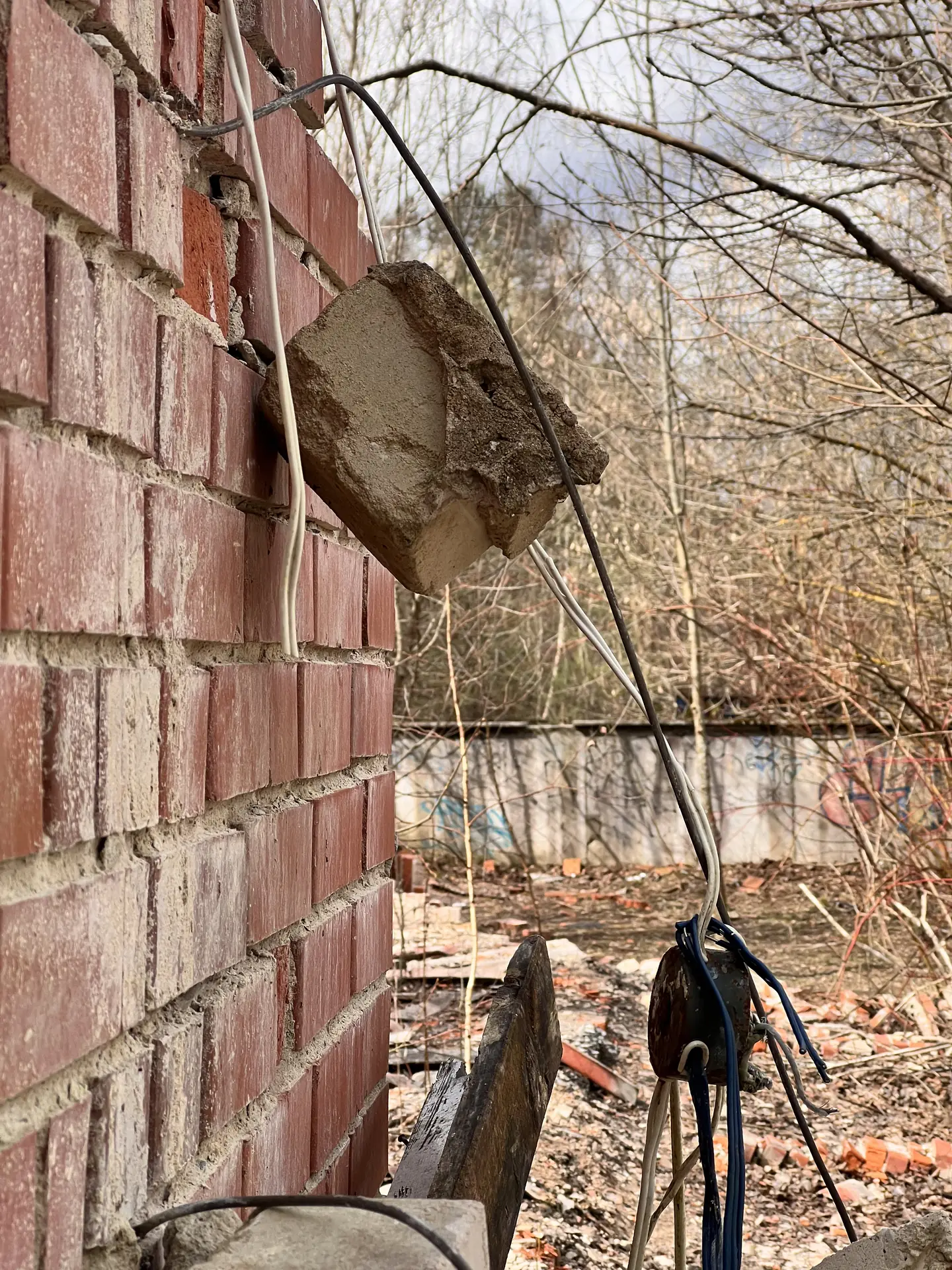
The building is not the only one that gives instructions. A wall, left for decay, takes decades to actually collapse. It absorbs water, resists gravity, and roots enter its foundations. The wall makes terms with forces it was never designed to accommodate.
Waste begins when a building no longer supports the behaviours it was designed for.
Even the wish to leave a place alone quickly turns into an urge to preserve it. Or the opposite response comes just as fast: to repurpose these places, to get rid of the “waste” as fast as possible. We create scenarios for ramshackle buildings and know exactly what they could become. Cleaned up, cleared of everything we call debris. It seems obvious. But maybe everything we call waste is just our interpretation of efficiency? Waste is only waste because we no longer know what to do with it.
The obvious response is to re-something: reuse, repurpose, redo. But there is another way; I call it re-valuing. What if we started to design from that angle instead?
Why did I ask you to touch the ground?
The things I am proposing to do in this guidebook might seem strange. Touch the ground, ask permission, lie down? It’s not promised that you will actually discover something while doing these gestures for the first time. Or for the second. Do they even work, you may ask?
I propose to spend time with the abandoned buildings before starting to plan what to do with them. Before the plan, let’s make an encounter. For architecture and design, this means delaying the impulse to optimise.
The body here has to be careful. My hands drowned into the gritty texture of eroding concrete. The familiar materials’ touch confirms what we already expect. Decay does neither reliably. What looks solid can crumble, and what crumbles can also hold something underneath. You can touch, and the material gives you no clear instructions about what will happen next. Be careful; decay might touch you back.
This makes me suspicious. Not even the words I use here are neutral.
A ruin, for instance.10
A ruin sounds finished. A thing, a fact, and something that was.
Another word to doubt is abandoned.11
I keep returning to the question “what does it mean to put nature first”? I used to think of nature as something that arrives after abandonment. If nature comes first, then what exactly is second? A human, architecture, ownership? I am less certain now.
After six years of returning, I no longer enter the building in the same way. The building changed quite quickly, without intention and without asking me to notice.
Notes
- Ann Laura Stoler separates ruins from ruination, drawing attention to ruination as an ongoing process. This separation lets go of the nostalgia and romanticisation of ruins. Also, it is letting go of the illusion of control. I return to these places for precisely this reason. I am less interested in what they are than in what is happening to them. The word “ruination” gives the building back its agency, as both an individual and an object. ↩
- The word already tells us what to think: dangerous, empty, wasted, forgotten. But empty of what? Of us? What if there was never an outside? ↩
V. Encounters
What Lichen Knows
My encounter with lichen was gradual. First, I started to observe what kinds of lichen had decided to grow and stay there. They followed damp surfaces, corners, the tile lines. These were the places where materials change first. Eventually, I stopped looking for decay itself. I looked for the lichens. Then made a map.
The map showed decay through its indicators – the lichens themselves.
Water
Outside, there was a swimming pool that had been left behind with the rest of the building. I would see it occasionally, overrun with vegetation, slowly returning to the earth.
One spring, water appeared in the pool again. Frogs wending their way through the tangle of plants, slugs on the trail of a meal that had previously been a pool. It is a swimming pool. It is a swimming pool.
I started looking for where the water had been. Plants grew strangely. Rust spread along the metal beams. I could follow the routes the water had taken through the building.
The water was gone. I could still follow.
Water does not know that the building is abandoned. It finds ways and cracks and gathers where it wants to. Once it stays, other forms of life follow.
Water is the only inhabitant you never see directly. It is the first anarchist in the building. You see the mark on the ceiling, the rust on steel beams, the mould on the wall, the crack in the basement through which it found its way.
The Snake
The building was never yours. Observation is reciprocal.
There is an encounter I cannot stop thinking about.
I was doing the lying-down exercise, trying to focus on the sound, my body, and the surface I was lying on. That was the exact moment I met her. For a moment, absurdly, I thought I had summoned the soul of the building. If the building needed a voice, perhaps this was it.
It came to me in the body of a snake.
She, nature, sat beside me, curled into her dwelling as if waiting for a sign. This was her home, not mine.
Abandoned? I don’t know what that word means to her.
Wasted? It was never finished.
The next time you pass a building in decay, hesitate.
This guidebook travels. It can be adapted to different building typologies.
Bibliography
Bachelard, Gaston. The Poetics of Space. Boston: Beacon Press, 1994.
Certeau, Michel de. The Practice of Everyday Life. Berkeley: University of California Press, 1984.
Escobar, Arturo. Designs for the Pluriverse: Radical Interdependence, Autonomy, and the Making of Worlds. Durham: Duke University Press, 2018.
Gibson, James J. The Ecological Approach to Visual Perception. Boston: Houghton Mifflin, 1979.
Harvey, Graham. Animism: Respecting the Living World. New York: Columbia University Press, 2006.
Ingold, Tim. The Life of Lines. London: Routledge, 2015.
Kimmerer, Robin Wall. Braiding Sweetgrass. Minneapolis: Milkweed Editions, 2013.
Morton, Timothy. Dark Ecology: For a Logic of Future Coexistence. New York: Columbia University Press, 2016.
Morton, Timothy. Hyperobjects: Philosophy and Ecology after the End of the World. Minneapolis: University of Minnesota Press, 2013.
Pallasmaa, Juhani. The Thinking Hand: Existential and Embodied Wisdom in Architecture. Chichester: John Wiley & Sons, 2009.
Purvis, William. Lichens. London: Natural History Museum, 2000.
Stoler, Ann Laura. Imperial Debris: On Ruins and Ruination. Durham: Duke University Press, 2013.
Turner, Victor. The Ritual Process: Structure and Anti-Structure. Chicago: Aldine, 1969.